 BGASC
BGASC
1 listing
Filters
| Product | /oz | Premium | Price | |
|---|---|---|---|---|
| $4,602.02 | +15.21% | $1,150.51 | View Deal |

Prices are fetched automatically and may not reflect current merchant prices. Currency conversions and tax treatment are approximate. Rankings are based solely on price. We are not a dealer and accept no responsibility for transactions with listed merchants. Past performance is not indicative of future results. This site does not provide investment advice. Full disclaimer
About the 1/4 oz Bounty Gold Coin
The 1/4 oz Cook Islands Bounty Gold Coin
The 1/4 oz Bounty gold coin is a fractional issue from the Cook Islands' HMS Bounty series, struck in .9999 fine gold with a $25 Cook Islands dollar face value. The quarter ounce (7.7758 grams) appeared in the series' original 2009 release alongside 1 oz, 1/2 oz, and 1/10 oz versions, making it one of the rarer entries in a programme that has continued annually in its 1 oz and 1/10 oz sizes. The coin is legal tender of the Cook Islands, a self-governing South Pacific nation in free association with New Zealand, denominated in Cook Islands dollars pegged to the NZD.
The series sits in a specific niche: a genuine sovereign legal tender coin priced as budget bullion. That gives it a legal status advantage over private mint rounds while conceding market recognition to the major sovereign programmes. Its .9999 purity matches the Canadian Maple Leaf and exceeds 22 karat coins like the Krugerrand and American Gold Eagle, though purity says nothing about value; equal fine gold content means equal melt value.
The 1/4 oz weight itself is the middle fractional gold size and a practical entry point for sovereign-coin buyers, with quarter-ounce gold generally trading at 7-12% over spot against 3-5% for 1 oz gold coins and 10-18% for tenth-ounce pieces. The HMS Bounty design adds real historical resonance: the 1789 mutiny against Captain Bligh remains one of the most famous events in naval history, and descendants of the mutineers still live on Pitcairn Island where the ship was burned in 1790.
1/4 oz Bounty Gold Coin Specifications
| Attribute | Detail |
|---|---|
| Weight | 1/4 troy oz (7.7758 g) |
| Metal | Gold |
| Purity | .9999 fine (24 karat) |
| Face value | $25 (Cook Islands Dollar) |
| Issue | 2009 release |
| Issuer | Cook Islands |
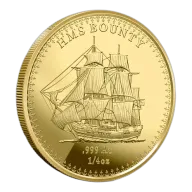
The coin shows a finely detailed HMS Bounty under sail on one side, with the Ian Rank-Broadley effigy of Queen Elizabeth II on the other, the standard portrait across Commonwealth coinage of the era. Both faces carry the series' distinctive stylised grid-and-wave background pattern, an element not found on other bullion coins and a quick visual identifier for the series. Year date, face value, weight, and purity are all inscribed.
The Cook Islands has no minting facilities of its own; the 2009 originals, which include this fractional, were struck by Heimerle + Meule GmbH of Pforzheim, Germany, with later annual production contracted to Sunshine Minting in Idaho. A quarter-ounce gold coin is a small object, around the 22mm class for this weight, so capsule storage is standard and sensible.
Tax Treatment of the 1/4 oz Bounty Gold Coin
As a .9999 fine legal tender gold coin, the Bounty qualifies as investment gold in most jurisdictions, with one significant American exception.
- US: The series' main market, but the coin is not IRA-eligible despite exceeding the purity requirement; the IRS treats Cook Islands coins as overly collectible due to limited mintages and premium pricing. Buyers wanting retirement-account gold need an Eagle, Maple Leaf, or similar instead. No federal sales tax; most states exempt bullion, though a roughly $1,000 coin sits near the threshold in the $1,000-floor states. Long-term gains taxed at the collectibles rate of up to 28%.
- UK: VAT-exempt as investment gold (post-1800 legal tender coin above 900 fineness). Not UK legal tender, so no CGT exemption; gains above the £3,000 annual allowance are taxable, unlike a 1/4 oz gold Britannia.
- EU: 0% VAT as investment gold under the EU directive.
- Canada: 0% GST/HST at 99.5%+ purity. No specific RRSP recognition.
- New Zealand: Investment bullion coins at 99.5%+ gold purity are GST-exempt; the Cook Islands' free association with NZ and NZD-pegged currency give the coin particular local relevance.
- Australia: GST exemption applies to investment-grade gold at 99.5%+ purity; treatment of small-nation legal tender coins can depend on ATO recognition.
- Singapore and Hong Kong: No GST on qualifying investment gold in Singapore, no sales tax in Hong Kong, and no capital gains tax in either.
The HMS Bounty and a Coin Series From the South Pacific
The ship on the coin earned its place in history the hard way. HMS Bounty was a Royal Navy vessel acquired in 1787 whose crew, led by Lieutenant Fletcher Christian, mutinied against Captain William Bligh in 1789. The mutineers eventually burned and scuttled the ship at Pitcairn Island in 1790, and their descendants live on the island to this day. The Cook Islands' own naming traces to Captain James Cook, who reached the fifteen-island group in 1773, tying issuer and subject together in Pacific maritime history.
The coin series began in 2009 with gold and silver versions, the gold issued in 1 oz, 1/2 oz, 1/4 oz, and 1/10 oz weights; the half and quarter ounce gold appeared only in that first 2009 release, while the 1 oz and 1/10 oz returned in 2020 and have run annually since. The 2009 originals were minted by Heimerle + Meule in Germany, with production from at least 2017 contracted to Sunshine Minting in Idaho, one of North America's largest private mints and a supplier of blanks to the US Mint itself.
The Cook Islands, population around 17,000, has become a prolific coin-issuing state, one of several Pacific nations alongside Niue, Tuvalu, and Tokelau that license their sovereign status for coin programmes. Mintages in this series have run genuinely low; the 2017 silver issue was capped at 5,000 coins, a tiny figure beside the 20-40 million American Silver Eagles struck in a typical year, which is why early-year Bounty coins carry numismatic premiums on top of their metal value.
Bounty Gold vs the Mainstream Quarter-Ounce Coins
Every major mint makes a 1/4 oz coin, so the Bounty competes against the most crowded fractional field in gold. The 1/4 oz American Gold Eagle ($10 face value) is IRA-eligible and widely traded; the 1/4 oz Krugerrand, Maple Leaf, Philharmonic, and Kangaroo all bring deep dealer networks and tight spreads. The Bounty's case is price and purity: it has historically positioned as a lower-premium alternative to the big sovereign names, and its .9999 fineness matches the Maple Leaf while exceeding the 22 karat Eagle and Krugerrand. Its weakness is the flip side, thinner recognition and a smaller pool of dealers quoting buyback, plus the IRA exclusion that removes a large slice of American demand.
For UK buyers the decisive comparison is with the 1/4 oz gold Britannia and the Gold Sovereign, both UK legal tender and therefore CGT-exempt, which the Bounty is not. The Sovereign (7.32g of 22k gold, 0.2354 oz fine content) sits at nearly the same price point and is the traditional choice; the Bounty would need a meaningful price advantage to justify giving up the tax exemption.
Against fellow small-nation issues like Niue coins, the comparison is even: both rely on external mints (Niue uses the New Zealand Mint and Perth Mint, the Cook Islands uses Sunshine Minting) and both serve as budget sovereign alternatives whose legal tender status puts them a step above private rounds. As a 2009-only fractional, this particular coin trades as much on scarcity as on its gold content.