1 product · 5 deals
Filters
| Product | /oz | Premium | Price | |
|---|---|---|---|---|

5 deals
|
$4,492.04 | +3.36% |
$144,422.30
€126,023
|
Compare |
Prices are fetched automatically and may not reflect current merchant prices. Currency conversions and tax treatment are approximate. Rankings are based solely on price. We are not a dealer and accept no responsibility for transactions with listed merchants. Past performance is not indicative of future results. This site does not provide investment advice. Full disclaimer
About 1 Kilo Gold Coins
A Kilogram of Gold, Struck as a Coin
One kilogram is 32.15 troy ounces, and in gold that is roughly a $100,000+ purchase at current prices. This is primarily institutional and high-net-worth territory; the kilo is the standard metric bullion weight, recognised globally and particularly prevalent in Asian markets such as Singapore, Hong Kong, and mainland China, where the kilobar trades on the Shanghai Gold Exchange and through the Singapore Bullion Market Association.
The coin version of this weight is rarer than the bar. The retail kilo gold market is dominated by bars from LBMA-accredited refiners, which are the most premium-efficient gold format available. A kilo coin exists because a few sovereign mints, led by the Perth Mint, extend their coin programmes to unusual sizes: the gold Kangaroo is produced in sizes from 1/20 oz all the way up to 1 kg. The coin buyer at this weight is paying for legal tender status, sovereign mint striking, and a recognisable design on top of the metal.
Whether that is worth it depends on jurisdiction and intent. Coins carry higher premiums than bars of equivalent weight because of the more complex minting process, legal tender status, and sovereign branding, and at a kilogram of gold even small percentage differences are large sums. The countercase is recognisability and, in some jurisdictions, tax: a .9999 legal tender coin qualifies for GST exemptions in Australia, NZ, Singapore, and Canada, and investment gold is VAT-exempt in the UK and EU regardless of coin or bar form. For most buyers the practical comparison is this page against 1 kilo gold bars, and the premium gap between them is the number to watch.
Premium Efficiency at the Top of the Weight Scale
The kilo is where gold premiums bottom out. Gold kilo bars run 1-2% over spot, the most premium-efficient retail gold format there is, and the whole logic of buying at this weight is cost per gram: kilo buyers are optimising for the lowest premium, not flexibility. Premiums fall steadily up the weight scale, from 3-7% on 1 oz sovereign coins through 2-4% on 100g bars, and the marginal saving from each further step up shrinks; by the time you reach a kilogram there is nowhere cheaper to go in the retail market.
Coins complicate that picture. A sovereign mint coin carries a premium above the equivalent bar at every weight, reflecting minting complexity, legal tender status, and anti-counterfeiting work, and at kilo scale that percentage gap translates into a four-figure difference on a single purchase. The coin format therefore only makes sense at this weight when the buyer specifically values what a coin is: a government-struck, instantly recognisable piece, rather than the cheapest possible kilogram of metal.
Secondary-market pieces are worth watching in the listings. Across the gold coin market, random-year and pre-owned coins typically trade 1-3% below current-year premiums, and at $100,000+ per unit that discount is substantial in absolute terms. As always at large weights, comparing live dealer prices matters more than rules of thumb, because a single percentage point on a kilo of gold exceeds the entire premium on most 1 oz purchases.
Who Mints a Kilo Gold Coin
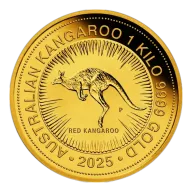
The Perth Mint owns this niche. Its flagship 1 kilo Kangaroo gold coin is the standard product at this weight: the Kangaroo programme, first issued in 1986 and originally called the Gold Nugget, is struck in .9999 gold and runs in sizes from 1/20 oz to 1 kg, with the reverse design changing annually. The kilo Kangaroo is the size-extreme of a mainstream sovereign bullion series rather than a one-off novelty, which helps its recognition with dealers.
Perth Mint Lunar series coins also appear at this weight in dealer inventories, alongside generic and secondary-market kilo gold coins listed without a guaranteed design or year. The Lunar programme's annually changing zodiac designs give those coins a collector dimension on top of their bullion value.
Everything at this weight shares the same fundamentals: .9999 fine gold, legal tender status from the issuing government, and a unit price in six figures. The practical differences between listings come down to premium, year, and condition. For buyers who conclude the coin premium is not worth paying, the bar market at the same weight offers PAMP Suisse, Valcambi, Argor-Heraeus, Heraeus, Metalor, Perth Mint, and Royal Canadian Mint kilobars, all LBMA-accredited and produced to Good Delivery purity standards.
Selling a Six-Figure Coin
Liquidity at kilo scale is a different proposition from mainstream coin weights. The kilo format itself is globally recognised, and LBMA-accredited kilo bars are interchangeable worldwide and can be sold to any dealer in any country. A kilo coin from the Perth Mint rides on similar recognition: sovereign mint product, .9999 purity, documented specifications. The constraint is not recognisability but the buyer pool; a single unit costing $100,000+ has far fewer potential retail buyers than the same metal in 1 oz gold coins, so resale typically routes through larger dealers rather than local shops.
The all-or-nothing problem is the other side of the coin. Partial liquidation is impossible: each piece is a single sale, and an investor who may need to raise smaller amounts of cash is structurally better served by holding the same weight in smaller units, accepting the higher aggregate premium as the price of flexibility.
Storage, by contrast, is trivially easy. Gold's density means a kilogram occupies remarkably little space, roughly the size of a small smartphone in bar form, and gold does not tarnish or corrode, so no special environmental control is needed. A kilo coin is physically large for a coin but still compact in absolute terms, and stores in a capsule in any decent safe or vault. For a holding of this value, professionally insured vault storage is the common choice, and gold's compactness keeps vault fees low relative to value compared with bulkier metals.
1 Kilo Gold Coins: frequently asked questions
-
A 1kg gold coin contains 32.1507 troy ounces of gold, so its metal value is roughly 32 times the current troy ounce spot price ($4,408.10). Retail prices sit above that, reflecting a dealer premium. The table above shows live offers from 3 dealers so you can find the sharpest price on 6 tracked listings.
-
Reporting rules depend on your country. In the UK, there is no requirement to declare a purchase, but gains above the £3,000 annual CGT exemption must be reported when you sell. In Canada, gold is a capital property and gains are taxable at a 50% inclusion rate. Check your local tax authority for your specific obligations.
-
Most 1kg investment gold coins are struck to 999.9 fineness (24 carat). A small number of collectible or commemorative 1kg issues may differ, but the investment-grade products tracked on this page are typically 999.9 fine.
-
A 1kg coin is a high-value single item that requires serious storage. A home safe rated for the weight and insured for replacement value is a starting point. Specialist vault storage through a bullion dealer or private vault company is often more cost-effective for an asset at this level, with insurance built into the fee. Always check that your home insurance policy covers bullion before relying on it.