1 product · 14 deals
Filters
| Product | /oz | Premium | Price | |
|---|---|---|---|---|

14 deals
|
$5,171.67 | +19.02% |
$498.82
£374
|
Compare |
Prices are fetched automatically and may not reflect current merchant prices. Currency conversions and tax treatment are approximate. Rankings are based solely on price. We are not a dealer and accept no responsibility for transactions with listed merchants. Past performance is not indicative of future results. This site does not provide investment advice. Full disclaimer
About 3g Gold Coins
3 Gram Gold Coins: Fractional Pandas and Entry-Level Gold
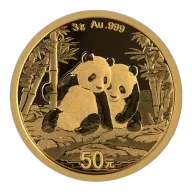
The 3 gram gold coin weight class is defined primarily by the Chinese Gold Panda 3g, which replaced the pre-2016 Panda 1/10 oz denomination during the series' conversion from troy ounces to metric grams. At 3 grams (0.0965 troy ounces), the coin lost 0.11 grams compared to the old 1/10 oz Panda (3.11 grams), a small but measurable reduction. The 3g Panda is one of the smallest denominations in the series, sitting between the 1g and the 8g sizes, with only the tiny 1g coin below it.
At just 18 mm in diameter, the 3g gold coin is comparable in size to a small shirt button. Its appeal is as an entry point to gold coin ownership, a gifting item, and a vehicle for cost-averaging in small increments. The gold content is modest, but the coin carries the same .999 purity, annual design changes, and legal tender status (50 yuan face value) as the larger 30g Gold Panda.
Beyond the Panda, the 3g weight sees limited activity. The 3g Austrian Mint gold coin offers an alternative from a European sovereign mint, though in a different product format. Some private refiners (PAMP, Valcambi) produce 3g gold bars in sealed assay cards, but these are less common than the 1g, 5g, or 10g bar sizes that dominate the small-bar market. In India, 3g gold coins from domestic jewellers (Tanishq, Malabar Gold) are popular for festival gifting, typically in 22K or 24K purity.
Who Buys 3g Gold Coins
The buyer profile at this weight differs from the standard bullion investor. Festival and occasion gifting drives significant demand, particularly in Asian markets. Small-increment accumulators who prefer coin format over bars form another segment. Panda collectors building year sets across all denominations need the 3g alongside the larger sizes. Pure investment buyers focused on premium efficiency are better served by larger denominations, where manufacturing costs are spread across more gold. The premium gap is substantial: the 3g Panda typically trades at 10% to 20% over spot, compared to 3% to 7% for the 30g version.
Premium Economics of 3g Gold Coins
Small fractional gold coins carry the highest percentage premiums of any bullion format, and the 3g weight is no exception. The 3g Panda typically trades at 10% to 20% over spot, with exact premiums varying by dealer and year of issue. Manufacturing costs per coin are broadly similar regardless of size, so when spread across just 3 grams of gold, the per-gram premium rises sharply.
For context across the Panda range: the 30g (approximate 1 oz) version runs 3% to 7% over spot, the 8g runs 5% to 10%, and the 3g sits at the higher end. The 1g Panda, below the 3g, carries even steeper premiums. The pattern is universal across all bullion series: the smaller the coin, the higher the percentage premium.
Specific years with popular designs or lower mintages can push the 3g Panda's premium higher than the typical range. The annual design change on the reverse, a core feature of the Panda series, creates collector demand for specific years that pure bullion coins at this size do not generate.
Buyback spreads are wider in percentage terms than for larger denominations. A dealer buying back a 3g Panda may offer spot minus a fixed handling fee, which represents a larger percentage of the coin's total value than the same fee on a 30g coin. Buyers at this weight should factor the round-trip cost (buy premium plus resale discount) into their assessment. For pure gold accumulation efficiency, the 1 oz weight class remains the optimal point on the premium curve.
Major 3g Gold Coin Products
The Chinese Gold Panda 3g is the dominant product at this weight. Issued annually from 2016 onward (replacing the pre-2016 1/10 oz denomination), it is struck in .999 fine gold with a 50 yuan face value. The obverse carries the Hall of Prayer for Abundant Harvests at the Temple of Heaven in Beijing; the reverse features a new panda design each year. Coins are sold in individual plastic capsules. Major US dealers (APMEX, JM Bullion, Money Metals) and international dealers stock and trade them.
The 3g Austrian Mint gold coin is represented in the market by the Austrian 10 Corona, a historic coin containing approximately 3 grams of .900 fine gold. These are restrike-era coins based on the original Austro-Hungarian Empire denomination, struck by the Austrian Mint. The 900 fineness (21.6 karat) is lower than the Panda's .999, reflecting the coin's historical design origins rather than modern bullion standards.
3g gold bars from PAMP Suisse, Valcambi, and similar LBMA-accredited refiners are available in sealed assay cards but are less commonly stocked than 1g, 5g, or 10g bars. Dealers tend to carry the bar sizes that align with the strongest demand, and 3g falls into a gap between the entry-level 1g bar and the more established 5g format.
In the Indian market, 3g gold coins from domestic jewellers are extremely popular as gifts during Diwali, weddings, and other festivals. These are typically 24K (999) or 22K (916) purity coins from brands like Tanishq and Malabar Gold, sold through jewellery retail networks rather than bullion dealer channels.
Resale and Storage for 3g Gold Coins
The 3g Panda has reasonable liquidity among dealers who specialise in Chinese Pandas and fractional gold. Major US online dealers buy and sell them, and the international Panda collector market ensures a steady secondary market. The 3g size is not as universally recognised at general-purpose coin shops in Western markets, where the 1/10 oz denomination (from the Eagle, Maple Leaf, Krugerrand, and Britannia series) is the more familiar fractional coin.
For quick resale at the best price, selling through a dealer with active Panda inventory typically yields better results than a local coin shop. The 3g weight in troy ounce terms (0.0965 oz) does not align with any standard Western denomination, which can cause pricing hesitation from dealers who primarily trade in troy ounce products.
Storage of 3g gold coins requires attention to organisation. At 18 mm diameter, these coins are small enough to lose easily. Pandas arrive in individual plastic capsules, but buyers accumulating multiple years should invest in purpose-built storage (albums, slotted cases) to keep coins organised and protected. The small size does have an upside for secure storage: a substantial collection of 3g coins occupies very little space in a safe or vault.
The counterfeit risk that affects the broader Panda series extends to the 3g denomination. NGC and PCGS grading is available and provides third-party authentication, though grading fees represent a higher proportion of the coin's value at this small size than for larger denominations.