 SD Bullion
1 listing
Filters
| Product | /oz | Premium | Price | |
|---|---|---|---|---|
| $4,988.45 | +13.17% | $24,942.26 | View Deal |

Prices are fetched automatically and may not reflect current merchant prices. Currency conversions and tax treatment are approximate. Rankings are based solely on price. We are not a dealer and accept no responsibility for transactions with listed merchants. Past performance is not indicative of future results. This site does not provide investment advice. Full disclaimer
About the 5 oz Panda Gold Coin
China's Large-Format Gold Bullion Coin
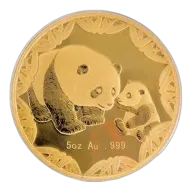
The 5 oz gold Panda (designated as 150 grams since China's 2016 metric conversion) is the largest regularly produced gold coin in the Chinese Panda series. Struck by the China Gold Coin Corporation (CGCC) in .999 fine gold, it carries the same annually changing panda reverse design that has defined the series since its 1982 debut, paired with the unchanging Temple of Heaven obverse.
The 2016 metrication is especially relevant at this size. Pre-2016 coins contain a full 5 troy ounces (155.5 g) of gold, but post-2016 coins contain 150 grams (4.823 troy ounces), roughly 3.5% less metal. Both carry the same visual format, so buyers need to verify which era a specific coin dates from. The face value on the 150 g version is typically 2,000 yuan.
Production of the large-format Pandas has been sporadic compared to the standard 30 g (formerly 1 oz) denomination. Not every year includes a 5 oz or 150 g release, and mintages are substantially lower than the standard sizes, which can create year-specific collector premiums on top of the metal value. This positions the 5 oz Panda as a hybrid product: partly a large gold bullion holding, partly a collectible with numismatic characteristics driven by the annually changing design and constrained supply.
5 oz / 150 g Gold Panda Specifications
| Attribute | Pre-2016 | Post-2016 |
|---|---|---|
| Weight | 5 troy oz (155.5 g) | 150 g (4.823 troy oz) |
| Purity | .999 fine gold | .999 fine gold |
| Face value | 500 yuan (pre-2001: varied) | 2,000 yuan |
| Manufacturer | China Gold Coin Corporation (CGCC) | |
| Legal tender | People's Republic of China | |
The CGCC strikes coins at multiple facilities including Beijing, Shanghai, Shenyang, and Shenzhen. Unlike most Western sovereign mints, there are no standardised mintmarks to identify which facility produced a given coin, making attribution to a specific mint difficult without specialist knowledge of die variations.
Counterfeiting is a well-documented concern for the Panda series. NGC has noted that "skillful counterfeits are endangering the integrity of the Chinese Panda coin series," with recent years counterfeited at an alarming rate. For a coin of this value, purchasing from established dealers or obtaining NGC/PCGS certification is strongly advisable. The CGCC does not offer a coin-level digital authentication system comparable to the Royal Canadian Mint's Bullion DNA technology.
Gold Panda Tax Treatment by Country
United States
Gold Pandas are generally considered not IRA-eligible. The IRS does not recognise the Chinese mint as an approved foreign mint for IRA purposes under Section 408(m), and the coins' semi-numismatic character (annual design changes, collector premiums) can classify them as collectibles rather than qualifying bullion. Some IRA custodians may accept .999+ purity sovereign coins on a case-by-case basis, but this should be confirmed before purchase. Capital gains are taxed at the collectibles rate of up to 28% for holdings over one year. Sales tax varies by state, with roughly 35 states exempting bullion purchases.
United Kingdom
Gold Pandas are VAT-exempt as investment gold. They meet the requirements for post-1800 legal tender coins with purity above 900 fine. They are not CGT-exempt, as only UK legal tender coins (the Sovereign and Britannia) receive that benefit. The annual CGT allowance (currently GBP 3,000) applies to any gains.
Canada
Exempt from GST/HST as gold bullion refined to 99.5% or higher purity. Capital gains are taxed at a 50% inclusion rate. Not eligible for RRSP or TFSA accounts.
Australia
GST-free as investment-grade gold (99.5%+ purity). Capital gains tax applies on disposal, with a 50% discount for individuals holding longer than 12 months.
European Union
VAT-exempt under the EU investment gold directive (Directive 98/80/EC), which covers gold coins of 900+ fineness that are legal tender in their country of origin.
Singapore and Hong Kong
In Singapore, gold Pandas qualify as Investment Precious Metals (IPM) and are GST-exempt. Hong Kong has no sales tax or capital gains tax on bullion.
5 oz Gold Panda vs Other Large Gold Coins
The most direct comparison is with the 5 oz Perth Kangaroo, which also changes its design annually. The Kangaroo is .9999 fine (four nines) versus the Panda's .999, contains a full 5 troy ounces (no metric conversion issue), and benefits from the Perth Mint's micro-laser engraved authentication feature. The Kangaroo is IRA-eligible in the US; the gold Panda generally is not. For pure bullion purposes, the Kangaroo offers clearer provenance and better security features.
The Panda's advantage lies in its collector market. Annual design changes over four decades have built a dedicated following, and low-mintage years for large-format Pandas can trade at substantial premiums over melt value. The 1983 proof silver Panda (10,000 mintage) appreciated to approximately $16,430 in top grade, illustrating the ceiling for early Panda numismatics, though gold Pandas at this size are a different market segment.
Against the 5 oz Commander gold, the Panda has decades of established collector demand versus the Commander's recent 2024 launch. The Commander is .9999 fine and SD Bullion-exclusive, while the Panda is available from multiple international dealers. Both carry collector premiums above standard bullion, but the Panda's premiums are more established and its secondary market more developed.
For buyers who simply want 5 ounces of gold at the lowest premium, sovereign mint coins like the Kangaroo or standard 5 oz gold coins from established mints will typically offer better value. The Panda's appeal is for buyers who value the combination of Chinese cultural significance, annual design variety, and the potential for year-specific collector premiums alongside their gold holding.
5 oz Panda Gold Coin: frequently asked questions
-
The cheapest 5 oz Gold Panda we track is $24,942.26, available from SD Bullion, at around 13.2% over the gold spot price. Gold Panda coins carry collector premiums above generic gold products due to their annually changing designs and sovereign status.
-
Gold Panda coins are struck in 999 fine gold (99.9% pure). The 5 oz size weighs 155.5175 g and is issued by China Gold Coin Group Co., Ltd. Note that from 2016 the standard sizes switched to metric grams, so newer large-format Pandas may weigh 150g rather than exactly 5 troy oz depending on the year of issue.
-
Yes. The reverse of the Gold Panda has featured a new giant panda illustration every year since the series launched in 1982, with one exception: the 2001 and 2002 coins shared the same reverse design after a short-lived freeze policy that was reversed following collector backlash. The obverse, showing the Temple of Heaven in Beijing, has remained unchanged throughout the series.
-
Gold Panda coins command higher premiums because the annually changing reverse design creates collector demand on top of the bullion value. They are legal tender of the People's Republic of China, struck in limited annual productions, and carry cultural significance that drives buying beyond pure metal stackers. The crossover between collector and investor markets tends to widen the buy/sell spread compared to standard bullion coins.