1 product · 1 deal

Prices are fetched automatically and may not reflect current merchant prices. Currency conversions and tax treatment are approximate. Rankings are based solely on price. We are not a dealer and accept no responsibility for transactions with listed merchants. Past performance is not indicative of future results. This site does not provide investment advice. Full disclaimer
About the Engelhard Silver Bars Gold
Engelhard Gold Bars
Engelhard was one of the most significant precious metals refiners in American history. Charles W. Engelhard Sr. founded the company in 1902 in Newark, New Jersey, and by the 1950s it had grown into the world's largest precious metals smelter. His son, Charles Engelhard Jr., consolidated the family holdings into Engelhard Industries, Inc. in 1958 and listed it on the New York Stock Exchange. Charles Engelhard Jr. is widely cited as the inspiration for Ian Fleming's James Bond villain Auric Goldfinger.
Engelhard produced retail bullion bars from the late 1960s through approximately 1986, when the company exited the retail bullion market to focus on industrial catalysts and materials. BASF acquired Engelhard in 2006 for US $5 billion. No new Engelhard-branded bullion bars have been produced since the mid-1980s, making every existing bar a finite, collectible product.
Gold bars from Engelhard are struck in .999 or .9999 fine gold across a range of sizes, from 1 oz up to 1 kilo. Intermediate sizes include 100g, 10 oz, and 5 oz. Nearly all bars carry a unique serial number, which serves as the primary authentication marker.
Because production ceased decades ago and a significant number of bars were melted during the 1979-1980 silver price spike (when silver hit approximately $50/oz), surviving Engelhard bars are rarer than the original production numbers suggest. This scarcity drives collector premiums above the metal content value.
Engelhard Gold Bar Details
Engelhard gold bars were produced using multiple methods: cast (poured), pressed, and extruded. Weight and purity are identical across production methods, but the surface finish and overall appearance vary. No standard dimensions were published across the product range, as sizes and profiles changed across the many production varieties.
| Available Weights | Purity |
|---|---|
| 1 oz, 2 oz, 5 oz, 10 oz, 100g, 50g, 2g, 1 Kilo | .999 to .9999 fine gold |
Serial numbers follow several formats depending on the era and production facility. Numerical-only sequences use 5-6 digits, and letter-prefix series (PA, PB, FG, and others) were used across different production runs and bar sizes. The PB prefix uses 6 digits while most others use 5. The distinctive Engelhard hallmarks, including the "E" mark and the bull-and-bear logo (used on commercial bars), are key identifiers for authentication.
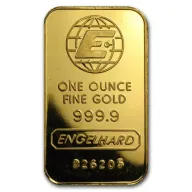
The earliest bars from the late 1960s used minimalist elongated octagon hallmarks with an extruded finish. Bars from the 1970s introduced the bull-and-bear commercial logo. The 1981-1986 portrait-orientation bars introduced the distinctive "E" globe logo. The final production run in 1986 used an Eagle logo design. The AllEngelhard.com collector community maintains the definitive catalogue of all known varieties and is the standard reference for authentication.
Tax Treatment for Engelhard Gold Bars
Engelhard bars are not legal tender in any jurisdiction. They carry no face value and are products of a now-defunct private refiner (acquired by BASF in 2006). Tax treatment follows standard rules for gold bullion bars.
Purchase Tax
- United Kingdom: VAT-exempt as investment gold, provided the bars meet the .995+ purity threshold. Engelhard bars at .999+ purity qualify.
- European Union: VAT-exempt under the Investment Gold Directive for bars of .995+ fineness.
- United States: No federal sales tax. State-level bullion exemptions apply in most states.
- Canada: GST/HST exempt for gold bullion at .995+ purity.
- Australia: GST-free for investment gold at .995+ purity in bar form.
Capital Gains and Retirement Accounts
In the United Kingdom, gold bars are subject to CGT on disposal. Only UK legal tender coins are CGT-exempt; bars from any refiner (including Engelhard) do not qualify. US capital gains are taxed at the collectibles rate of up to 28%.
For IRA eligibility in the United States, bars must be .995+ fine gold from an LBMA-accredited refiner or a national government mint. Engelhard held refining accreditations during its operational period, and some dealers list Engelhard gold bars as IRA-eligible. However, eligibility depends on the specific IRA custodian's policies, and the discontinued status of the brand may complicate acceptance. Confirm with your custodian before purchasing for retirement accounts.
Engelhard vs Modern Gold Bars and Johnson Matthey
Engelhard's closest historical peer is Johnson Matthey (JM), another major refiner that produced retail bullion bars in the same era. Both are .999+ fine, both carry serial numbers, and both have ceased retail bar production (JM's bullion arm was sold to Asahi Refining in 2015). Engelhard bars generally command higher collector premiums than equivalent JM bars, driven by a wider variety of documented types and the Goldfinger cultural connection.
Against modern gold bars from LBMA-accredited refiners like PAMP Suisse, Valcambi, or Argor-Heraeus, the premium structure is inverted. Modern bars trade close to spot with premiums driven by manufacturing and distribution costs. Engelhard bars carry a significant collector premium on top: the premium pays for historical provenance and scarcity, not additional gold content. For buyers whose sole objective is acquiring gold at the lowest cost per ounce, a current-production LBMA bar achieves the same investment outcome at a lower price.
Engelhard gold bars are counterfeited, though less frequently than the company's 100 oz silver bars (which are the most targeted size). The serial number format, font consistency, weight precision, and edge finishing are the primary authentication checks. AllEngelhard.com maintains definitive pages on known counterfeits with detailed visual comparisons.
The collector market for Engelhard is strongest in the United States, where most production occurred. Canadian-marked Engelhard varieties (stamped "Engelhard Industries of Canada") are separately collected. UK and Australian-marked varieties exist but are less common. Unusual sizes (2 oz, 5 oz) command premiums well above their gold content and standard-size equivalents.