1 product · 2 deals
Filters
| Product | /oz | Premium | Price | |
|---|---|---|---|---|

2 deals
|
$5,103.92 | +17.46% |
$1,275.98
£956
|
Compare |
Prices are fetched automatically and may not reflect current merchant prices. Currency conversions and tax treatment are approximate. Rankings are based solely on price. We are not a dealer and accept no responsibility for transactions with listed merchants. Past performance is not indicative of future results. This site does not provide investment advice. Full disclaimer
About the Gold Standard Gold
The Royal Mint's Tribute to Britain's Monetary History
The Gold Standard is an annual bullion coin from The Royal Mint, first struck in 2016 to mark the 200th anniversary of Britain's formal adoption of the gold standard. The historical gold standard was effectively established in 1816 via the Coinage Act, following Sir Isaac Newton's 1717 report that assigned a fixed value to the gold guinea. Britain was the first major economy to formally tie its currency to gold, with the United States, Canada, and Germany following later. The UK remained on the gold standard until 1931.
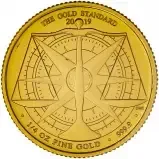
Available in 1/4 oz and 1 oz sizes, both struck in 999.9 fine gold (24 karat). As UK legal tender, every Gold Standard coin is both VAT-free and CGT-exempt for UK residents, sharing this tax advantage with the Britannia and Sovereign. The series was designed by Royal Mint graphic designer Dominique Evans, whose work depicts imagery related to Britain's gold standard history, including scales of justice and a lion motif symbolising the weight and authority of the monetary system.
The Gold Standard occupies an unusual position in The Royal Mint's lineup. It carries the same purity and legal tender status as the Britannia but has significantly lower mintage numbers and less market recognition. Known issued years include 2016, 2019, 2020, and 2021, with the 1 oz bullion version introduced in 2021; earlier years appear to have been limited to 1/4 oz or proof editions. This lower profile keeps primary-market premiums competitive but narrows the secondary market compared to the Britannia. For UK buyers specifically seeking CGT exemption with a less common design, it is worth considering alongside the higher-volume alternatives.
Gold Standard Specifications
| Attribute | 1 oz | 1/4 oz |
|---|---|---|
| Purity | 999.9 fine gold (24ct) | 999.9 fine gold (24ct) |
| Weight | 1 troy oz (31.21g) | 1/4 troy oz |
| Diameter | 32.69 mm | 22.00 mm |
| Face value | £100 | £25 |
| Finish | Bullion standard | Bullion standard |
Both sizes are individually packaged in single coin capsules. The face values (£100 and £25) are purely nominal, well below the actual gold content value, as is standard for modern bullion coins. The 1 oz coin weighs 31.21 grams rather than the standard troy ounce weight of 31.1035 grams; the slight difference reflects the total coin weight including any trace alloy content, though the fine gold content is one full troy ounce.
The 2021 specification mentions a micro-dot table texture on the coin surface, a subtle anti-counterfeiting measure incorporated into the minting process. This technique creates a pattern of microscopic raised dots visible under magnification that is difficult to reproduce with casting or stamping methods used by counterfeiters. It is less sophisticated than the Britannia's latent image and micro-text security features but adds a layer of verification beyond simple weight and dimension checks.
Proof editions have been produced in limited quantities alongside the bullion versions. The 2021 proof 1 oz was limited to 250 pieces and the 1/4 oz proof to 500 pieces, with significantly higher premiums reflecting the mirror-finish fields, frosted relief, and restricted mintage. For buyers focused on metal content rather than collectibility, the bullion versions offer the same gold weight and purity at lower premiums.
Gold Standard Tax Treatment by Country
The Gold Standard's status as UK legal tender with .9999 purity gives it one of the most favourable tax profiles available to British bullion buyers. Both the CGT exemption and VAT-free treatment apply regardless of the coin's lower market profile compared to the Britannia or Sovereign.
- United Kingdom: VAT-free and CGT-exempt. The VAT exemption applies because the Gold Standard qualifies as investment gold (UK legal tender coin above 900 fineness). The CGT exemption applies because it is UK legal tender. This dual exemption is the coin's primary selling point for UK investors. The annual CGT allowance is currently £3,000, so the CGT exemption becomes material for holdings above that threshold. Gold bars and non-UK-legal-tender coins are subject to CGT at the individual's marginal rate (18% for basic-rate taxpayers, 24% for higher-rate). The Gold Standard also qualifies for SIPP (Self-Invested Personal Pension) inclusion, with tax relief at the holder's marginal rate and no CGT within the pension wrapper.
- European Union: VAT-exempt as investment gold under Council Directive 98/80/EC. The directive covers gold coins with a fineness of 900 or above that are legal tender in their country of origin and minted after 1800. The historical gold standard theme has resonance in European monetary history, given that several EU member states adopted the system after Britain pioneered it.
- United States: No federal sales tax. State exemptions vary. The Gold Standard's .9999 purity meets IRA requirements for gold (minimum 99.5%), though US buyers would more typically choose American-produced or Canadian-produced coins for retirement accounts. Capital gains on bullion are taxed at the collectibles rate of up to 28% for holdings over one year.
- Canada: GST/HST-exempt at .9999 purity. Meets the 99.5% minimum threshold for the federal precious metals exemption.
- Australia: GST-free as investment-grade gold (99.5%+ purity). Capital gains tax applies on disposal, with a 50% discount for holdings over 12 months.
- Singapore and Hong Kong: GST-exempt under Singapore's IPM scheme. Hong Kong has no sales tax or capital gains tax on bullion.
A Coin for the System That Defined Modern Money
The gold standard as a monetary system has a history intertwined with Britain's rise as a global economic power. Sir Isaac Newton, serving as Warden and later Master of the Royal Mint from 1696, inadvertently set the stage in 1717 by assigning a fixed value to the gold guinea relative to silver. His valuation slightly overpriced gold against silver at the prevailing market rate, which gradually drove silver coins out of circulation (a textbook case of Gresham's Law: "bad money drives out good"). By the late 18th century, gold had become the de facto basis of the British monetary system.
The formal adoption came with the Coinage Act of 1816, which officially placed Britain on a monometallic gold standard. The Act introduced the Sovereign (20 shillings, 7.32g of 22-carat gold) as the primary gold coin, replacing the guinea. This was the system that underpinned the expansion of the British Empire, the growth of the City of London as the world's financial centre, and the development of the first truly global trade network settled in a single currency.
Other nations followed: Germany adopted the gold standard in 1871 after unification, the United States de facto in 1873 and formally in 1900, and most major economies joined by the early 1900s. Britain abandoned the system in 1931 during the Great Depression, and the last vestiges (the Bretton Woods system, where the US dollar was convertible to gold at $35/oz) ended in 1971 when President Nixon closed the gold window.
The Royal Mint's Gold Standard coin, designed by Dominique Evans, draws on this history with imagery of scales and a lion motif. The reverse design captures the conceptual weight of the system: the idea that currency derived its value from a fixed relationship to a physical quantity of gold. Editions through 2021 carry Jody Clark's portrait of Queen Elizabeth II on the obverse; editions from 2023 onward would feature King Charles III, though the specific transition year for this series has not been confirmed. Limited proof editions alongside the bullion versions have kept collector interest alive, though the series' lower profile compared to the Britannia means secondary-market availability is more limited.
Gold Standard vs Britannia, Sovereign, and International 24-Karat Coins
The most obvious comparison is with The Royal Mint's own Britannia. Both coins are 999.9 fine gold, both are UK legal tender with CGT exemption and VAT-free status, and both are produced by the same mint. The Britannia wins on every metric except exclusivity: it has higher mintages, wider global recognition, tighter buy-sell spreads, and more advanced security features (latent image, micro-text, surface animation). The Gold Standard's advantage is its relative scarcity and its more focused thematic appeal for buyers interested in monetary history. If resale liquidity is a priority, the Britannia is the stronger choice.
The Sovereign offers the same CGT exemption for UK residents but in 22-carat gold (916.7 fineness) rather than 24-carat. The Sovereign has the longest production history of any bullion coin (continuously minted since 1817), and its smaller size (roughly 1/4 oz of fine gold) makes it popular for fractional holdings. The Gold Standard provides more fine gold per coin at 24 carats but lacks the Sovereign's centuries-deep brand recognition and its uniquely liquid global secondary market.
Among international 24-karat coins, the Canadian Maple Leaf, Austrian Philharmonic, and Australian Kangaroo all match the Gold Standard's .9999 purity. All three have vastly higher production volumes and global dealer networks. None offers CGT exemption in the UK, which is the Gold Standard's key differentiator for British buyers. For international buyers without a UK tax nexus, the liquidity advantage of these established programmes outweighs the Gold Standard's niche appeal.
The Gold Standard is a sensible choice for UK-based buyers who want CGT-exempt, high-purity gold with a design that stands apart from the ubiquitous Britannia. It is not the optimal choice for buyers prioritising resale ease, international recognition, or the tightest possible spreads.
Gold Standard Gold: frequently asked questions
-
The Gold Standard is a range of gold bullion coins from The Royal Mint, first issued in 2016 to mark the 200th anniversary of Britain formally adopting the gold standard monetary system. It is a distinct Royal Mint bullion product and should not be confused with the historical gold standard itself. Available in 1 oz and 1/4 oz sizes, both struck in 999.9 fine gold, and qualifying for UK CGT exemption as UK legal tender.
-
The live gold spot price is $4,408.10. Gold Standard coin prices track spot closely, with a fabrication and dealer premium on top. The size of that premium varies by dealer and coin format, so comparing offers across listed products gives you a real-time picture of total cost.
-
The Gold Standard range covers gold coins in 1 oz and 1/4 oz sizes, both in 999.9 fine gold. Proof editions with limited mintages have also been produced alongside the standard bullion versions. We currently track 3 listings from 2 dealers, giving a broad view of available prices across the range.