
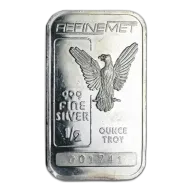

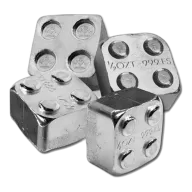
Prices are fetched automatically and may not reflect current merchant prices. Currency conversions and tax treatment are approximate. Rankings are based solely on price. We are not a dealer and accept no responsibility for transactions with listed merchants. Past performance is not indicative of future results. This site does not provide investment advice. Full disclaimer
About 1/2 oz Silver Bars
1/2oz Silver Bars: A Niche Fractional Format
A 1/2oz bar contains 15.5517 grams of silver, half a troy ounce. In gold, the 1/2oz weight is a mainstream fractional size produced by every major sovereign mint. In silver, it sits well outside the mainstream. Half-ounce silver products are uncommon in bullion form and appear more often as commemoratives or proof pieces, and bars below one ounce are far less common for silver than they are for gold. The standard retail ladder for silver bars runs 1 oz, 5 oz, 10 oz, 1 kg, and 100 oz, with smaller fractional weights existing as a sideline rather than a core product category.
The economics explain the niche status. Silver bars carry the lowest premiums of any silver form, but that advantage is concentrated at the larger weights. At the bottom of the scale the fixed costs of manufacturing and handling dominate the price: 1oz silver bars already run 8-15% over spot in normal market conditions, and the steepest premium savings only arrive as you move up towards 10oz bars at 4-8%. A half-ounce bar moves in the opposite direction from where the cost efficiency lies.
The buyer this weight suits is one who values small, low-cost units of silver over premium efficiency: gifting, very small recurring purchases, or maximum divisibility. Anyone whose goal is accumulating silver weight per dollar is better served further up the scale, where the source of bars' cost advantage actually operates. Silver's low value-to-weight ratio means even a substantial holding of small bars remains physically compact, so storage is not the constraint at this weight; premium is.
Where 1/2oz Sits on the Silver Bar Premium Scale
Published premium data for silver bars starts at the 1oz weight, and the pattern across the ladder makes the position of anything smaller clear. Approximate premiums over spot in normal market conditions:
| Bar size | Premium over spot |
|---|---|
| 1 oz | 8-15% |
| 5 oz | 6-10% |
| 10 oz | 4-8% |
| 1 kg | 3-6% |
| 100 oz | 2-5% |
The single biggest drop on that ladder happens between 1 oz and 10 oz, a reduction of 4-5 percentage points. After 10 oz each step up saves less. Premiums rise as bars get smaller, so a 1/2oz bar sits at the expensive end of the scale, above the 8-15% that 1oz bars command. Manufacturing method matters too: cast bars run 1-2% cheaper than minted bars of the same weight, though cast production is concentrated in the larger sizes (10 oz and up), so small bars are normally minted.
Tax amplifies the small-bar penalty in some markets. In the UK, silver bars carry 20% VAT on purchase, and across the EU standard national VAT rates apply to new silver. In these jurisdictions the effective premium including tax can reach 25-40% for 1oz bars, and the larger the bar, the more the premium savings offset the fixed VAT hit. By contrast, Canada and Australia exempt silver refined to at least 99.9% purity from GST/HST, New Zealand and Singapore exempt silver bars at 99.9%+ purity, and Hong Kong levies no VAT or duties at all. In those markets a small bar costs only its premium, not premium plus tax.
Reselling and Storing Half-Ounce Silver Bars
Silver bars from recognised refiners are liquid, though they carry slightly wider buy-sell spreads than sovereign mint coins. The general rules of the silver bar market apply with extra force at small weights. Brand matters: LBMA-accredited refiner bars command better resale prices than generic bars, and generic or unbranded bars from lesser-known refiners will normally sell at melt value only, with no brand premium recovery. Since a 1/2oz bar's acquisition price contains a proportionally large premium, buying a no-name bar at this weight means accepting that most of that premium will not come back at sale.
Packaging is the other lever. Minted bars are often sealed in assay packaging, and sealed bars in original packaging resell better than loose ones. Keeping a small bar in its card is the simplest way to protect its resale value. Per-unit handling cost also works against small bars on the buyback side: dealers note that even 1oz bars, though liquid, cost more to process per unit than 100oz bars or 10oz bars, which resell efficiently and are popular with dealers.
Storage is the one area where small silver bars are unproblematic. Silver's defining storage challenge is bulk: roughly USD 50,000 of silver weighs about 45 kg at current prices. A handful of half-ounce bars takes negligible space. The practical care points are environmental. Silver tarnishes when exposed to sulphur compounds, so bars should be stored dry, ideally wrapped or in their sealed packaging, with anti-tarnish strips as a cheap safeguard. Professional vault storage is rarely sensible at this scale; some vault providers charge minimum fees that make silver storage uneconomical below certain thresholds.
1/2 oz Silver Bars: frequently asked questions
-
The melt value of a half-oz silver bar is half the current $67.63 silver spot price. Retail prices sit above that because dealers add a premium to cover production and handling. Half-oz bars carry a relatively high premium per troy ounce compared with larger sizes, so buyers prioritising cost efficiency often prefer 1 oz or larger bars.
-
Across the dealers we track, 6 currently list half-oz silver bars, with 9 individual products available. The half-oz is a less common size than the 1 oz bar, so choice is more limited, but comparing prices across those listings can still reveal meaningful differences in premium.
-
Silver bars attract VAT in the UK at 20% and in much of the EU. In Australia, investment-grade silver bars are GST-free at 0%. In Canada, GST applies to silver at 0%. US buyers face state sales tax rules that vary by state, with no federal rate.