2 products · 12 deals Prices & premiums exclude tax to compare across countries


Prices are fetched automatically and may not reflect current merchant prices. Currency conversions and tax treatment are approximate. Rankings are based solely on price. We are not a dealer and accept no responsibility for transactions with listed merchants. Past performance is not indicative of future results. This site does not provide investment advice. Full disclaimer
About 1/10 oz Silver Coins
The Smallest Step Into Silver
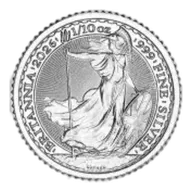
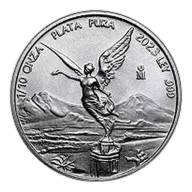
A 1/10 oz coin contains 3.1103 grams of metal, which in silver makes for an unusual product. The 1 oz coin dominates silver minting, and fractional silver coins are rare. The handful of tenth-ounce silver coins that do exist, such as the 1/10 oz Silver Britannia and the 1/10 oz Mexican Libertad, occupy a niche rather than a mainstream investment role.
The reason comes down to what fractional sizing is for. In gold, splitting an ounce into tenths creates an affordable entry point. Silver does not have that problem: with spot at roughly USD 30-40 per ounce against USD 3,000+ for gold, a full ounce of silver is already accessible to almost any buyer, and 1 oz silver coins are the most popular entry point for new bullion investors. A tenth-ounce silver coin holds only a few dollars of metal, so its appeal is not affordability.
Who buys them, then? Gift buyers and collectors, mostly. A tiny legal tender coin from a sovereign mint makes a low-cost present, and series with collector followings give these pieces a second life beyond their melt value; older Libertads, for example, are collectible because of their lower mintages. Stackers focused on accumulating metal efficiently should look at this weight with clear eyes: the production costs of minting, quality control, and packaging do not shrink in proportion to the coin, so the smaller the coin, the larger those fixed costs loom relative to the silver inside it. For metal accumulation, larger silver coins deliver far more silver per unit of spend.
Premium Structure at the Bottom of the Weight Scale
Silver coin premiums run substantially higher than gold coin premiums as a percentage of spot, because the costs of producing a coin are similar regardless of the metal's value. When the metal in the coin is worth USD 30-40 rather than USD 3,000+, mining, refining, minting, and packaging costs make up a much larger share of the price. Even at the standard 1 oz size, government silver coins typically carry premiums of 15-25% over spot in normal market conditions, and premiums have exceeded 50% during supply crunches.
Tenth-ounce coins push this arithmetic to its extreme. Die work, quality control, and packaging cost nearly as much for a small coin as for a 1 oz coin, but those costs are spread over one-tenth the metal. The result is that 1/10 oz coins carry the highest relative premiums of any standard bullion weight. Buyers paying for a tenth-ounce silver coin are paying mostly for the minting, not the silver.
Tax treatment compounds the picture in some markets. In the UK, silver coins attract 20% VAT on purchase, and in EU countries silver is charged at full local VAT rates; for silver coins in these jurisdictions the effective premium including tax can reach 35-45% above spot. Other markets are kinder: Canada exempts silver refined to 99.9% purity or higher from GST/HST, New Zealand exempts silver at 99.9%+ purity from GST, Australia treats investment-grade silver as GST-free, Singapore's Investment Precious Metals scheme covers silver at 99.9%+ purity, and Hong Kong levies no sales tax at all. UK buyers do get one offset on legal tender coins: the Silver Britannia is exempt from capital gains tax on sale, though on a coin this small the exemption matters far less than it does on larger holdings.
The Few Coins Struck at This Weight
Because fractional silver is rare, the field at 1/10 oz is thin. Two sovereign coins account for most of the dealer listings at this weight.
The 1/10 oz Silver Britannia from the Royal Mint is the most widely stocked. The Britannia series dates to 1997 and was struck in .999 fine silver until 2013, when the Royal Mint raised the standard to .9999. As UK legal tender, it is exempt from capital gains tax for UK sellers, and it carries the same tincture line and micro-text security features as the gold version. Those security features matter less at this size than on a 1 oz coin, since the low metal value of small silver gives counterfeiters little incentive, but they help with quick visual verification.
The 1/10 oz Mexican Libertad comes from Casa de Moneda de Mexico, which has produced the Libertad series in .999 fine silver since 1982. The series is known for comparatively low mintages, which mean older years trade as collectibles rather than pure bullion. For buyers at this weight that is a genuine consideration: a tenth-ounce coin is more likely to be bought for collection or gifting than for metal content, and the Libertad's collector market plays to that.
Beyond these two, listings are sparse. Most major silver series, including the American Silver Eagle, the Canadian Maple Leaf, and the Austrian Philharmonic, are struck at 1 oz and concentrate their volume there. Buyers wanting variety in small silver will find more choice one step up the scale.
Selling and Storing Tenth-Ounce Silver
Silver coins from major sovereign mints are highly liquid and widely recognised by dealers, and that recognition extends to the small Britannia and Libertad pieces. The economics of selling them are less favourable than the recognition suggests, though. Buy-sell spreads on silver coins are already wider in percentage terms than on gold coins, reflecting the higher purchase premiums, and fractional sizes carry the widest bid-ask spreads of all. A seller should expect to recover noticeably less of the premium paid than they would on a 1 oz silver coin.
Shipping economics work against small silver too. Silver is heavy relative to its value, worth roughly 1/80th as much as gold ounce for ounce, so postage and handling eat a proportionally larger share of any sale. On a coin containing a few dollars of metal, selling individual pieces by post rarely makes sense; these coins move most sensibly in person or bundled with larger lots.
Storage is the one area where this weight is effortless. The coins are tiny, which cuts both ways: they take almost no space, but they are easy to lose without proper housing, so capsules or mint tubes are essential. Standard silver coin packaging uses mint tubes of 20 or 25 coins. As with all silver, tarnish is the long-term enemy. Exposure to sulphur compounds in the air turns silver dark grey or black; this does not affect metal content or melt value, but it can reduce appeal on resale, so a low-humidity environment and anti-tarnish strips in storage containers are worthwhile precautions even for a small holding.