1 product · 3 deals

Prices are fetched automatically and may not reflect current merchant prices. Currency conversions and tax treatment are approximate. Rankings are based solely on price. We are not a dealer and accept no responsibility for transactions with listed merchants. Past performance is not indicative of future results. This site does not provide investment advice. Full disclaimer
About the Fiji Taku Silver
The Original Hawksbill Turtle Silver Bullion Coin
The Fiji Taku is a silver bullion coin series featuring the hawksbill turtle, known as "taku" in Fijian. Minted by the New Zealand Mint on behalf of the Reserve Bank of Fiji, the series ran from 2010 to 2013 before political changes in Fiji ended the programme. The design continued from 2014 onward under Niue's authority, but the Fiji-branded coins represent the original and now-discontinued series.
Each coin contains .999 fine silver and carries a $2 FJD face value. The primary size is 1 oz, though the series also includes 1/2 oz and 5 oz variants. The hawksbill turtle (Eretmochelys imbricata) is critically endangered and native to tropical waters including the South Pacific, making the coin both a bullion product and a nod to Fijian marine biodiversity.
The four-year production window gives the Fiji Taku a finite supply that distinguishes it from open-ended annual series like the Silver Kookaburra or Silver Philharmonic. Earlier years, particularly the 2010 inaugural issue, carry scarcity premiums on the secondary market. The 2013 coin is notable for a design change: the reverse switched from Queen Elizabeth II's portrait to the Fiji coat of arms, a direct consequence of Fiji's political transition toward becoming a republic.
The series was not a low-mintage collector product. The 2013 issue had a confirmed cap of 350,000 coins for the 1 oz silver, placing it in the mid-range for bullion mintages. Availability on the secondary market remains reasonable through major bullion dealers, particularly in the Australasian market where proximity to the New Zealand Mint ensured wider initial distribution.
Fiji Taku Denominations and Dimensions
| Attribute | 1 oz Silver | 1/2 oz Silver | 5 oz Silver |
|---|---|---|---|
| Weight | 1 troy oz (31.1 g) | 1/2 troy oz (15.55 g) | 5 troy oz (155.5 g) |
| Purity | .999 fine silver | .999 fine silver | .999 fine silver |
| Diameter | 40.50 mm | Not published | Not published |
| Thickness | 2.30 mm | Not published | Not published |
| Face value | $2 FJD | $1 FJD | $10 FJD |
| Edge | Milled (reeded) | Milled (reeded) | Milled (reeded) |
The 1 oz coin at 40.50 mm diameter is slightly larger than many sovereign mint competitors. The 1oz Silver Britannia measures 38.61 mm and the 1oz Silver Maple Leaf is 38 mm, making the Taku a physically more substantial coin in the hand. The .999 purity is standard for silver bullion, matching the Britannia and Philharmonic, though below the Maple Leaf's .9999 four-nines standard.
The $2 FJD face value on the 1 oz coin is typical for bullion coins from smaller nations. The face value exists to establish legal tender status rather than to reflect any relationship with the metal content, which is worth many times more at any realistic silver price.
Fiji Taku Tax Treatment by Country
The Fiji Taku is legal tender of Fiji with a $2 FJD face value, authorised by the Reserve Bank of Fiji. This status affects its tax treatment in purchasing jurisdictions, though it does not confer the same advantages as domestic legal tender coins in most markets.
- United States: The .999 silver purity meets the IRS Section 408(m) minimum for precious metals IRA eligibility. Actual custodian acceptance varies; the Fiji Taku's legal tender status from a sovereign nation supports eligibility. State sales tax exemptions for investment bullion apply in roughly 35 states. Capital gains are taxed at the collectibles rate, maxing at 28% for long-term holdings.
- United Kingdom: Silver coins from non-UK mints attract 20% VAT. Pre-owned Fiji Taku coins are available VAT-free from some UK dealers through the margin scheme, which taxes only the dealer's margin rather than the full price. The Taku is not CGT-exempt in the UK, as that exemption applies only to UK legal tender coins such as the Silver Britannia.
- Canada: Silver at 99.9% purity or above is exempt from GST/HST. The .999 Fiji Taku meets this threshold. Capital gains apply at the 50% inclusion rate.
- Australia: Silver bullion at 99.9% purity or above is GST-free. The .999 Taku meets this standard. Capital gains tax applies with a 50% discount for individual holdings over 12 months.
- New Zealand: The New Zealand Mint produced these coins, but the Taku carries Fiji legal tender status rather than NZ. Fine silver at 99.9% purity is GST-exempt in NZ. No capital gains tax applies, though IRD may assess profits as income if purchased for resale.
- Singapore: Silver coins at 99.9% purity that are or were legal tender qualify as Investment Precious Metals, exempt from 9% GST. The Taku's status as Fiji legal tender and .999 purity should meet IPM criteria. No capital gains tax in Singapore.
- Hong Kong: No sales tax, no import duty, and no capital gains tax on silver bullion.
From Fiji's Waters to Political Transition
The Fiji Taku launched in 2010, introducing the hawksbill turtle to the international bullion market. The New Zealand Mint, located in Auckland, struck the coins under contract with the Reserve Bank of Fiji. The "taku" name comes from the Fijian word for the hawksbill turtle, not from Maori as some sources incorrectly state. Fijian and Maori belong to different language families (Melanesian and Polynesian respectively), despite both being Pacific Island languages.
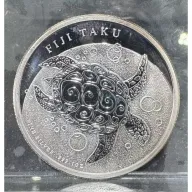
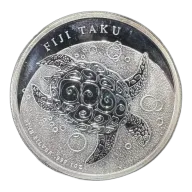
The first three years (2010-2012) followed a consistent format. The obverse depicted a stylised hawksbill turtle swimming along the ocean floor amid bubbles. The reverse featured Ian Rank-Broadley's portrait of Queen Elizabeth II, the standard effigy used across Commonwealth coinage from 1998. The design was clean and immediately recognisable, with the turtle rendered in enough anatomical detail to identify the species from its overlapping shell scutes and pointed beak.
The 2013 issue marked a significant departure. Fiji had undergone a military coup in 2006 under Commodore Frank Bainimarama, followed by years of constitutional upheaval. By 2013, the country adopted a new constitution and formally became a republic, removing the British monarch as head of state. The coin's reverse was redesigned to feature the Fiji coat of arms in place of Queen Elizabeth II's portrait, making the 2013 Taku one of the earliest Fijian coins to reflect the political transition. The obverse turtle design was retained unchanged.
After 2013, the relationship between the Fiji government and the New Zealand Mint for this bullion programme ended. The mint continued the hawksbill turtle design from 2014 onward, reissuing it as legal tender of Niue, a self-governing island state in free association with New Zealand that recognises the British Crown. The Niue version reverted to a Queen Elizabeth II portrait on the reverse, and the inscription changed from "Fiji Taku" to simply "Turtle." The Fiji-branded series, limited to four annual issues, became a closed set.
The hawksbill turtle itself is listed as critically endangered by the IUCN. Found throughout tropical waters, including the South Pacific reefs around Fiji, the species faces threats from habitat loss, illegal trade in shell products, and accidental capture in fishing gear. The coin programme brought modest international attention to the species, though its primary purpose was always as a bullion product rather than a conservation effort.
Fiji Taku vs Southern Hemisphere and Pacific Silver Coins
The Fiji Taku's natural competitors are the other silver bullion coins from the Southern Hemisphere and Pacific region, along with the continuation series that replaced it.
The most direct comparison is with the Niue Hawksbill Turtle (2014 onward), which is essentially the same coin from the same mint with a different issuing authority. The Fiji versions (2010-2013) are the original series with finite supply, while the Niue versions continue with annual releases and broader availability. On the secondary market, Fiji Taku coins, particularly the 2010 first-year issue, command a scarcity premium over their Niue successors. For a buyer seeking the cheapest way to own a New Zealand Mint hawksbill turtle coin, the Niue version is the practical choice. For a buyer who values the original series and its connection to Fiji's political history, the Fiji Taku has an appeal that newer issues cannot replicate.
Against the Australian Kookaburra and Australian Koala from the Perth Mint, the Taku trades at somewhat higher premiums relative to its mintage. Perth Mint coins benefit from greater liquidity, wider dealer networks across all English-speaking markets, and Australian legal tender status backed by the Currency Act 1965. The Taku was never produced in the volumes that Perth Mint achieves, and its dealer network is narrower, making resale slightly less straightforward outside Australasia.
Compared to the Silver Maple Leaf, the gap in liquidity is larger still. The Maple Leaf is the global benchmark for .9999 silver purity, struck in the millions annually with near-universal dealer acceptance. The Taku at .999 purity and a capped mintage of 350,000 (for the 2013 issue) is a fundamentally different product. The Maple Leaf is for accumulating silver at competitive premiums; the Taku is for buyers who want a specific design with some scarcity value built in.
The 5oz and 1/2oz Fiji Taku variants have fewer direct competitors at those weights. Fractional and heavy-weight silver coins are produced by fewer mints, giving the Taku additional differentiation outside the crowded 1 oz category. The 5 oz Taku is a substantial coin that appeals to collectors who prefer fewer, larger pieces over tubes of 1 oz coins.
Fiji Taku Silver: frequently asked questions
-
Fiji Taku silver coins are priced relative to the silver spot price, currently $67.63 per troy ounce. Because the Fiji-branded series ran from 2010 to 2013 and is now discontinued, all stock comes from the secondary market, which can add a scarcity premium over standard bullion. BullionFerret tracks 3 dealers with 5 listings so you can compare current offers.
-
The Fiji Taku is a 1 troy oz .999 fine silver bullion coin issued as legal tender of Fiji, produced by the New Zealand Mint on behalf of the Reserve Bank of Fiji. The series ran from 2010 to 2013 and features a hawksbill turtle on the obverse. "Taku" is the Fijian word for the hawksbill turtle. After 2013, the programme was reissued under the Niue name rather than Fiji.
-
Yes. The Fiji Taku is struck in .999 fine silver by the New Zealand Mint and carries official Fiji legal-tender status, authorised by the Reserve Bank of Fiji. It trades at the silver spot price plus a premium, which typically reflects the coin's discontinued status and collector appeal. The series is a real bullion product with verifiable weight, purity, and government-backed face value.
-
"Taku" is the Fijian word for the hawksbill turtle, a critically endangered species native to tropical Pacific waters. The coin's obverse features a stylised hawksbill turtle swimming along the ocean floor. The reverse on early issues showed a portrait of Queen Elizabeth II; from 2013 onward it was replaced by the Fiji coat of arms. The coin celebrates Fiji's marine biodiversity.