1 product · 1 deal
Filters
| Product | /oz | Premium | Price | |
|---|---|---|---|---|
| $150.00 | +121.80% | $150.00 | View Deal |

Prices are fetched automatically and may not reflect current merchant prices. Currency conversions and tax treatment are approximate. Rankings are based solely on price. We are not a dealer and accept no responsibility for transactions with listed merchants. Past performance is not indicative of future results. This site does not provide investment advice. Full disclaimer
About the Gods of Olympus Silver
Perth Mint Greek Mythology in .9999 Silver
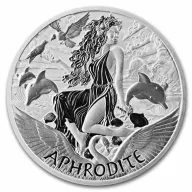
The Gods of Olympus series is produced by the Perth Mint and issued as legal tender of Tuvalu, a South Pacific island nation within the British Commonwealth. Each coin features a different Greek deity from the Olympian pantheon, rendered in the detailed style that has made the Perth Mint one of the most respected government mints for collector-oriented bullion.
The series has an unusual history. It began in 2014 as a high-premium antiqued numismatic collection featuring rimless 2 oz silver coins with very limited mintages. That original run covered the twelve major Olympians. In 2020, the Perth Mint relaunched the concept as a bullion series through an exclusive distribution partnership with LPM (Lee Precious Metals), adapting the original designs into multiple formats: 1 oz silver BU, 1 oz antiqued, 5 oz silver BU, 5 oz antiqued, and 1 oz gold.
The bullion relaunch started with Zeus in 2020, followed by Poseidon and Hades in 2021, Hera in 2022, and Ares, Apollo, and Artemis in 2023. New deities continue to be added, and the trajectory suggests the series may eventually cover all twelve major Olympians in bullion format. For buyers, the appeal is Perth Mint production quality combined with .9999 silver purity and genuinely tight mintages that sit between mass-market bullion and pure numismatics.
Gods of Olympus Denominations and Dimensions
| Format | Weight | Purity | Diameter | Face Value | Mintage |
|---|---|---|---|---|---|
| 1 oz Silver BU | 31.107 g | .9999 | 40.90 mm | $1 TVD | 13,500 |
| 1 oz Silver Antiqued | 31.107 g | .9999 | 40.90 mm | $1 TVD | 1,500 |
| 5 oz Silver BU | 155.53 g | .9999 | 55.90 mm | $5 TVD | 450 |
| 5 oz Silver Antiqued | 155.53 g | .9999 | 55.90 mm | $5 TVD | 50 |
| 1 oz Gold BU | 31.107 g | .9999 | 32.60 mm | $100 TVD | 100 |
The coins carry face values in Tuvalu dollars, which are pegged 1:1 to the Australian dollar. The Perth Mint "P" mint mark appears on all reverse designs. Protective capsules are included, and Certificates of Authenticity accompany the 5 oz and gold versions.
BU vs Antiqued Finish
The BU (Brilliant Uncirculated) versions have the standard shiny finish expected of bullion coins. Antiqued versions receive an artificially aged patina that gives them an ancient, archaeological appearance appropriate to the Greek mythology theme. The antiqued finish also makes counterfeiting more difficult than plain-finish coins. Mintage differences are dramatic: 13,500 for the 1 oz silver BU versus just 1,500 for the antiqued version of the same coin.
Tuvalu Legal Tender Tax Treatment
The Gods of Olympus coins are legal tender of Tuvalu with face values denominated in Tuvalu dollars (pegged to the Australian dollar). This legal tender status affects tax treatment in several markets.
United Kingdom: Gold versions are VAT-exempt as investment gold (.9999 purity exceeds the required threshold). Silver versions carry the full 20% VAT rate. The coins are not UK legal tender, so there is no CGT exemption. Profits on disposal are subject to standard capital gains tax at the individual's rate.
United States: The .9999 purity meets IRS requirements for inclusion in precious metals IRAs (gold must be 99.5%+, silver must be 99.9%+). State sales tax treatment varies. The coins qualify for exemption in most states that exempt precious metals bullion. Capital gains on bullion are taxed at the collectibles rate of up to 28% for holdings over one year.
Australia: As Tuvalu legal tender struck by the Perth Mint, these coins may qualify for GST exemption under Australia's investment-grade precious metals rules, though classification depends on whether they are treated as investment or collector coins. Gold versions meeting the 99.5% purity threshold are clearly exempt.
Canada: Silver bullion at .9999 purity exceeds the 99.9% GST/HST exemption threshold. Legal tender status from a Commonwealth nation supports the investment classification.
Singapore and Hong Kong: Singapore exempts qualifying Investment Precious Metals from GST. Gold coins on the MAS-approved list qualify; silver coins meeting the 99.9% purity threshold in qualifying form also qualify. Hong Kong imposes no sales tax on precious metals.
European Union: Gold coins meeting the Investment Gold Directive criteria (post-1800, 900+ fine, legal tender, sold at no more than 80% above gold value) are VAT-exempt throughout the EU. Silver coins are subject to standard VAT rates in each member state.
From Antiqued Numismatics to Bullion Series
The 2014 original antiqued series holds a special place in Perth Mint history: it was the mint's first-ever antiqued coin release. The initial trilogy featured Zeus, Poseidon, and Hades as rimless 2 oz silver coins with mintages of approximately 1,500 each. These were high-premium numismatic pieces targeted at collectors rather than bullion buyers. A complete twelve-coin set followed in 2016-2017, covering all twelve major Olympians, accompanied by a 5 oz Mount Olympus centrepiece coin.
The 2020 bullion relaunch transformed the concept. Rather than the exclusive, high-premium antiqued format, the new series offered multiple price points: 1 oz silver BU at 13,500 mintage for buyers wanting accessible Perth Mint quality, antiqued versions at 1,500 mintage for collectors, 5 oz silver pieces at just 450 (BU) or 50 (antiqued), and 1 oz gold coins at a remarkable 100-piece mintage. The gold mintage of 100 makes these among the rarest regular Perth Mint bullion issues. By comparison, Perth Mint Lunar gold coins are minted in the tens of thousands.
Each reverse features a dramatic classical scene: Ares in Corinthian helmet and armour amid battle, Apollo with his lyre alongside Daphne transforming into a laurel tree, Poseidon with trident amid crashing waves. The obverse initially carried the Ian Rank-Broadley portrait of Queen Elizabeth II with reign dates "1952-2022," transitioning to the King Charles III effigy for newer issues. The seventh bullion release (Ares, 2023) confirmed the series would continue expanding beyond the original trilogy's three deities rather than pivoting to a different mythological tradition.
Tuvalu, the issuing nation, is one of the smallest territories in the world with a population of roughly 11,000 people. It is one of several Pacific Island states that license their currency to mints worldwide for commemorative and bullion issues. The coins are denominated in Tuvalu dollars but will almost certainly never circulate on the islands.
Gods of Olympus vs Other Mythology and Wildlife Silver
The most direct comparison within the Perth Mint's own catalogue is the Lunar Series. Perth Mint Lunar coins have mintages exceeding 300,000 for the 1 oz silver, making them far more liquid on the secondary market. Lunar is the better choice for buyers prioritising resale ease and tight buy-sell spreads. The Gods of Olympus, at 13,500 mintage for the 1 oz BU, occupies a different space where collector interest overlays the bullion value.
The Royal Mint's Myths and Legends series features British mythology (Robin Hood, Merlin, Morgan le Fay) as UK legal tender, which provides CGT exemption for UK buyers. For anyone buying silver in the UK specifically, the Myths and Legends coins avoid the CGT liability that applies to the Tuvalu-issued Gods of Olympus. The mythological traditions are different (British vs Greek), but the collector proposition is similar.
Against the Canadian Predator series from the Royal Canadian Mint, the Gods of Olympus trades higher recognition and .9999 purity parity for lower mintages and stronger collector premiums. The RCM series benefits from the Maple Leaf brand halo and wider dealer availability across North America.
Within the private mint space, Niue and New Zealand Mint mythological issues compete on theme but generally lack the Perth Mint's production quality and institutional reputation. The .9999 purity is also a differentiator; most silver bullion coins are struck at .999. The Gods of Olympus matches the Canadian Maple Leaf and Australian Kangaroo for purity, which is unusual for a collector-oriented series. For buyers who want Greek mythology theming with government-backed quality assurance, this series has limited direct competition.
Gods of Olympus Silver: frequently asked questions
-
Gods of Olympus silver coins trade at a premium above the silver spot price ($67.63), with the exact markup depending on the format and dealer. The 1 oz BU coins carry higher premiums than mass-market bullion due to their limited mintages. Prices vary across the 1 dealer we track, so comparing offers on this page is the quickest way to find the best deal.
-
The bullion series has released coins depicting Zeus (2020), Poseidon and Hades (2021), Hera (2022), and Ares, Apollo, and Artemis (2023). Each reverse features a dramatic classical scene: Ares armoured for battle, Apollo with his lyre alongside Daphne transforming into a laurel tree, Poseidon rising from the waves with trident. The series continues to expand toward the full twelve Olympians.
-
The bullion series launched in 2020 and has released new deities each year, with seven individual gods featured through 2023 (Zeus, Poseidon, Hades, Hera, Ares, Apollo, Artemis). The series is ongoing. We currently track 1 distinct listing across BU, antiqued, and gold formats, and new releases are expected annually.
-
The Gods of Olympus coins are produced by the Perth Mint and issued as legal tender of Tuvalu, a South Pacific island nation within the British Commonwealth. They carry Tuvalu dollar face values (pegged to the Australian dollar). This gives them formal legal-tender status, though the coins are produced for collectors and investors rather than circulation.