2 products · 66 deals Prices & premiums exclude tax to compare across countries


Prices are fetched automatically and may not reflect current merchant prices. Currency conversions and tax treatment are approximate. Rankings are based solely on price. We are not a dealer and accept no responsibility for transactions with listed merchants. Past performance is not indicative of future results. This site does not provide investment advice. Full disclaimer
About the Philharmonic Silver
Austria's Orchestra in Silver
The Silver Philharmonic is one of the lowest-premium sovereign silver coins available, consistently undercutting the Silver Britannia and Silver Krugerrand in most markets. For investors focused on accumulating the most silver for their money from a government-backed mint, it occupies a distinctive position in the market.
Produced by the Austrian Mint (Munze Osterreich) since 2008, the silver version followed the gold Philharmonic, which launched in 1989 and became the world's best-selling gold coin in four separate years (1992, 1995, 1996, and 2000). The silver coin is struck at 99.9% fine silver, carries a face value of 1.50 EUR, and is legal tender in Austria, though not in other eurozone countries despite its euro denomination.
The Austrian Mint traces its origins to 1194, when Duke Leopold V of Austria used 12 tonnes of silver from King Richard the Lionheart's ransom to establish large-scale coin production in Vienna. That founding story, one of the most unusual in the minting world, connects the Philharmonic to over 800 years of Austrian coinage tradition.
Between 2008 and 2012, the Austrian Mint sold 54 million silver Philharmonic coins. Over 30 million more were sold in the three-year period from 2021 to 2023 alone, reflecting the strong retail investment demand that followed the pandemic. The coin is available only in the 1 oz denomination for silver; the Austrian Mint has not produced fractional or larger silver sizes.
Silver Philharmonic Technical Details
| Attribute | Value |
|---|---|
| Weight | 31.103g (1 troy oz) |
| Purity | 999 (99.9% fine silver) |
| Diameter | 37.0mm |
| Face Value | 1.50 EUR |
| Edge | Reeded |
| First Year | 2008 |
| Legal Tender | Austria only |
The 1.50 EUR face value is among the lowest nominal denominations of any major sovereign silver bullion coin. The coin's dimensions are identical to the gold Philharmonic (37.0mm diameter), a deliberate design choice that keeps the format consistent across metals.
Design
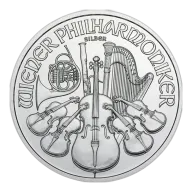
Both sides were designed by Thomas Pesendorfer, an Austrian Mint engraver, for the gold version's 1989 launch. The obverse depicts the pipe organ of the Musikverein's Golden Hall (Grosser Musikvereinssaal) in Vienna, built in 1870 and widely considered one of the finest concert halls in the world. The specific organ shown is the Rieger organ, installed in 1907. The reverse features an ensemble of instruments from the Vienna Philharmonic Orchestra: a cello at centre, flanked by four violins, with a Vienna horn (Wiener Horn), bassoon, and harp behind. The Wiener Horn is deliberately depicted rather than a standard French horn, reflecting the orchestra's commitment to historically informed performance practice and the instrument's warmer, rounder tone.
The design has remained completely unchanged since 1989, with only the year-date and the switch from Austrian schilling denominations to euro denominations (in 2002) as variations. This stability makes the Philharmonic one of the most recognisable bullion coins worldwide.
Philharmonic Tax Position by Country
The Philharmonic's tax treatment varies considerably depending on the buyer's location. Its Austrian legal tender status provides VAT exemption for gold in the EU, but the silver version attracts standard VAT rates in most European countries.
- United Kingdom: Silver Philharmonics are subject to 20% VAT on purchase. They are not CGT-exempt in the UK because they are not UK legal tender. The Silver Britannia is the only sovereign silver coin with UK CGT exemption.
- Austria and Germany: The home market. Gold Philharmonics are VAT-exempt under the EU Investment Gold Directive. Silver Philharmonics are subject to VAT, but German dealers commonly sell them under the margin scheme (Differenzbesteuerung) at an effective rate of approximately 7%, significantly below the standard 19% German VAT rate.
- European Union: Silver coins are subject to local VAT rates across EU member states (17-27%). The margin scheme is available in several countries including Germany, the Netherlands, and Spain for pre-owned or imported silver coins.
- United States: IRA-eligible. The 99.9% purity meets the IRS minimum of 99.9% for silver in a self-directed precious metals IRA. Capital gains are taxed at the collectibles rate of up to 28%. Sales tax varies by state.
- Australia: Silver at 99.9% purity qualifies as investment-grade precious metal and is GST-free.
- Canada: Silver bullion coins at 99.9% purity or above are GST/HST-exempt. The Philharmonic qualifies.
- Singapore: Qualifies as Investment Precious Metals (IPM) at 99.9% purity. GST-exempt. No capital gains tax.
- Hong Kong: No sales tax, no import duty, no capital gains tax.
- New Zealand: Fine silver at 99.9% purity is GST-exempt.
- South Africa: Silver bullion is subject to 15% VAT. No exemption for non-South African coins.
From Ransom Silver to Modern Bullion
The Austrian Mint's founding story begins in 1194, when Duke Leopold V of Austria received 12 tonnes of silver as ransom for King Richard I of England, who had been captured during the Third Crusade. That ransom funded the expansion of coin production in Vienna and established the institution that, over 800 years later, would produce the Philharmonic.
The gold Philharmonic was introduced on 10 October 1989, just weeks before the fall of the Berlin Wall. Named after the Vienna Philharmonic Orchestra, one of the world's most prestigious ensembles, the coin's cultural association gave it a distinctive identity in a market then dominated by the Krugerrand and Maple Leaf. The gold coin rapidly gained market share, becoming the world's best-selling gold bullion coin in 1992, 1995, 1996, and 2000.
The silver version arrived on 1 February 2008, timed to capitalise on the growing silver investment market. It launched with only the 1 oz denomination and the Austrian Mint has maintained this single-size approach, unlike mints that produce fractional or larger silver versions of their flagship coins. The simplicity has served the coin well commercially, with sales exceeding 84 million units in the first 15 years.
The Musikverein Golden Hall depicted on the obverse was built in 1870 and hosts the Vienna Philharmonic's annual New Year's Concert, broadcast to over 90 countries. The building's acoustics are regarded among the finest of any concert venue worldwide, a reputation that adds genuine cultural weight to the coin's imagery.
In 2004, the Austrian Mint produced 15 examples of a 1,000 troy ounce gold Philharmonic (approximately 31 kg), nicknamed the "Big Phil," with a face value of 100,000 EUR. At the time, it was the largest gold coin ever minted. The 1/25 oz denomination, introduced in 2014 for both gold and platinum, was designed as an affordable entry point for new European bullion investors.
Silver Philharmonic vs Britannia, Eagle, and Maple Leaf
The Philharmonic's primary competitive advantage is price. Among major sovereign silver coins, it consistently offers one of the lowest premiums over spot, making it the natural choice for buyers focused on maximising ounces. This comes at the cost of security features: the Philharmonic has no anti-counterfeiting technology comparable to the Britannia's latent image and surface animation, the Maple Leaf's MintShield and micro-engraving, or even the Perth Mint's micro-laser marks.
Against the 1 oz Silver Britannia, the Philharmonic is typically cheaper to buy, but the Britannia carries UK CGT exemption as legal tender. For UK investors selling at a gain, the Britannia's tax advantage can more than offset the higher purchase premium. The Britannia also features four visual security features from 2021 that make it substantially harder to counterfeit. For buyers outside the UK who do not benefit from CGT exemption, the Philharmonic's lower premium is the stronger argument.
The American Silver Eagle is the most traded silver coin globally but carries the highest premiums among sovereign coins (typically 20-30% over spot compared to the Philharmonic's 12-18%). For investors accumulating silver by weight, buying Philharmonics instead of Eagles can mean 10-15% more metal per dollar. The Eagle's advantage is unmatched liquidity in the US domestic market.
The Canadian Silver Maple Leaf at 99.99% purity is marginally purer than the Philharmonic's 99.9%, and includes MintShield anti-tarnish coating plus micro-engraved security marks. The Maple Leaf's premium sits between the Philharmonic and the Eagle, making it a middle-ground option that combines reasonable pricing with strong security and the highest available purity.
Within Europe specifically, the Philharmonic benefits from its euro denomination and strong distribution network. German investors can access it through the margin scheme at reduced effective VAT, giving it a meaningful cost advantage over importing non-EU silver coins. In Austria and neighbouring countries, the Philharmonic is the default silver bullion choice, much as the Britannia dominates the UK market.