2 products · 60 deals Prices & premiums exclude tax to compare across countries


Prices are fetched automatically and may not reflect current merchant prices. Currency conversions and tax treatment are approximate. Rankings are based solely on price. We are not a dealer and accept no responsibility for transactions with listed merchants. Past performance is not indicative of future results. This site does not provide investment advice. Full disclaimer
About the SA Mint Krugerrand Silver
The World's Most Famous Bullion Brand, in Silver
The Silver Krugerrand carries the most recognisable name in bullion. The gold version, first struck in 1967, created the modern gold bullion coin market and has sold over 60 million coins in its history. Every subsequent sovereign bullion coin, from the Canadian Maple Leaf (1979) to the Britannia (1987) to the Philharmonic (1989), was a direct competitive response to the Krugerrand's success.
The silver version arrived in 2017, marking the gold Krugerrand's 50th anniversary. It was the first Krugerrand to carry a face value denomination (R1 South African Rand), a detail that distinguishes it from the gold version, which has no face value and derives its legal tender status solely from its gold content. The silver coin is struck at 99.9% fine with a diameter of 38.7mm, slightly larger than the gold Krugerrand's 32.77mm.
The initial 2017 mintage was 1,000,000 Premium Uncirculated coins plus 15,000 proofs, and annual production has continued since. The Silver Krugerrand competes directly with the 1 oz Silver Philharmonic, 1 oz Silver Britannia, and other sovereign silver coins, drawing on the brand recognition that decades of gold Krugerrand trading have established.
The coin is produced by the South African Mint, which is wholly owned by the South African Reserve Bank. Production takes place at the SA Mint facility in Pretoria, with blank preparation handled by the Rand Refinery in Germiston. This sovereign backing gives the Silver Krugerrand the same institutional credibility as the gold version, even though the silver coin has a much shorter track record. The Krugerrand name alone opens doors at dealers worldwide that might be more cautious with products from less established mints.
Silver Krugerrand Technical Details
| Attribute | Value |
|---|---|
| Weight (fine silver) | 31.1g (1 troy oz) |
| Total Weight | 31.1g |
| Purity | 999 (99.9% fine silver) |
| Diameter | 38.7mm |
| Thickness | 2.84mm |
| Face Value | R1 (South African Rand) |
| Edge | Reeded (180 serrations bullion, 220 serrations proof) |
| First Year | 2017 |
Unlike the gold Krugerrand, which is 22-karat (91.67% gold alloyed with copper), the Silver Krugerrand is 99.9% pure silver with no alloy. This means the total coin weight equals the fine silver content, which is simpler than the gold version where each 1 oz coin weighs 33.93g total to contain exactly 1 troy ounce of fine gold.
Design
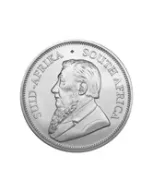
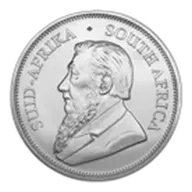
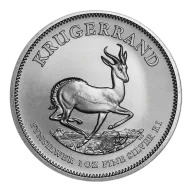
The obverse carries the portrait of Paul Kruger, President of the South African Republic, designed by Otto Schultz. The reverse depicts a springbok antelope in mid-leap, designed by Coert Steynberg. Both designs are the same as the gold version, with the addition of the R1 face value denomination on the reverse. The coin carries "KRUGERRAND" above the springbok and the fine silver weight below. The 2017 50th anniversary coins carry a discreet privy mark.
The design has been essentially unchanged since the gold version launched in 1967, making the Krugerrand one of the most stable and recognisable designs in the precious metals industry. The gold version's distinctive warm orange colour comes from its copper alloy; the silver version has the standard bright appearance of pure silver.
Silver Krugerrand Tax Treatment by Country
The Silver Krugerrand's tax position is notably less favourable than its gold counterpart in several key markets, particularly South Africa itself.
- South Africa: Gold Krugerrands are zero-rated for VAT under Section 11(1)(k) of the Value-Added Tax Act. Silver Krugerrands are not covered by this exemption and are subject to the full 15% VAT, despite being legal tender. This is a significant cost disadvantage for South African silver buyers. When selling back to a VAT-registered dealer, the VAT is partially recoverable through a VAT resale declaration.
- United Kingdom: Silver Krugerrands attract 20% VAT on purchase, the same as all silver bullion in the UK. They are not CGT-exempt because they are not UK legal tender. The Silver Britannia is the only sovereign silver coin with UK CGT exemption.
- United States: IRA-eligible. The 99.9% purity meets the IRS minimum for silver in a self-directed precious metals IRA. Sales tax varies by state, with most states exempting investment-grade silver bullion. Capital gains taxed at the collectibles rate of up to 28%.
- Canada: GST/HST-exempt for qualifying silver bullion at 99.9% purity or above. The Krugerrand qualifies.
- Australia: Silver at 99.9% purity qualifies as investment-grade and is GST-free. Subject to capital gains tax with a 50% discount for holdings over 12 months.
- European Union: Silver coins are subject to local VAT rates. Gold Krugerrands are listed on the annual EU investment gold coin list and are VAT-exempt; silver Krugerrands are not covered by this gold-specific exemption.
- Singapore: Qualifies as Investment Precious Metals (IPM) at 99.9% purity. GST-exempt. No capital gains tax.
- Hong Kong: No sales tax, no import duty, no capital gains tax.
- New Zealand: Fine silver at 99.9% purity is GST-exempt.
From Apartheid-Era Gold Icon to Modern Silver Coin
The Krugerrand's story begins on 3 July 1967, when the South African Mint struck the first 40,000 bullion coins plus 10,000 proof editions. It was a radical idea: a gold coin designed purely for investment, with no numismatic pretensions, marketed to ordinary people as a way to own gold. The strategy worked spectacularly. By 1980, the Krugerrand accounted for more than 90% of the global gold coin market.
The coin is named after Paul Kruger, president of the South African Republic (the pre-Union Transvaal state), and the Rand, South Africa's currency. The 22-karat composition was borrowed from the British Sovereign, providing durability for a coin designed to be handled and traded. The copper alloy gives the gold version its distinctive orange-gold colour, quite different from the pure yellow of 24-karat coins.
International sanctions during the apartheid era disrupted the Krugerrand's dominance. The United States enacted an import ban in 1985, and broader international restrictions followed. This created the opening for competing coins: Canada launched the Maple Leaf in 1979 specifically to capture investors who were concerned about purchasing South African gold. The sanctions were lifted in 1991, but by then the competitive landscape had permanently changed.
The silver version arrived in 2017 for the 50th anniversary, with an initial mintage of 1 million Premium Uncirculated coins. It was the first Krugerrand to bear a face value denomination (R1), breaking from the gold version's tradition of deriving legal tender status purely from gold content. A platinum version (R10 face value, 99.9% fine) was also introduced in 2017 in limited quantities.
Over 53 million troy ounces of gold Krugerrands, comprising more than 60 million individual coins including fractional sizes, had been sold by 2017. That accumulated production volume gives the Krugerrand name a secondary market depth that newer silver coins cannot match, even though the silver version itself is only a few years old.
Silver Krugerrand vs Britannia, Maple Leaf, and Eagle
The Silver Krugerrand enters a competitive field where it trades primarily on brand recognition rather than technical superiority. At 99.9% purity, it matches the 1 oz Silver Britannia and 1 oz Silver Philharmonic but falls short of the Canadian Silver Maple Leaf's 99.99% fine standard.
In security features, the Krugerrand is the least sophisticated of the major sovereign silver coins. It has no micro-engraving, no holographic element, no latent image, and no MintShield-type coating. Authentication relies on weight, dimensions, and the quality of the strike. For a coin with the Krugerrand's name recognition, this is a notable gap, particularly given that counterfeiting of gold Krugerrands is well-documented and the silver version inherits that targeting risk.
For UK buyers, the tax comparison with the Britannia is decisive. Both attract 20% VAT on purchase, but the Britannia is CGT-exempt as UK legal tender while the Krugerrand is not. A UK investor selling Silver Krugerrands at a gain above the annual CGT allowance (currently 3,000 GBP) faces a tax bill that Britannia holders avoid entirely.
Against the American Silver Eagle, the Krugerrand typically trades at lower premiums. The Eagle's premium (20-30% over spot) reflects its status as the most traded silver coin worldwide, with unmatched liquidity in the US domestic market. For non-US buyers, the Krugerrand offers comparable brand recognition at a more competitive price. The Krugerrand's advantage is the depth of dealer familiarity: the name is universally known from decades of gold trading, even if the silver coin itself has only been in production since 2017.
The 1 oz Silver Philharmonic is the Krugerrand's closest competitor on price, typically matching or slightly undercutting it in premium terms. The Philharmonic's edge is its euro denomination and strong European distribution network, particularly the margin scheme advantage available to German buyers. The Krugerrand's edge is brand recognition and a slightly larger secondary market.