

Prices are fetched automatically and may not reflect current merchant prices. Currency conversions and tax treatment are approximate. Rankings are based solely on price. We are not a dealer and accept no responsibility for transactions with listed merchants. Past performance is not indicative of future results. This site does not provide investment advice. Full disclaimer
About the Silver Buffalo Round Silver
The Silver Buffalo Round
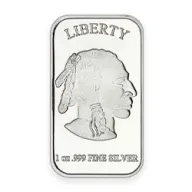
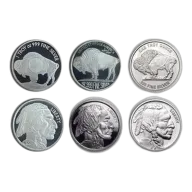
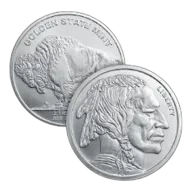
The Silver Buffalo round is the most widely traded generic silver round in the world. It reproduces James Earle Fraser's 1913 Buffalo Nickel design, which the US Mint struck from 1913 to 1938 and which entered the public domain, allowing any private mint to use it freely. The result is a near-commodity product: dozens of mints produce buffalo rounds to identical specifications, and dealers routinely sell them as "random mint," meaning the buyer may receive product from SilverTowne, Golden State Mint, Mason Mint, Highland Mint, Sunshine Minting, or others.
This fungibility is the buffalo round's defining feature. Because dealers can source from whichever manufacturer offers the lowest price, the savings pass to the buyer. The 1 oz Silver Buffalo round consistently trades at the lowest premiums of any .999 silver product in a standardised format. For buyers whose goal is to accumulate the most silver per dollar spent, the buffalo round is the benchmark product against which everything else is measured.
The trade-off is straightforward. Buffalo rounds carry no legal tender status, no face value, no government backing, and no standardised security features. Authentication relies on weight, dimensions, and composition testing. Resale premiums are lower than sovereign coins: dealers buy buffalos at approximately spot minus 2-5%, compared to tighter spreads on products like the American Silver Eagle or Canadian Maple Leaf. The buy-sell spread means silver must appreciate further before a buffalo round investor breaks even, compared to a sovereign coin holder. But the lower entry premium partially offsets this, since the buyer pays less above spot to begin with.
Available in sizes from 1/10 oz fractionals through 10 oz, with tubes of 20 and monster boxes of 500 as standard packaging, the buffalo round covers the full range from small-scale collecting to serious weight accumulation. Some mints produce variations including proof finishes, antique patina, radial line backgrounds, and stackable rim versions, but the standard BU 1 oz remains the volume product.
Standard 1 oz Silver Buffalo Round
| Attribute | Value |
|---|---|
| Weight | 1 troy oz (31.1g) |
| Purity | .999 fine silver |
| Diameter | 39 mm (typical) |
| Thickness | ~3 mm (varies by mint) |
| Edge | Reeded (most mints) |
| Legal Tender | No |
Available Sizes
- 1/10 oz (fractional)
- 1/4 oz (fractional)
- 1/2 oz
- 1 oz (standard)
- 2 oz
- 5 oz
- 10 oz
Packaging
- Individual: plastic flips
- Bulk: tubes of 20
- Monster boxes: 500 rounds (25 tubes of 20)
Exact dimensions, edge detail, and mint marks vary by manufacturer since there is no single issuer. Weight and purity are consistent across manufacturers: .999 fine silver at stated weights. Some newer versions from specific mints include radial line patterns or privy marks, but these are manufacturer-specific rather than series-wide features.
Authentication
With no standardised security features across manufacturers, authentication relies on physical testing: weight, dimensions, and magnetic properties for basic checks; Sigma Metalytics or XRF analysers for compositional verification. The lack of advanced anti-counterfeiting features is one reason buffalo rounds trade at lower premiums than government coins with features like the Maple Leaf's MicroEngraved security mark or the Britannia's latent image.
Silver Buffalo Round Tax Treatment by Country
As private mint rounds with no legal tender status, no face value, and no government backing, buffalo rounds follow the standard generic silver bullion tax treatment in all jurisdictions. This is identical to any non-sovereign silver product.
United States
No federal sales tax. State sales tax varies, with roughly 35 states exempting investment bullion. Many buffalo rounds are IRA-eligible when .999+ fine from an accredited or certified manufacturer, but not all manufacturers meet IRA custodian requirements. Dealers specify IRA eligibility on individual listings. Capital gains on silver are taxed at the collectibles rate of up to 28%. The random-mint nature of buffalo purchases means IRA buyers should confirm the specific manufacturer's eligibility.
United Kingdom
Silver rounds carry 20% VAT on purchase. No investment silver exemption applies. No CGT exemption since the rounds are not UK legal tender. The 20% VAT makes buffalo rounds a particularly poor choice for UK buyers: the upfront tax eats into the very premium advantage that makes buffalos attractive. UK investors seeking cost-efficient silver should consider silver Britannias (CGT-exempt) or margin scheme silver from dealers like Chards.
Canada
Silver at 99.9% purity or higher is GST/HST-exempt. The .999 purity qualifies. Capital gains follow the 50% inclusion rate. Canada is one of the few countries where generic silver rounds receive the same purchase-tax treatment as sovereign coins.
Australia
Investment-grade silver at 99.9% purity or higher is GST-free. The .999 purity meets this threshold. A 50% CGT discount applies for holdings over 12 months.
New Zealand
Silver at 99.9% purity or higher is GST-exempt. No formal capital gains tax.
Singapore
The IPM scheme's requirements for silver may not straightforwardly cover "rounds" (which are neither bars nor legal tender coins). GST status depends on IRAS interpretation. Buyers should confirm before purchase.
Hong Kong
No sales tax, import duty, or capital gains tax. Fully tax-free.
European Union
Silver rounds are subject to the standard VAT rate of the member state (17-27%). No investment silver exemption applies.
Fraser's Buffalo Nickel and Its Afterlife in Silver
The design that graces millions of silver rounds was created in 1913 by James Earle Fraser for the US Mint. Fraser, one of the most important American sculptors of the early 20th century (he also created "End of the Trail," the iconic 1915 sculpture of a Native American on horseback), designed both sides of the coin from life. The obverse portrait is a composite of three Native American sitters: Iron Tail of the Oglala Lakota, Two Moons of the Northern Cheyenne, and John Big Tree of the Seneca, though Big Tree's involvement has been historically debated. The reverse depicts an American bison modelled after Black Diamond, a bison at the Central Park Zoo in New York City.
The Buffalo Nickel was minted from 1913 to 1938 and is considered one of the most artistically accomplished US coin designs. When the design entered the public domain, private mints adopted it for silver rounds beginning in the early 1980s, following the 1979-1980 silver price spike that created demand for affordable physical silver products. The Buffalo Nickel design was ideal for this purpose: instantly recognisable, culturally significant, and free of any copyright restrictions.
The US Mint itself revived Fraser's design in 2006 for the American Gold Buffalo, a 1 oz .9999 gold coin that became one of the most popular gold bullion coins in the world. In 2008, a silver proof version was briefly minted. These government revivals renewed interest in the design and cemented the buffalo as the definitive American bullion motif alongside the Eagle.
Since the 1980s, the "random mint" sales model has created a quasi-commodity market for buffalo rounds. Multiple manufacturers produce essentially the same product, dealers source from the cheapest available supplier, and buyers receive interchangeable units regardless of manufacturer. This commoditisation is what drives the consistently low premiums. Some mints have introduced variations including dated versions (with a production year stamp), stackable rim versions with thicker edges for stable storage, and radial line backgrounds, but the core design and specifications remain standardised across the market.
Buffalo Rounds vs Silver Eagle, Maple Leaf, and Branded Alternatives
The American Silver Eagle is the most direct high-end comparison. The Eagle is the US government's official silver bullion coin with legal tender status, a $1 face value, government backing, and the potential for PCGS or NGC grading. Eagles carry premiums significantly higher than buffalo rounds. For pure silver accumulation per dollar, buffalo rounds deliver more metal. The Eagle's advantages are liquidity, resale premiums, and the institutional trust of a government-issued product.
The Canadian Silver Maple Leaf shares the same dynamic but adds .9999 purity (versus .999 for most buffalo rounds), the MicroEngraved maple leaf security mark, and $5 CAD legal tender status. The Maple Leaf's higher purity is marginally better but functionally irrelevant for most buyers. Its security features and sovereign status command a premium that the buffalo round avoids. For Canadian buyers, the Maple Leaf's identical GST/HST exemption to generic rounds removes one of the buffalo's usual advantages.
The SilverTowne Buffalo is one of the most established branded versions of the buffalo round. Buying "SilverTowne Buffalo" guarantees a specific manufacturer with a minting history dating to 1973, whereas "random mint" buffalo rounds may come from any manufacturer. The premium difference is typically negligible, but guaranteed-manufacturer purchases provide more certainty about quality consistency.
Against other generic round designs (Walking Liberty, Morgan, etc.), buffalo rounds carry identical or marginally lower premiums. The choice is purely aesthetic. The buffalo is the most liquid and recognisable generic design, which gives it a slight edge on resale. No generic round, regardless of design, matches the liquidity of sovereign coins, but the buffalo comes the closest.
The Scottsdale Cowboy represents a newer category of "premium generic" rounds. At .9999 purity with multiple finish options and a distinctive theme, the Cowboy round commands a modest premium above buffalo rounds while remaining cheaper than sovereign coins. For buyers who want more character than a generic buffalo but less cost than an Eagle or Maple Leaf, the Cowboy occupies a middle ground.
Silver Buffalo Round Silver: frequently asked questions
-
Silver Buffalo rounds carry some of the lowest premiums available for physical silver. The current silver spot price is $67.63, and these rounds typically trade a small margin above that. We track 14 listings from 11 dealers on this page, so you can compare current offers directly.
-
A Silver Buffalo round is a 1 oz .999 fine silver privately minted round whose design reproduces James Earle Fraser's Buffalo Nickel (1913). Multiple private mints produce them, including CNT, Golden State Mint, SilverTowne, and others. They carry no face value and no government backing. When dealers sell them as "random mint," the manufacturer may vary.
-
Both contain 1 oz of fine silver, but Silver Eagles are struck by the US Mint, carry a $1 face value as legal tender, and typically command a higher premium over spot. Buffalo rounds are privately minted generic silver with no face value and lower premiums, making them a cost-efficient choice for buyers focused on accumulating silver weight rather than legal tender status.
-
The COPY stamp is a legal requirement, not a sign of fraud. The US Hobby Protection Act requires that reproductions of genuine US coins be marked COPY. Since the Buffalo Nickel was a US Mint coin, some manufacturers apply the stamp to stay compliant. These are legal reproductions, not counterfeits. However, the stamp can reduce resale appeal, so buyers should verify weight (31.1 g) and purity (.999) using a scale or acid test.