1 product · 48 deals
Filters
| Product | /oz | Premium | Price | |
|---|---|---|---|---|

48 deals
|
$78.70 | +18.06% |
$78.70
£59
|
Compare |
Prices are fetched automatically and may not reflect current merchant prices. Currency conversions and tax treatment are approximate. Rankings are based solely on price. We are not a dealer and accept no responsibility for transactions with listed merchants. Past performance is not indicative of future results. This site does not provide investment advice. Full disclaimer
About the American Eagle Silver
The American Silver Eagle
The American Silver Eagle (ASE) is the world's best-selling silver bullion coin. Authorised by the Liberty Coin Act of 1985 and first struck in 1986, it is produced by the United States Mint with its weight, content, and purity guaranteed by the US government. Each coin contains one troy ounce of .999 fine silver and carries a face value of $1, making it legal tender of the United States.
The ASE's dominance in the silver market rests on several advantages. It is IRA eligible, qualifying for tax-advantaged US retirement accounts under IRS Section 408(m). It has the deepest dealer network and tightest bid-ask spreads of any silver coin in North America. And it carries the strongest brand recognition among US investors, making it the easiest silver coin to buy and sell at virtually any bullion dealer in the country.
The trade-off for these advantages is premium. Silver Eagles consistently carry the highest premiums among sovereign silver coins, typically 20% to 30% above spot in normal market conditions. During demand spikes like March 2020 and early 2021, premiums surged past 50%. Investors who prioritise ounces-per-dollar over brand and liquidity may find better value in the Silver Maple Leaf, Silver Philharmonic, or Silver Britannia, all of which trade at lower premiums. The Eagle's counter-argument is that it also commands higher buyback prices, partially offsetting the entry cost.
In 2021, the ASE underwent its first design change since launch. The original Type I reverse by John Mercanti (a heraldic eagle with shield, the most reproduced coin image in history) was replaced by the Type II reverse designed by Emily Damstra, showing an eagle landing with an oak branch. The transition year saw both types minted, making 2021 coins sought by collectors. Type II coins also introduced an anti-counterfeiting reed pattern on the edge, with a specific missing-reed position that varies by year.
American Silver Eagle Specifications
| Specification | Detail |
|---|---|
| Weight | 31.103 g (1 troy oz) |
| Purity | .999 fine silver |
| Diameter | 40.6 mm |
| Thickness | 2.98 mm |
| Face Value | $1 USD |
| Edge | Reeded (anti-counterfeiting notch added 2021+) |
| Obverse | Walking Liberty by Adolph A. Weinman (from the 1916-1947 half dollar) |
| Reverse (Type I, 1986-2021) | Heraldic eagle with shield by John Mercanti |
| Reverse (Type II, 2021-present) | Eagle landing with oak branch by Emily Damstra |
| Mint | US Mint (West Point, Philadelphia, San Francisco) |
| First Year | 1986 |
| Status | In production |
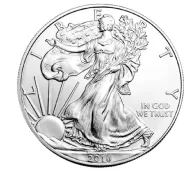
The obverse has remained unchanged since 1986: Adolph A. Weinman's Walking Liberty design, originally created for the 1916 half dollar. This iconic figure of Liberty striding toward the sunrise is one of the most admired coin designs in American numismatic history.
Production peaked at 47 million coins in 2015. During the 2008 financial crisis, demand surged with the 1 oz gold version exceeding 1.4 million pieces. The ASE is struck from silver originally mandated from the US Defense National Stockpile under the Strategic and Critical Materials Stock Piling Revision Act.
Silver Eagle Tax Treatment by Country
The American Silver Eagle's legal tender status, IRA eligibility, and government guarantee create a distinctive tax profile, particularly in the United States. The Eagle is one of the most tax-advantaged silver investments for US buyers, but it carries no special exemptions in most foreign jurisdictions.
Country-by-Country Summary
- United States: No federal sales tax. Most states exempt investment-grade precious metals; approximately 35 states fully exempt bullion, with threshold-based exemptions in California (over $2,000), Florida (over $500), Louisiana, Massachusetts, and New York (over $1,000 each). IRA eligible under IRS Section 408(m), with a special exemption: American Eagles qualify regardless of purity (the 22-karat Gold Eagle is specifically named as exempt from the normal 99.5% gold purity requirement). Silver Eagles meet the standard 99.9% silver threshold directly. Capital gains taxed at the collectibles rate of up to 28%. Dealers must file IRS Form 1099-B for certain bulk sales, though Silver Eagles specifically have no 1099-B trigger quantity.
- United Kingdom: Silver Eagles are subject to 20% VAT on purchase. Not UK legal tender, so not CGT exempt (only UK Royal Mint coins qualify). Pre-owned Eagles may be available under the margin scheme from some dealers.
- Canada: The 999 purity meets the 99.9% GST/HST exemption threshold. As a foreign sovereign coin in bar/coin form, Eagles should qualify for exemption, though they are not eligible for RRSP (only Canadian-minted products qualify).
- Australia: The 999 purity meets the 99.9% silver threshold for GST exemption. Subject to CGT with 50% discount for holdings over 12 months.
- New Zealand: GST exempt for silver at 99.9% purity or above. No capital gains tax.
- Singapore: Qualifies for IPM GST exemption at 999 purity as legal tender. No CGT.
- Hong Kong: No sales tax, import duty, or capital gains tax.
- South Africa: 15% VAT on silver. No exemption for foreign coins.
- EU: Silver subject to local VAT rates. Some EU countries offer margin scheme on secondary-market coins.
Walking Liberty to Type II: 40 Years of the Silver Eagle
The American Silver Eagle programme was born from two pieces of legislation in 1985. The Gold Bullion Coin Act created the Gold Eagle, and the Liberty Coin Act authorised the Silver Eagle. Both entered production in 1986, establishing the American Eagle as a two-metal franchise that expanded to platinum in 1997.
The obverse design was not new. Adolph A. Weinman's Walking Liberty had appeared on the half dollar from 1916 to 1947 and was already considered one of the finest American coin designs. Repurposing it for the Silver Eagle gave the new bullion coin instant visual authority. The reverse was a fresh creation by John Mercanti, then a sculptor-engraver at the US Mint and later its 12th Chief Engraver. Mercanti's heraldic eagle with thirteen stars became the most reproduced coin design in history, appearing on every Silver Eagle minted from 1986 through mid-2021.
For 35 years, neither side of the coin changed. This consistency built the Silver Eagle's identity as a bullion product: instantly recognisable, easy to authenticate, and universally accepted. The design stability mirrored the approach of the Canadian Maple Leaf and Austrian Philharmonic.
The 2021 redesign broke that streak. The Type II reverse, designed by Emily Damstra and sculpted by Michael Gaudioso, replaced the heraldic eagle with a close-up of an eagle landing while clutching an oak branch. The transition was staggered: Type I coins were produced in the first half of 2021, Type II in the second half. Both versions from 2021 became collector items. The Type II also introduced an anti-counterfeiting reed pattern on the coin's edge, with a specific missing-reed position that changes annually, providing year-specific authentication.
Mintage has fluctuated with market conditions. The 2015 peak of 47 million coins dwarfs the early years. Demand surges correlate with economic uncertainty: the 2008 financial crisis, the 2020 pandemic, and the 2021 retail investor movement all drove sharp increases. The ASE's role as a crisis-demand product reinforces its liquidity advantage, since high production volumes mean large dealer inventories and tight spreads.
Silver Eagle vs Maple Leaf, Britannia, and Philharmonic
The American Silver Eagle competes with three other major sovereign silver coins: the Canadian Maple Leaf, the British Britannia, and the Austrian Philharmonic. Each has different strengths depending on the buyer's priorities.
The Silver Maple Leaf is the Eagle's closest rival in North America. It offers higher purity (9999 vs 999), advanced security features (MicroEngraved maple leaf privy mark and Bullion DNA verification), and consistently lower premiums. For Canadian buyers, the Maple Leaf is RRSP eligible, an advantage the Eagle cannot match. The Eagle's counter-advantages are IRA eligibility in the US, stronger brand recognition domestically, and higher buyback prices from US dealers.
The Silver Britannia carries a specific advantage for UK buyers: CGT exemption as UK legal tender. The Britannia moved to 999 purity in 2013 (from 958 Britannia silver) and added a four-feature security suite in 2021. It typically trades at lower premiums than the Eagle in UK markets. For non-UK buyers, the Britannia has less brand cachet than the Eagle or Maple Leaf, though its security features are the most advanced of any silver bullion coin.
The Silver Philharmonic from the Austrian Mint is consistently among the lowest-premium sovereign silver coins, trading 12% to 18% above spot versus the Eagle's 20% to 30%. For investors who prioritise minimising premiums while retaining sovereign coin status, the Philharmonic offers strong value. It carries a EUR 1.50 face value and 999 purity.
The Armenian Noah's Ark and Armenian Mint Noah's Ark provide an even lower-premium alternative with legal tender status. In European markets particularly, Noah's Ark coins can be purchased under margin scheme VAT treatment, making them competitive on total cost even against the Philharmonic.
The Eagle's IRA eligibility is its strongest structural advantage in the US market. No other foreign sovereign silver coin carries this status by name in IRS regulations (though coins meeting the 99.9% silver threshold from approved sources may also qualify through custodian approval). For US investors building retirement-account positions in physical silver, the Eagle is the default choice.