

Prices are fetched automatically and may not reflect current merchant prices. Currency conversions and tax treatment are approximate. Rankings are based solely on price. We are not a dealer and accept no responsibility for transactions with listed merchants. Past performance is not indicative of future results. This site does not provide investment advice. Full disclaimer
About the Somalia Elephant Silver
Annual-Design Bullion from an 850-Year-Old Mint
The Somalia Elephant is an annual-design bullion coin series produced by the Bayerisches Hauptmunzamt (Bavarian State Mint) in Munich, Germany. The mint has been in continuous operation since 1158, making it one of the oldest minting institutions in the world. Each year since 2004, the reverse has featured an entirely new depiction of African elephants in their natural habitat, giving the series strong crossover appeal between the bullion and collector markets.
The series actually began in 1999 under Zambia, with coins denominated in Zambian Kwacha. In 2004, the issuing authority changed to the Republic of Somalia, with coins now denominated in Somali Shillings. The circumstances of this transition are unusual: there is no public evidence that the Bavarian State Mint received formal authorisation from Somalia's Central Bank, and the Central Bank has reportedly never acknowledged these coins as its own legal tender issues. Despite this contested status, the coins are accepted and traded as bullion by every major dealer worldwide.
Silver Elephants are struck in .999 fine silver, with the 1 oz coin being the most widely traded size. The range extends from fractional sizes (1/4 oz, 1/2 oz) introduced in 2017, through mid-weight options (2 oz, 5 oz), up to the 1 Kilo coin for larger purchases. Gold versions are also produced in .9999 fine, with the 1 oz gold Elephant and an exceptionally wide range of fractional gold sizes including 1/50 oz and 0.5g denominations.
Production has grown from roughly 5,000 coins annually in the early years to over 130,000 per year, reflecting the series' increasing popularity. The annual design change is the primary driver of this demand, as older vintages command progressively higher premiums on the secondary market.
Somalia Elephant Denominations
Silver (999 fine)
| Size | Face Value | Diameter | Thickness |
|---|---|---|---|
| 1/4 oz | - | - | - |
| 1/2 oz | - | - | - |
| 1 oz | 100 Shillings | 39.00 mm | 3.00 mm |
| 2 oz | - | - | - |
| 5 oz | - | - | - |
| 10 oz | 1,000 Shillings | - | - |
| 1 kg | 2,000 Shillings | - | - |
The fractional ounce sizes (1/4 oz, 1/2 oz) were added to the silver range in 2017. Pre-2006 coins carried a 1,000 Shillings face value for the 1 oz size; this was reduced to 100 Shillings from 2006 onward, likely to avoid inflated face value denominations as the range expanded.
Gold (999.9 fine)
| Size | Face Value |
|---|---|
| 0.5g | - |
| 1/50 oz | - |
| 1/25 oz | - |
| 1/10 oz | - |
| 1/4 oz | - |
| 1/2 oz | - |
| 1 oz | 1,000 Shillings |
The gold series offers one of the widest ranges of fractional sizes of any bullion coin series, with the 1/50 oz and 0.5g denominations among the smallest fractional bullion coins available globally. Platinum versions (999.5 fine) have been produced in 1 oz for some years. Silver purity is .999 (three nines); some dealer listings state .9999 but the standard production specification from the Bavarian State Mint is .999.
The coins carry no proprietary anti-counterfeiting features such as latent images, micro-text, or holographic elements. The annual design change itself provides a degree of authentication, as counterfeiters must produce new dies for each vintage. Coins are sold individually, in tubes of 20, or in monster boxes of 500.
Tax and Legal Status of Somalia Elephant Coins
The legal tender status of Somalia Elephant coins is contested. The coins are denominated in Somali Shillings and bear the Somali Republic coat of arms, but Somalia's Central Bank has not formally endorsed or distributed them. The Somali Shilling itself has been largely worthless in practical terms since the 1991 civil war, so the face value carries no real spending power. The bullion market treats the coins as legal tender based on their markings.
United States
Somalia Elephant coins are not IRA-eligible. Despite meeting the .999 silver purity standard (which exceeds the IRS minimum of 99.9% for silver), the IRS considers them collectibles due to their high premiums over spot and collector appeal. Capital gains are taxed at the federal collectibles rate of 28% for long-term holdings. State sales tax varies, with approximately 35 states exempting bullion purchases.
European Union
Gold versions of the Somalia Elephant are listed on the EU's annual investment gold exempt list, with certain Somali Shilling denominations qualifying for 0% VAT across the EU. Silver versions are subject to the standard VAT rate of the buyer's country: 19% in Germany, 20% in France, 21% in the Netherlands and Belgium, and up to 27% in Hungary. The German margin scheme (Differenzbesteuerung) is commonly applied to pre-owned silver Elephants, reducing the effective VAT to the dealer's margin only.
United Kingdom
Gold Elephants are VAT-exempt as investment gold (they appear on the EU investment gold list, which the UK still recognises). Silver Elephants are subject to 20% VAT on new purchases, with the margin scheme available for pre-owned coins. The coins are not CGT-exempt since they are not UK legal tender.
Other Markets
In Canada, silver coins at 99.9%+ purity are exempt from GST/HST. In Australia, silver at 99.9%+ purity is GST-free. Singapore exempts qualifying IPM silver from GST. Hong Kong charges no sales tax. South Africa charges 15% VAT on all silver bullion.
From Zambia to Somalia: An Unusual Numismatic Journey
The Somalia Elephant series has one of the more unusual origin stories in modern bullion. The coins were not created at the request of the Somali government. They emerged from a commercial arrangement between the Bavarian State Mint and the former issuing authority of Zambia, then transferred to Somalia under circumstances that remain opaque.
The first coins appeared in 1999 bearing Zambian markings, with a different obverse featuring the Zambian coat of arms. These early Zambian issues had extremely low mintages of roughly 5,000 coins per year, making them highly sought after by collectors today. The transition to Somali denominations occurred in 2004, with the obverse changing to the Somali Republic coat of arms: a shield with a central star, supported by two leopards standing on crossed spears with palm fronds.
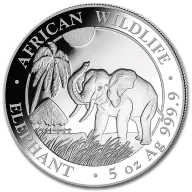
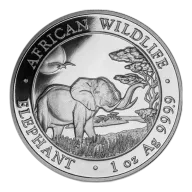
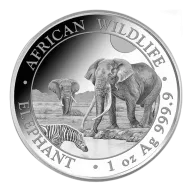
The design concept has remained consistent since inception: the reverse features African elephants in a new scene each year, depicted in their natural habitat in various poses, from solitary adults at watering holes to family groups with calves. The inscriptions "AFRICAN WILDLIFE" and "ELEPHANT" appear alongside weight and purity markings. This annual design change is the foundation of the series' collector appeal, as each vintage becomes a distinct item on the secondary market.
The Bavarian State Mint itself is a regular Eurozone coin producer for Germany, giving it sovereign mint credibility. It has operated since 1158, predating the formation of modern Germany by over seven centuries. German distribution of the Somalia Elephant series is handled by Emporium Hamburg through B.H. Mayer's Kunstprageanstalt as authorised distributor.
Special editions have appeared in various years, including privy-mark editions, gilded versions, and antiqued-finish variants. The Bavarian State Mint has also launched a companion series, the Somalia Leopard, using the same format of annual design changes with the Somali Republic obverse.
Somalia Elephant vs Other Annual-Design Silver Coins
The Somalia Elephant occupies a distinctive position in the bullion market: it is a collector-bullion crossover product, valued both for its silver content and for the secondary market premiums that annual design changes generate. This combination has advantages and significant trade-offs compared to alternatives.
Against the Silver Britannia, the Elephant trades collector appeal for tax efficiency. The Britannia is CGT-exempt for UK residents and carries four layers of anti-counterfeiting security, but its design changes are less dramatic and do not generate the same vintage premiums. The Britannia's premiums over spot are typically moderate, while Elephant premiums are moderate to high, reflecting the collector element.
The Perth Mint Kookaburra shares the annual design change format. Both series command moderate-to-high premiums and attract buyers interested in collecting complete year sets. The Kookaburra has the advantage of genuine sovereign legal tender status (Australian dollar denomination) and Perth Mint's micro-laser authentication feature. The Elephant counters with the Bavarian State Mint's 850+ year heritage and the more dramatic design variations between vintages.
For buyers focused purely on silver accumulation, the Walking Liberty round sits at the opposite end of the spectrum. Walking Liberty rounds trade at the lowest premiums in the market, with no collector appeal or legal tender status. The Elephant's higher premiums only make economic sense if the buyer values the annual design collectibility or plans to hold specific vintages for secondary market appreciation.
The Armenian Noah's Ark offers lower premiums with a static design, positioning it as a budget sovereign coin. It lacks the collector dimension entirely but delivers more silver per dollar spent. The South African Silver Krugerrand, introduced in 2017 with a static design, similarly prioritises low premiums over collectibility.
One clear disadvantage of the Elephant is its IRA ineligibility in the US. Buyers seeking tax-advantaged retirement account holdings should look to the American Silver Eagle or Canadian Maple Leaf instead. The contested legal tender status, while immaterial for trading purposes, also means the coins carry no CGT exemption in the UK and may face varying treatment in other jurisdictions.
Somalia Elephant Silver: frequently asked questions
-
The Somalia Elephant is an annual bullion coin series produced by the Bavarian State Mint in Munich, Germany, issued under the Somali Republic. Each year the reverse features a completely new African elephant design, making it part of the broader African Wildlife programme. Originally issued for Zambia from 1999 to 2003, the series transitioned to Somalia from 2004 onward and is widely traded by major dealers worldwide.
-
Prices track the live $67.63 spot price plus a dealer premium. We compare listings across 4 dealers carrying 11 Somalia Elephant products, so you can see the full range at a glance. Gold and silver versions carry different premiums; older annual designs with lower mintages often trade at a higher premium on the secondary market.
-
Yes. Each annual release features a completely new reverse design depicting African elephants in a different scene from their natural habitat. The coins are investment bullion rather than numismatic collectibles, but the annually rotating design is the series' primary collector appeal. Earlier years, particularly the original Zambian issues from 1999 to 2003, command significant premiums due to their low mintages.
-
The series spans gold (999.9 fine) and silver (999 fine), with a 1 oz platinum version in some years. Gold runs from fractional sizes as small as 1/50 oz up to 1 kg. Silver includes 1/10 oz, 1/4 oz, 1/2 oz, 1 oz, 2 oz, 5 oz, 10 oz, and 1 kg, with fractional silver sizes introduced from 2017. We currently track 11 listings across both metals.