0 products · 0 deals
Filters
No products match your filters.
Prices are fetched automatically and may not reflect current merchant prices. Currency conversions and tax treatment are approximate. Rankings are based solely on price. We are not a dealer and accept no responsibility for transactions with listed merchants. Past performance is not indicative of future results. This site does not provide investment advice. Full disclaimer
About the Two Dragons Silver
The Royal Mint's Dual-Dragon Bullion Coin
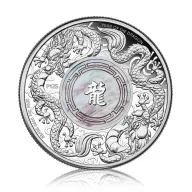
The Two Dragons is a 2018 one-off bullion release from The Royal Mint, issued in both 1 oz gold and 1 oz silver. Designed by Timothy Noad, a heraldic artist who holds the title of Herald Painter and Scrivener at the College of Arms in London, the coin features two culturally significant dragons arranged in a yin-and-yang composition: the Welsh dragon (Y Ddraig Goch) and the Chinese dragon.
The coin was issued to coincide with The Royal Mint's 50th anniversary at its Llantrisant headquarters in South Wales, a facility the Mint moved to in 1968. The choice to pair the Welsh and Chinese dragons was not arbitrary: the Welsh dragon represents the homeland of the modern Royal Mint, while the Chinese dragon reflects the Mint's expanding presence in Asian bullion markets. The yin-yang arrangement symbolises cultural balance between East and West.
With a worldwide mintage of 50,000 for the silver coin and just 5,000 for the gold, the Two Dragons was produced in quantities far below the Silver Britannia's unlimited production. The 5,000-piece gold mintage is among the lowest for any 1 oz gold bullion coin from a major government mint. Both versions are UK legal tender (silver at £2, gold at £100), carrying the same CGT exemption as the Britannia and Sovereign for UK residents.
This was a one-time release. No subsequent editions have been produced, and The Royal Mint has not indicated plans to continue the series. As a result, the Two Dragons has become a collector item on the secondary market, with premiums increasing since the original mintage sold out. Buyers considering the Two Dragons should be aware they are purchasing a limited-edition collectible with bullion content, not a regularly produced bullion coin that can be acquired at standard premiums.
Two Dragons Coin Specifications
| Attribute | 1 oz Silver | 1 oz Gold |
|---|---|---|
| Weight | 31.21 g (1 troy oz) | 31.21 g (1 troy oz) |
| Purity | .999 fine silver | .9999 fine gold |
| Diameter | 38.61 mm | 32.69 mm |
| Face value | £2 (Two Pounds) | £100 (One Hundred Pounds) |
| Mintage | 50,000 worldwide | 5,000 worldwide |
| Finish | Bullion (BU) | Bullion (BU) |
| Designer | Timothy Noad | Timothy Noad |
| Mint | The Royal Mint, Llantrisant | The Royal Mint, Llantrisant |
Design Details
The reverse features two dragons in a circular arrangement deliberately echoing the yin-yang symbol. The Chinese dragon occupies the top half, moving left to right and looking back. The Welsh dragon occupies the bottom half, moving right to left, also looking back. The inscription "TWO DRAGONS" runs between them. The composition creates a sense of balanced opposition, with each dragon curling into the space left by the other.
The obverse features the fifth and final official UK coin portrait of Queen Elizabeth II by Jody Clark, surrounded by a textured guilloche background, an ornamental pattern of interlaced ribbons not commonly seen on bullion coins. This decorative background is a distinctive feature of the Two Dragons that sets it apart visually from the cleaner fields of the Britannia or Sovereign.
The silver version at .999 purity follows the Royal Mint's standard for silver bullion (matching the Britannia), rather than the .9999 standard used by some international competitors like the Canadian Maple Leaf.
Two Dragons Tax Treatment by Country
Both the gold and silver Two Dragons are UK legal tender, struck by The Royal Mint with face values denominated in pounds sterling. This provides specific tax advantages for UK buyers that many other bullion coins cannot match.
United Kingdom
Both versions are CGT-exempt for UK individuals, as all UK legal tender coins are exempt from Capital Gains Tax regardless of their metal content. This is the same exemption that applies to the Gold Britannia and Gold Sovereign. The gold version is VAT-free as investment gold. The silver version is subject to 20% VAT, though most UK dealers sell silver under the VAT margin scheme (VAT charged only on the dealer's margin, not the full price), significantly reducing the effective tax burden on pre-owned pieces.
United States
No federal precious metals sales tax. State sales tax exemptions vary. The .999 silver meets the purity threshold for potential IRA eligibility, though the limited-edition nature and collector premiums may affect some custodians' willingness to accept it. The .9999 gold exceeds the .995 threshold. Federal capital gains on precious metals are taxed at the collectibles rate of up to 28% for long-term holdings.
EU Countries
Investment gold meeting the EU Directive 98/80/EC criteria is VAT-exempt. The gold Two Dragons at .9999 purity and legal tender status qualifies. Silver is subject to local VAT rates (17% to 27%), with margin scheme available in some countries for secondary market sales.
Australia
Gold is GST-free as investment-grade precious metal. Silver at .999 purity meets the 99.9% threshold for GST exemption.
Hong Kong and Singapore
Hong Kong has no sales tax on precious metals. In Singapore, investment gold and silver meeting the IPM purity thresholds are GST-exempt. The dual-dragon design resonates in Asian markets, where dragon symbolism carries cultural significance.
Welsh and Chinese Dragons in Heraldic Art
The Welsh dragon (Y Ddraig Goch, "the red dragon") has been a symbol of Wales since at least the early medieval period. It appears on the Welsh flag, the only national flag in the United Kingdom to feature a dragon. The earliest references to the red dragon as a Welsh symbol date to the Historia Brittonum (c. 829 AD), which tells of a red dragon battling a white dragon beneath the fortress of Dinas Emrys. Welsh legend associates the red dragon with the native Britons resisting Saxon invasion.
The Chinese dragon (long or lung) is one of the most enduring symbols in Chinese mythology, representing power, strength, and good fortune. Unlike Western dragon traditions where dragons are typically portrayed as adversaries, the Chinese dragon is a benevolent creature associated with water, weather, and imperial authority. Dragon imagery has been central to Chinese culture for thousands of years, appearing in architecture, textiles, ceramics, and festivals.
Timothy Noad's design brings these two dragon traditions together in a single composition. His credentials for the task were unusual among bullion coin designers: as Herald Painter and Scrivener at the College of Arms, he is responsible for painting new coats of arms and scribing royal charters, making him one of the most formally trained heraldic artists in the world. The yin-yang arrangement he chose reflects the complementary rather than competing nature of the two cultural symbols.
The 2018 release coincided with The Royal Mint's 50th anniversary at Llantrisant. The Mint had moved from Tower Hill in London to its purpose-built facility in south Wales in 1968, and the Welsh dragon connection to the Mint's home nation provided the local angle for the coin. The Royal Mint had also been actively expanding into Asian bullion markets during this period, and the Chinese dragon provided a cultural bridge to those buyers. The coin was not repeated in subsequent years, making it a genuine one-off rather than the beginning of a series.
Two Dragons vs Britannia, Queen's Beasts Dragon, and Perth Dragon Coins
The most direct comparison within The Royal Mint's own catalogue is the Silver Britannia, the flagship annual bullion coin with unlimited mintage and advanced security features including surface animation, micro-text, and a latent image. The Two Dragons lacks these security technologies but offers something the Britannia cannot: a limited-edition design (50,000 silver, 5,000 gold) that has appreciated on the secondary market. Both are UK legal tender and CGT-exempt, so the tax treatment is identical.
The Royal Mint also issued a Dragon of Wales coin in the Queen's Beasts series (2017), featuring a single heraldic Welsh dragon. That is a separate programme from the Two Dragons and depicts only one dragon in a traditional heraldic pose. The Two Dragons' dual-culture yin-yang concept is more conceptually ambitious and has no equivalent in the Queen's Beasts range.
Perth Mint has produced various dragon-themed coins over the years, including Dragon-themed entries in the Lunar series and standalone releases. These typically feature Chinese or mythological dragons in Australian legal tender denominations. The Two Dragons is unique in pairing dragons from two distinct cultural traditions (European heraldic and East Asian) in a single design from a major government mint.
As a one-off 2018 release that has sold out, the Two Dragons occupies a different market position from annually produced bullion. Secondary market premiums reflect both the silver content and the scarcity, and buyers pay more than they would for a current-year Britannia or Maple Leaf of the same weight. For collectors of Royal Mint bullion, it fills a specific niche. For pure silver accumulation at the lowest premium per ounce, a standard Britannia or Maple Leaf remains more cost-effective.