696 products · 6,154 deals Prices & premiums exclude tax to compare across countries
Filters
| Product | /oz | Premium | Price (ex. tax) | |
|---|---|---|---|---|

2 deals
|
$77.82 | +19.14% | $38.91 | Compare |
| $77.84 | +19.17% | $19.46 | View Deal | |

5 deals
|
$77.86 | +19.20% | $77.86 | Compare |

5 deals
|
$77.86 | +19.20% | $7,786.00 | Compare |
| $77.87 | +19.22% | $77.87 | Compare | |
| $77.87 | +19.22% | $389.35 | Compare | |
| $78.03 | +19.43% | $780.29 | View Deal | |
| $78.03 | +19.43% | $250.88 | View Deal | |

2 deals
|
$78.06 | +19.44% |
$50.19
CA$71
|
Compare |
| $78.12 | +19.57% |
$78.12
S$101
|
View Deal | |

46 deals
|
$78.21 |
+19.64%
+44% inc.VAT
|
$2,514.48
£2,277 inc.VAT
|
Compare |
| $78.18 | +19.66% | $156.36 | Compare | |

4 deals
|
$78.25 | +19.70% |
$1,257.82
£949
|
Compare |
| $78.36 | +19.80% |
$783.55
A$1,118
|
Compare | |
| $78.37 | +19.95% | $783.65 | View Deal | |

22 deals
|
$78.44 |
+19.98%
+44% inc.VAT
|
$392.18
£355 inc.VAT
|
Compare |

103 deals
|
$78.45 |
+20.00%
+44% inc.VAT
|
$78.45
£71 inc.VAT
|
Compare |
| $78.51 | +20.17% | $785.15 | View Deal | |

2 deals
|
$78.65 | +20.26% |
$78.65
A$112
|
Compare |

4 deals
|
$78.62 |
+20.27%
+44% inc.VAT
|
$39.31
£36 inc.VAT
|
Compare |
| $78.65 |
+20.35%
+44% inc.VAT
|
$12,643.68
£11,452 inc.VAT
|
View Deal | |

2 deals
|
$78.58 |
+20.38%
+44% inc.VAT
|
$2,526.38
£2,288 inc.VAT
|
Compare |
| $78.86 | +20.73% | $78.86 | Compare | |

4 deals
|
$78.86 | +20.73% | $78.86 | Compare |

8 deals
|
$78.86 | +20.73% | $78.86 | Compare |
| $78.86 | +20.73% | $78.86 | View Deal | |
| $78.86 | +20.73% | $788.60 | Compare | |
| $78.86 | +20.73% | $788.60 | Compare | |
| $78.87 | +20.75% | $78.87 | Compare | |

2 deals
|
$78.92 |
+20.76%
+45% inc.VAT
|
$78.92
£71 inc.VAT
|
Compare |




















Prices are fetched automatically and may not reflect current merchant prices. Currency conversions and tax treatment are approximate. Rankings are based solely on price. We are not a dealer and accept no responsibility for transactions with listed merchants. Past performance is not indicative of future results. This site does not provide investment advice. Full disclaimer
About Silver Bullion
Silver Bullion: Affordable Entry With Industrial Tailwinds
Silver is the most accessible precious metal for new bullion buyers. A single troy ounce costs a fraction of what gold or platinum commands, making it possible to build a meaningful holding with a modest budget. That affordability comes with trade-offs: higher percentage premiums, bulkier storage, and a more volatile price. But it also comes with something neither gold nor platinum offers to the same degree: rapidly growing industrial demand driven by solar energy, electrification, and AI-related electronics.
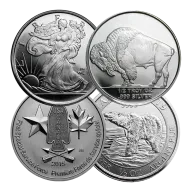
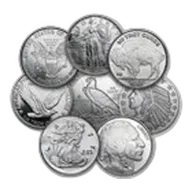
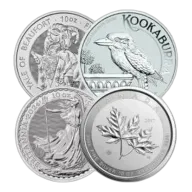
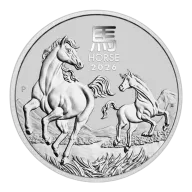
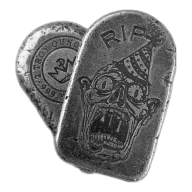
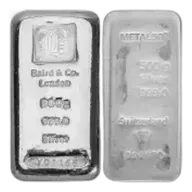
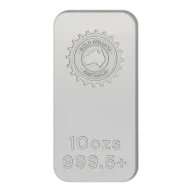
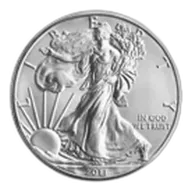
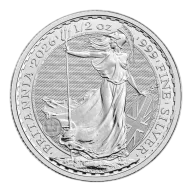
Physical silver bullion is available as coins, bars, and rounds. The product range is broad. Seven sovereign mints produce major 1 oz silver coins, led by the American Silver Eagle (the world's most traded silver coin), the Canadian Maple Leaf (the highest-purity sovereign coin at 999.9 fine), and the British Britannia (CGT-exempt in the UK). Bars range from 1 oz to 1,000 oz, with the 10 oz and 100 oz sizes most popular among serious investors. Silver rounds from private mints occupy a middle ground on premium between coins and bars.
The silver market has been in structural supply deficit since 2021, with cumulative shortfalls exceeding 678 million ounces through 2024. Total demand reached 1.16 billion ounces in 2024, exceeding total supply of 1.01 billion ounces. Industrial fabrication alone consumed a record 680.5 million ounces, driven primarily by solar photovoltaic manufacturing (an estimated 232 million ounces). Physical bar and coin investment added 190.9 million ounces. Unlike gold, where annual mine production adds less than 2% to existing above-ground stocks, silver is consumed industrially. Much of the silver used in electronics, solar panels, and industrial applications is not economically recoverable, tightening the long-term supply picture.
Silver's density is 10.49 g/cm3, roughly half that of gold. This means silver is far bulkier per unit of value. At current prices, $50,000 of silver weighs approximately 52 kg (115 lbs) and takes up about 5 litres of space, versus roughly 0.8 kg for the same value in gold. Storage cost and logistics are the primary practical considerations for silver investors, particularly for larger holdings. Silver also tarnishes when exposed to sulphur compounds in the air, forming a dark surface layer that is cosmetic (it does not reduce metal content or resale value) but requires basic precautions: airtight storage, anti-tarnish strips, and avoidance of rubber and PVC materials.
Silver Tax Treatment Across Major Markets
Silver receives less favourable purchase tax treatment than gold in the UK and EU, where investment gold benefits from specific VAT exemptions that do not extend to silver. In purity-based exemption countries (Canada, Australia, New Zealand, Singapore), silver typically qualifies for GST exemption, though often at a higher purity threshold than gold.
United Kingdom
Silver bullion is subject to 20% VAT on purchase, whether coins or bars. There is no investment silver exemption. This is the single largest cost factor for UK silver buyers: GBP 200 in unrecoverable VAT on every GBP 1,000 of silver purchased for delivery.
Two mitigations exist. First, VAT-free vault storage: several UK dealers hold silver in LBMA-approved vaults where it is not in "free circulation" and VAT is not charged. Taking physical delivery later triggers the 20% VAT at that point. Second, the margin scheme (also called the "Second-Hand Scheme" or "Special Scheme"): pre-owned silver sold by VAT-registered dealers attracts VAT only on the dealer's margin (buy-sell spread), not the full price. The effective VAT is near zero. This makes pre-owned silver significantly cheaper than new silver in the UK.
On disposal, silver bars and non-UK coins are subject to Capital Gains Tax at 18-24%, with a GBP 3,000 annual allowance. Silver Britannias are CGT-exempt as UK legal tender, making them the most tax-efficient silver product for UK buyers despite the upfront VAT.
United States
No federal sales tax applies. Over 40 states exempt investment-grade silver from state sales tax. States that still impose tax include Hawaii, Maine, Maryland, Vermont, and Washington. California exempts purchases over $2,000. On disposal, silver is classified as a collectible by the IRS, taxed at a maximum long-term rate of 28%. Silver meeting 99.9%+ purity can be held in a self-directed IRA for tax-deferred or tax-free (Roth) growth.
Canada
Silver at 99.9%+ purity is GST/HST exempt across all provinces. Coins, bars, and wafers qualify. This is notably favourable: Canada is one of the few countries where silver and gold receive identical purchase tax treatment. Capital gains are taxable at a 50% inclusion rate (66.67% above CAD 250,000 from June 2024).
Australia
Silver is GST-free at 99.9%+ purity in investment form (bars, wafers, coins) from accredited sources. The purity threshold for silver (99.9%) is higher than for gold (99.5%) and platinum (99%). Standard bullion products from major mints and refiners easily meet it. Capital gains apply with a 50% discount for holdings over 12 months.
New Zealand
Fine silver at 99.9%+ purity is GST-exempt. Bars, ingots, and coins all qualify at that threshold. Silver below 99.9% attracts 15% GST. New Zealand has no formal capital gains tax, making it one of the most favourable jurisdictions for silver investment: no purchase tax on qualifying silver, no sale tax.
Singapore
Investment Precious Metal (IPM) silver is GST-exempt at 99.9%+ purity. Bars must weigh at least 0.5 troy ounce and coins must be or have been legal tender. Exempt from the 9% GST. Singapore has no capital gains tax.
Hong Kong
No sales tax, no VAT, no import duty, and no capital gains tax on silver. Fully tax-neutral.
South Africa
Silver bullion, including the Silver Krugerrand (introduced 2017), is subject to 15% VAT. The gold Krugerrand's VAT-exempt status as legal tender does not extend to the silver version. When selling silver back to a VAT-registered dealer, the VAT is partially recoverable through a resale declaration, but the initial cost is significant.
European Union
Standard VAT applies to silver across all EU member states, at rates from 17% to 27%. There is no investment silver exemption comparable to the Investment Gold Directive. Some countries offer reduced effective VAT through margin schemes: Germany applies Differenzbesteuerung (differential taxation under section 25a of the VAT Act) to imported and pre-owned silver coins. The Netherlands offers a margin scheme (margeregeling) for pre-owned silver coins, though new silver coins attract full 21% VAT as of January 2025. Estonia has offered 0% VAT on silver via bonded warehouse arrangements. Norway (EFTA, not EU) charges 0% VAT on silver coins delivered domestically.
Silver Purity Standards for Bullion
Silver purity standards are simpler than gold's, with no 22-carat/24-carat split to navigate. The distinction that matters most for silver buyers is between 999 and 999.9 fine, and even that gap is functionally negligible for investment purposes.
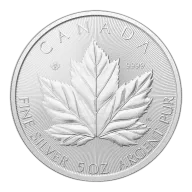
999.9 fine ("four nines") is the highest purity available in silver bullion. The Canadian Silver Maple Leaf has been struck at 999.9 since its introduction in 1988, as has the Australian Silver Kangaroo. The Royal Canadian Mint also produces 999.9 silver bars. This purity meets every tax exemption threshold worldwide.
999 fine ("fine silver") is the standard for most modern silver bullion. The American Silver Eagle, British Britannia, Austrian Philharmonic, Silver Krugerrand, and most refiner bars are 999 fine. This is also the minimum for LBMA Good Delivery bars (the 1,000 oz institutional standard). For practical purposes, 999 and 999.9 are interchangeable: the marginal purity difference does not affect value, tax treatment, or resale. The slight premium that the Maple Leaf commands over other sovereign coins is attributable to brand recognition and Canadian mint reputation, not the extra 0.09% purity.
The purity threshold that matters for tax is 99.9% (999 thousandths). Australia and New Zealand both require 99.9% for GST exemption on silver, a higher bar than for gold (99.5% in both countries) and platinum (99%+ in both). Singapore also requires 99.9% for IPM status. Canada's threshold is lower at 99.9%, and all standard silver bullion products exceed it comfortably.
925 fine (sterling silver) is a historical alloy of 92.5% silver and 7.5% copper, used in jewellery and silverware. It is not investment grade and does not qualify for any bullion tax exemptions.
900 fine (coin silver) refers to pre-1965 US dimes, quarters, and half-dollars, known in the bullion market as "junk silver." These contain 90% silver and are sold by face value in bags. They are popular among US buyers for divisibility and recognisability but are not part of the modern investment bullion market and are not relevant outside the United States.
Silver Supply, Demand, and the Deficit Trend
The silver market is defined by a dual identity. It is both a precious metal with a 4,000-year monetary history (the word "silver" is synonymous with "money" in many languages: French argent, Spanish plata) and an industrial commodity with rapidly growing technological demand. That dual nature creates a supply-demand picture distinct from gold or platinum.
Supply
Global mine production was 819.7 million ounces (approximately 25,500 tonnes) in 2024, up 0.9% year-on-year. The top producing countries are Mexico, China, Peru, Chile, Poland, and Australia. A critical structural feature: approximately 72% of silver is mined as a by-product of copper, lead, and zinc mining. Primary silver mines account for only about 28% of production. This means silver supply does not respond directly to silver price movements; it is largely governed by the economics of base metal mining.
Recycling contributed 193.9 million ounces in 2024, a 12-year high. Total supply reached approximately 1.01 billion ounces.
Demand
Total demand was 1.16 billion ounces in 2024, split across five categories:
- Industrial fabrication: 680.5 Moz (59%) a record high for the fourth consecutive year. Solar photovoltaic manufacturing consumed an estimated 232 Moz. Vehicle electrification, AI-related electronics, and electrical grid infrastructure are additional growth drivers.
- Jewellery: 208.7 Moz (18%)
- Physical investment (bars and coins): 190.9 Moz (16%) down 22% from elevated 2020-2023 levels but still substantial.
- Silverware: 54.2 Moz (5%)
- Photography: approximately 25 Moz (2%) a declining legacy use.
The solar energy sector is the most significant growth story. Silver is essential in photovoltaic cells as a conductive paste, and the shift to higher-efficiency cell architectures (heterojunction, TOPCon) uses more silver per panel. With global solar capacity expanding rapidly, this demand stream is expected to continue growing, providing a structural floor under silver consumption that did not exist a decade ago.
The Structural Deficit
The silver market has been in deficit since 2021, with annual shortfalls totalling approximately 678 million ounces over four years. The 2024 deficit was 148.9 million ounces; the 2025 projection is 117.6 million ounces. Unlike gold, where the enormous above-ground stock (212,000 tonnes) dwarfs annual flows, silver is being consumed industrially at a rate that exceeds new supply. A significant portion of silver used in electronics, solar panels, and catalytic applications is not economically recoverable, permanently removing it from the available stock. This consumption dynamic, combined with silver's dual monetary/industrial demand, is central to the long-term investment thesis.
Storing Silver: Managing Bulk, Weight, and Tarnish
Silver's storage characteristics are its most significant practical difference from gold and platinum. At a density of 10.49 g/cm3, roughly half that of gold, silver is far bulkier per unit of value. The weight and space required to store a meaningful silver holding can shape the entire investment decision.
Scale of the Challenge
| Value | Gold weight | Silver weight | Silver volume |
|---|---|---|---|
| $10,000 | ~0.16 kg | ~10.4 kg (23 lbs) | ~1 litre |
| $50,000 | ~0.8 kg | ~52 kg (115 lbs) | ~5 litres |
| $100,000 | ~1.6 kg | ~104 kg (230 lbs) | ~10 litres |
A single monster box of 500 American Silver Eagles weighs roughly 16 kg (35 lbs). A serious silver holding of 1,000 ounces weighs over 31 kg. Home storage is feasible for smaller amounts but becomes a genuine logistics challenge as holdings grow. Fire-rated safes that can accommodate significant silver weight are substantially larger and more expensive than those needed for equivalent gold holdings.
Tarnish Management
Silver tarnishes when exposed to hydrogen sulphide (H2S), a trace gas present in all air but concentrated near industrial areas, rubber products, certain foods, and urban pollution. The tarnish is a dark layer of silver sulphide on the surface. It is purely cosmetic: tarnished silver contains exactly the same metal content as bright silver, and dealers buy tarnished bullion at the same price as untarnished. Cleaning tarnish is generally unnecessary for bullion, and aggressive cleaning can actually reduce the value of proof or numismatic items.
Practical prevention measures include storing coins in mint tubes (which hold 20-25 coins and provide reasonable protection), using anti-tarnish strips (intercept technology or activated carbon), adding silica gel desiccants to storage containers, avoiding rubber bands and PVC holders (which release sulphur compounds), and handling silver with cotton gloves. Monster boxes (500 coins in sealed tubes) provide good long-term protection. For bars, sealed packaging from the refiner or vacuum-sealed bags work well.
Storage Options
Home storage works for smaller holdings. A 100 oz bar weighs 3.1 kg (6.9 lbs), manageable but adding up fast across multiple bars. Safe deposit boxes at banks may not be large enough for significant silver holdings, and the weight can exceed box capacity limits.
Professional vault storage is the standard for larger silver positions but is disproportionately expensive compared to gold. Storage fees are typically based on insured value or weight/space, and silver requires 50-80 times more space per dollar of value than gold. Some vault providers charge minimum fees that make silver storage uneconomical below certain thresholds. For UK buyers, vault storage has the additional advantage of keeping silver in a VAT-free state (no 20% VAT charged while the metal remains outside free circulation).
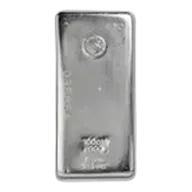
The most space-efficient silver products for storage are 100 oz bars (roughly 3.1 kg each, the largest commonly available retail size) and 1 kg bars (32.15 oz, the international retail standard popular in Europe, Asia, and Australia). 10 oz silver bars balance portability with reasonable storage density and are widely considered the most practical size for individual investors.
Silver bullion: frequently asked questions
-
The silver spot price is $65.28 per troy ounce. Spot is the benchmark for raw silver, but physical bullion always sells above it to cover fabrication costs, dealer margin, and storage or delivery. The gap between spot and the price you pay is called the premium.
-
Every piece of physical silver must be refined, fabricated, and distributed before it reaches you, so the sale price includes those costs plus a dealer margin. Coins carry the highest premiums because of die-striking and legal-tender surcharges; bars are cheaper to produce and typically sit closer to spot; generic rounds fall somewhere between the two.
-
Government-minted coins (Britannias, Maple Leafs, Eagles) are legal tender, carry the issuing authority's quality guarantee, and usually command the highest premiums. Bars are cast or minted by private refiners and offer the lowest cost per ounce for large purchases. Rounds look like coins but carry no legal-tender status, sitting between bars and coins on both price and recognition in the secondary market.
-
In the UK, gains above £3,000 are taxed at 18% or 24% depending on your income band; silver is not CGT-exempt regardless of form. US investors face a collectibles rate of up to 28% on long-term gains. In Canada, 50% of any capital gain is included in taxable income. In Australia, gains are taxed at your marginal rate, with a 50% discount if the metal was held over 12 months.
-
Yes. Legal-tender coins such as Britannias, Maples, and Eagles are struck by sovereign mints under government guarantee, which increases production cost and collector demand, pushing premiums higher than generic rounds. The trade-off is wider secondary-market liquidity: government mint coins are instantly recognised by dealers worldwide, whereas generic rounds may attract a lower buy-back price.