 Chards



Prices are fetched automatically and may not reflect current merchant prices. Currency conversions and tax treatment are approximate. Rankings are based solely on price. We are not a dealer and accept no responsibility for transactions with listed merchants. Past performance is not indicative of future results. This site does not provide investment advice. Full disclaimer
About the 1/4 oz Panda Gold Coin
The 1/4 oz Gold Panda
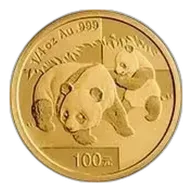
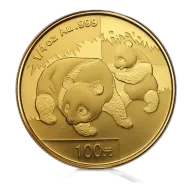
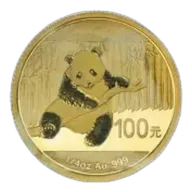
The 1/4 oz Gold Panda from China Gold Coin Corporation contains .999 fine gold and is legal tender of the People's Republic of China. Like all Pandas, the coin features the Hall of Prayer for Good Harvests at the Temple of Heaven on the obverse (unchanged since 1982) and a new giant panda illustration each year on the reverse. This annually rotating design is central to the Panda's identity and the source of its collector premiums.
The weight and denomination of this coin changed in 2016 when China switched the Panda series from troy ounces to metric grams. Pre-2016 coins at this denomination contain 7.776 grams (1/4 troy ounce) with a 25 yuan face value. Post-2016 coins contain 8 grams (0.2572 troy ounce) with a 100 yuan face value. The physical dimensions (22 mm diameter, 1.53 mm thickness) remained unchanged. The post-2016 coin contains slightly more gold (about 3% extra), so the two versions are not directly interchangeable for weight-based pricing, though most dealers list both under the "1/4 oz" heading.
Premiums on the Panda run higher than on comparable coins at this weight. The annually changing designs generate collector demand that the fixed-design 1/4 oz Gold Maple Leaf or 1/4 oz Gold Philharmonic do not carry. This means the cost to acquire a Panda exceeds what a buyer would pay for the same weight of gold in a Maple Leaf, and the buy-sell spread is typically wider. The 2001-2002 design freeze, when both years shared identical reverse designs (distinguishable only by the obverse date), demonstrated the importance of this annual change to the collector community; the backlash from collectors was strong enough to reverse the policy.
Counterfeiting risk is a more significant consideration with Pandas than with most competing coins. NGC has warned that "skillful counterfeits are endangering the integrity of the Chinese Panda coin series," with recent years counterfeited "at an alarming rate." The combination of high premiums, annually changing designs that make visual comparison harder, and less sophisticated security features than Western competitors creates an environment that favours counterfeiters. Buying from reputable dealers or purchasing NGC/PCGS-certified coins is strongly recommended. The CGCC offers no coin-level digital authentication comparable to the Royal Canadian Mint's Bullion DNA system.
1/4 oz Gold Panda Specifications
| Specification | Pre-2016 | Post-2016 |
|---|---|---|
| Fine gold content | 7.776 g (1/4 troy oz) | 8 g (0.2572 troy oz) |
| Purity | .999 (24 karat) | .999 (24 karat) |
| Diameter | 21.95 mm | 22 mm |
| Thickness | 1.53 mm | 1.53 mm |
| Face value | 25 yuan | 100 yuan |
| Edge | Reeded | Reeded |
| Obverse | Hall of Prayer for Good Harvests, Temple of Heaven, Beijing | |
| Reverse | Giant panda (new design each year) | |
| Mint | China Gold Coin Corporation (Beijing, Shanghai, Shenyang, or Shenzhen) | |
The CGCC strikes Pandas at multiple facilities without standardised mintmarks, making attribution to a specific mint difficult. Some years have subtle die differences that specialists can identify, but this is not a consistent system and the CGCC provides no official documentation for distinguishing production sites. This multi-facility production contrasts with mints like the Perth Mint or Royal Canadian Mint, which operate from identified single locations.
The .999 purity (three nines) sits below the .9999 standard used by the Gold Kangaroo, Gold Maple Leaf, and Gold Britannia. This is a design choice China has maintained since the series launched in 1982. The 2015 Gold Panda was uniquely issued without denomination, weight, fineness, or metal inscriptions on the coin itself, an anomaly that was not repeated and was widely criticised for both aesthetic and anti-counterfeiting reasons.
Security features on recent Pandas have improved with the addition of radial line backgrounds and micro-engraved security marks, similar to features found on Western coins. The series still lacks the advanced anti-counterfeiting technology found on coins like the Gold Maple Leaf (Bullion DNA digital authentication) or the Gold Britannia (latent image, surface animation, micro-text, tincture lines). This gap, combined with the annually changing designs that make year-to-year visual comparison harder, contributes to the counterfeiting risk that NGC has flagged as significant for the Panda series.
Gold Panda Tax Treatment by Country
The Gold Panda's tax treatment contains one significant surprise around US retirement account eligibility that does not affect most other sovereign gold coins.
- United States: Gold Pandas are generally considered not IRA-eligible. The IRS does not recognise the Chinese mint as an approved foreign mint for IRA gold purposes, and the coins' semi-numismatic nature can classify them as collectibles rather than qualifying bullion. This is a significant distinction from coins like the 1/4 oz American Eagle (which has explicit statutory IRA exemption) or the 1/4 oz Gold Maple Leaf (which qualifies via .9999 purity). Some IRA custodians may accept .999+ sovereign coins, so investors should verify with their specific custodian. Capital gains are taxed at the collectibles rate of up to 28%. State sales tax varies by jurisdiction.
- United Kingdom: VAT-exempt as investment gold meeting the purity threshold for post-1800 legal tender coins. Not CGT-exempt (only UK legal tender coins qualify). Annual CGT allowance is £3,000.
- Canada: GST/HST-exempt on gold at 99.5%+ purity. The Panda's .999 fineness qualifies. Capital gains taxed at the 50% inclusion rate. Not eligible for RRSP or TFSA.
- Australia: GST-free as investment-grade gold at 99.9% purity, exceeding the 99.5% threshold. Capital gains apply with a 50% discount for holdings over 12 months.
- European Union: VAT-exempt under the EU investment gold directive. Silver Pandas are subject to local VAT rates.
- Singapore: GST-exempt under the Investment Precious Metals scheme. No capital gains tax. Strong market presence due to regional proximity to China.
- Hong Kong: No sales tax, import duty, or capital gains tax. Strong market for Pandas with significant collector communities.
- South Africa: Gold coins are zero-rated for VAT. Capital gains taxed with a 40% inclusion rate.
1/4 oz Gold Panda vs Maple Leaf, Eagle, and Lunar
The 1/4 oz Gold Panda's competitors divide into two groups: coins that compete primarily on bullion economics (Maple Leaf, Eagle, Krugerrand) and coins that share the Panda's collector-oriented positioning (Lunar, Kangaroo).
Against the 1/4 oz Gold Maple Leaf, the Panda trades at meaningfully higher premiums for less gold purity (.999 vs .9999). The Maple Leaf's Bullion DNA system provides digital, individual coin-level authentication that the Panda cannot match. The Maple Leaf's fixed design keeps premiums low and predictable, with no year-to-year collector variation. For buyers focused on accumulating gold content efficiently, the Maple Leaf is the more cost-effective choice. The Panda's premium reflects the collector market's willingness to pay for annually changing designs.
The 1/4 oz Gold Eagle at .9167 purity (22 karat) contains the same 1/4 troy oz of fine gold in a harder, more scratch-resistant alloy. The Eagle has explicit IRA eligibility by statutory name, a significant advantage over the Panda's uncertain IRA status for US retirement investors. The Eagle's premiums are higher than coins like the Maple Leaf but typically lower than the Panda's collector-driven pricing.
The 1/4 oz Gold Lunar is the Panda's closest competitor in concept. Both change designs annually with cultural themes rooted in Chinese traditions (zodiac animals versus panda illustrations). The Lunar is .9999 fine (one nine purer), has clearer single-mint provenance from the Perth Mint, and carries Series III security features including micro-laser engraving. The Lunar's controlled mintages, particularly for Dragon years, can push premiums even higher than the Panda's. Both coins occupy the space where bullion and numismatics overlap.
The 1/4 oz Gold Kangaroo also changes designs annually but with unlimited mintage, keeping premiums lower than both the Panda and the Lunar. At .9999 purity, the Kangaroo delivers more purity for a lower premium. Buyers who want the annual design variety of the Panda but without the elevated premiums and counterfeiting concerns may find the Kangaroo a pragmatic alternative.
1/4 oz Panda Gold Coin: frequently asked questions
-
The cheapest 1/4 oz Gold Panda tracked here is £915.34, roughly 12.4% over the £3,256.26 gold spot price for 1/4 oz of .999 fine gold. Because Panda coins carry annual design changes that attract collector interest, premiums can run higher than on coins with fixed designs.
-
Current Gold Panda coins are struck in .999 fine gold (three nines), with a purity of 999. Pre-2016 issues were also .999 fine. The 1/4 oz coin contains approximately 7.776 grams of fine gold. Note that .999 is slightly below the .9999 purity of coins like the Canadian Maple Leaf or Australian Kangaroo, though both meet investment-gold standards in most markets.
-
Since 2016, Gold Pandas have been issued in metric weights: 1 g, 3 g, 8 g, 15 g, and 30 g (the standard size, roughly equivalent to one troy ounce). Larger occasional sizes include 50 g, 100 g, 150 g, and 1 kg. Older coins (pre-2016) used troy ounce denominations: 1/20 oz, 1/10 oz, 1/4 oz, 1/2 oz, and 1 oz.
-
Early-year Gold Pandas, particularly issues from the 1980s and some pre-1990 coins with lower mintages, can carry significant premiums above their gold melt value due to collector demand. The annually changing reverse design means each year is distinct, and scarcer years command higher prices in the secondary market. This site tracks current bullion buy prices only; for collector valuations, specialist numismatic sources apply.