
9 listings
Filters
| Product | /oz | Premium | Price | |
|---|---|---|---|---|
| £3,543.97 | +8.84% | £1,709.12 | View Deal | |
| £3,583.21 | +10.04% | £1,728.04 | View Deal | |
| £3,628.97 | +11.45% | £1,750.11 | View Deal | |
| £3,628.97 | +11.45% | £1,750.11 | View Deal | |

 Atkinsons Bullion
|
£3,629.03 | +11.45% | £1,750.14 | View Deal |
 UK Bullion
|
£3,646.97 | +12.00% | £1,758.79 | View Deal |
| £3,661.67 | +12.45% | £1,765.88 | View Deal | |
| £3,661.67 | +12.45% | £1,765.88 | View Deal | |
 Gold Bank
|
£3,685.25 | +13.17% | £1,777.25 | View Deal |







Prices are fetched automatically and may not reflect current merchant prices. Currency conversions and tax treatment are approximate. Rankings are based solely on price. We are not a dealer and accept no responsibility for transactions with listed merchants. Past performance is not indicative of future results. This site does not provide investment advice. Full disclaimer
About the 15g Panda Gold Coin
The 15g Gold Panda: China's Mid-Range Bullion Coin
The 15g Gold Panda is the second-largest denomination in China's post-2016 metric Panda series, sitting between the flagship 30g coin and the smaller 8g, 3g, and 1g sizes. It replaced the former 1/2 oz Panda when the China Gold Coin Corporation switched from troy ounces to metric grams in 2016, a move that reduced the gold content from 15.552g (half a troy ounce) to exactly 15g. That 0.552g difference amounts to roughly 3.5% less gold than a standard half-ounce gold coin from a Western mint.
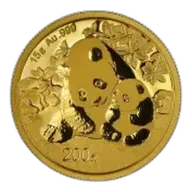
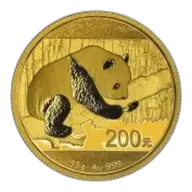
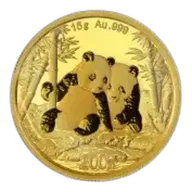
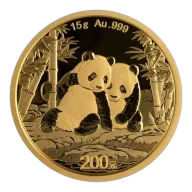
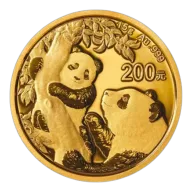
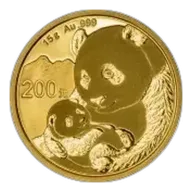
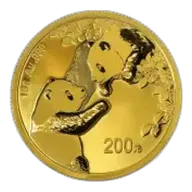
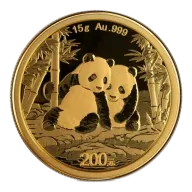
The Panda series is one of only a few government bullion programmes that changes its reverse design every year. Each annual issue features a new giant panda illustration, ranging from cubs at play to adults munching bamboo. The obverse has remained the same since 1982: the Hall of Prayer for Good Harvests at the Temple of Heaven in Beijing. This annual design rotation gives the Panda genuine collector appeal beyond its metal content, though it also means premiums tend to run higher than on comparable coins with fixed designs.
For buyers looking at the 15g specifically, the coin occupies a practical middle ground. It carries lower premiums than the smaller Panda denominations (where minting costs eat into value) while remaining accessible enough for regular accumulation. The 200 yuan face value makes it legal tender of the People's Republic of China, and at .999 fine gold, it qualifies as VAT-exempt investment gold in the UK and EU. That said, buyers focused purely on metal efficiency per pound spent will find marginally better value in a standard half-ounce coin from the Gold Britannia, Gold Kangaroo, or American Gold Eagle series, all of which contain 15.55g of gold at the half-ounce size.
The Panda's counterfeiting risk is worth noting. NGC has flagged that the series has been "disproportionately targeted by counterfeiters" compared to other major bullion coins. The annually changing designs make fakes harder to spot by comparison, and the series lacks the digital authentication systems found on the Canadian Maple Leaf (Bullion DNA) or the 1oz Gold Britannia (latent image, micro-text). Buying from established dealers or purchasing NGC/PCGS-certified coins is strongly recommended.
15g Gold Panda Technical Details
| Attribute | Value |
|---|---|
| Weight | 15 g (0.4823 troy oz) |
| Purity | .999 fine gold (three nines) |
| Diameter | 27 mm |
| Thickness | 1.85 mm |
| Face value | 200 yuan |
| Edge | Reeded |
| Obverse | Hall of Prayer for Good Harvests, Temple of Heaven, Beijing |
| Reverse | Giant panda (design changes annually) |
| Mint | China Gold Coin Corporation (multiple facilities) |
| Legal tender | People's Republic of China |
Weight Comparison with Half-Ounce Coins
The 15g Panda contains less gold than a standard 1/2 troy ounce coin. The table below compares gold content across the fractional range most relevant to buyers considering this size.
| Coin | Gold content | Total weight | Purity |
|---|---|---|---|
| 15g Gold Panda (post-2016) | 15.000 g | 15.000 g | .999 |
| 1/2 oz Gold Panda (pre-2016) | 15.552 g | 15.552 g | .999 |
| 1/2 oz Gold Britannia | 15.550 g | 15.600 g | .9999 |
| 1/2 oz Gold Eagle | 15.554 g | 16.965 g | .9167 |
| 1/2 oz Gold Maple Leaf | 15.554 g | 15.554 g | .9999 |
The 0.55g shortfall against a true half-ounce amounts to several dollars at current gold prices. Buyers accumulating over time should factor this into per-gram cost comparisons.
Tax Position for the 15g Gold Panda
Gold Pandas at .999 purity qualify as investment gold in most jurisdictions, which means no purchase tax in the majority of markets. The specific rules by country:
- UK: VAT-exempt as investment-grade gold (meets the 99.5%+ purity threshold for post-1800 legal tender coins). Not CGT-exempt, since only UK legal tender coins such as the Gold Britannia qualify for that relief. Gains above the annual CGT allowance are taxable.
- US: No federal sales tax. State-level sales tax varies; over 35 states exempt bullion entirely. Gold Pandas are generally considered not IRA-eligible. The IRS does not recognise the Chinese mint as an approved foreign mint for IRA purposes, and the coins' semi-numismatic character can classify them as collectibles. This is a notable disadvantage compared to the 1oz Gold Buffalo or 1oz Gold Eagle, both of which are IRA-approved. Capital gains are taxed at the collectibles rate of up to 28%.
- Canada: GST/HST-exempt as gold meeting the 99.5%+ purity threshold. Not RRSP or TFSA eligible.
- Australia: GST-free as investment-grade gold. Capital gains tax applies on disposal, with a 50% discount for holdings over 12 months.
- EU: VAT-exempt under the EU Investment Gold Directive.
- Singapore: GST-exempt under the Investment Precious Metals scheme (gold at 99.5%+ purity). No capital gains tax.
- Hong Kong: No sales tax, no import duty, no capital gains tax.
- New Zealand: GST-exempt as fine gold meeting the 99.5%+ purity threshold.
- South Africa: Gold bullion is VAT-exempt.
The IRA ineligibility is the single biggest tax disadvantage of the Gold Panda for US buyers. American investors seeking tax-advantaged retirement gold should look at the Gold Buffalo (.9999, IRA-eligible) or the Gold Eagle (IRA-eligible by specific statutory exemption despite its 22-karat alloy).
15g Gold Panda vs Half-Ounce Alternatives
The 15g Gold Panda competes primarily with standard half-ounce gold coins from Western sovereign mints. The comparison is straightforward on metal content: every major competitor contains 15.55g of gold, while the Panda contains 15.00g. That 3.5% difference is the direct consequence of China's 2016 switch from troy ounces to metric grams.
On purity, the Panda's .999 fineness is lower than the .9999 achieved by the Britannia, Maple Leaf, Kangaroo, and Philharmonic, though the practical difference in gold content at this weight is negligible (a fraction of a milligram). The American Gold Eagle is .9167 (22-karat) but still delivers exactly 15.554g of fine gold in its half-ounce coin, thanks to its heavier copper-silver alloy.
Premiums on the 15g Panda typically run 4-8% over spot, comparable to standard half-ounce coins from other mints. The difference is that the Panda's collector market can push premiums higher for popular design years. Coins like the 1/2 oz Gold Kangaroo and 1/2 oz Maple Leaf tend to have more predictable, lower premiums. On the buy-back side, the Panda's narrower Western dealer network can mean slightly wider spreads than an Eagle or Maple Leaf.
Security features favour the Western competition. The Canadian Maple Leaf has Bullion DNA micro-engraving and MintShield coating. The Britannia carries a latent image, surface animation, micro-text, and tincture lines. The Panda relies on reeded edges and, in recent years, radial line backgrounds. NGC has specifically highlighted the Panda's vulnerability to counterfeiting. For buyers prioritising authentication confidence, a half-ounce coin from a mint with modern anti-counterfeiting technology offers a meaningful advantage.
The Panda's genuine differentiator is its annually changing design. No other major gold coin at the half-ounce size offers this. Buyers who value the collector dimension alongside the metal content will find the Panda uniquely appealing. For those focused purely on gold accumulation at the lowest cost per gram, a standard half-ounce from the Britannia, Maple Leaf, or Kangaroo programme delivers more metal with better authentication infrastructure.
15g Panda Gold Coin: frequently asked questions
-
The cheapest 15g Gold Panda currently listed is £1,709.12, from Chards. That price includes around 8.8% above spot for 15 grams of 999 fine gold. The 15g size was introduced in 2016 when China moved from troy ounces to metric weights, replacing the old half-ounce denomination.
-
Gold Pandas change their panda reverse design every year, making each vintage a distinct collectible rather than a fungible bullion unit. This annual uniqueness limits the secondary-market pool for any given year, compressing liquidity and widening buy/sell spreads. Demand from Chinese collectors adds further price pressure. The metric gram sizing (introduced in 2016) also means Pandas do not map neatly onto troy-ounce pricing, which narrows the arbitrage that would otherwise keep premiums in check.
-
The current metric-era Gold Panda series (from 2016) comes in five standard sizes: 1g, 3g, 8g, 15g, and 30g. The 15g is the second-largest standard size. Larger collector formats (50g, 100g, 150g, 1kg) are also produced in smaller quantities. Before 2016, coins used troy ounce weights: 1/20 oz, 1/10 oz, 1/4 oz, 1/2 oz, and 1 oz.