7 listings
Filters
| Product | /oz | Premium | Price | |
|---|---|---|---|---|

 Baird & Co.
£1,571.44 for 26+
Baird & Co.
£1,571.44 for 26+
|
£3,345.90 | +2.75% | £1,575.30 | View Deal |
| £3,367.05 | +3.40% | £1,585.26 | View Deal | |
| £3,386.02 | +3.98% | £1,594.19 | View Deal | |
|
DO
Baird & Co.
|
£3,395.09 | +4.26% | £1,598.46 | View Deal |
|
DO
Baird & Co.
|
£3,395.09 | +4.26% | £1,598.46 | View Deal |
| £3,491.28 | +7.22% | £1,643.75 | View Deal | |
| £3,491.28 | +7.22% | £1,643.75 | View Deal |




Prices are fetched automatically and may not reflect current merchant prices. Currency conversions and tax treatment are approximate. Rankings are based solely on price. We are not a dealer and accept no responsibility for transactions with listed merchants. Past performance is not indicative of future results. This site does not provide investment advice. Full disclaimer
About the Double Sovereign Gold Coin
Twice the Sovereign, Same Tax Advantages
The Double Sovereign contains 14.644 grams of fine gold (0.4708 troy ounces) struck at 22 carat (916.7 fineness) by The Royal Mint. It carries a face value of two pounds sterling, making it UK legal tender and therefore exempt from both VAT and Capital Gains Tax. The coin is exactly twice the gold content of a Full Sovereign and four times a Half Sovereign.
The Double Sovereign appeals to buyers who want more gold per coin while retaining the Sovereign family's tax advantages. A single Double Sovereign holds nearly half a troy ounce of gold, putting it in a similar weight class to a 1/2 oz coin from other mints. For UK investors, the CGT exemption is the key consideration: profits on Double Sovereigns are entirely tax-free, with no annual limit and no reporting requirement. This exemption applies to all denominations in the Sovereign family, from the Quarter Sovereign through to the Five Sovereign.
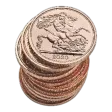
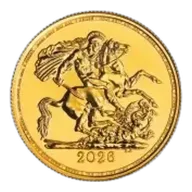
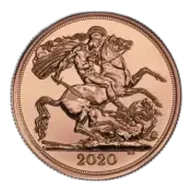
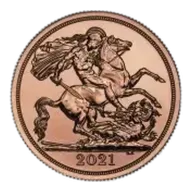
The coin's reverse carries Benedetto Pistrucci's iconic St George and the Dragon design, first struck in 1817 and considered one of the masterworks of numismatic art. The obverse bears the portrait of the reigning monarch. At 28.40mm diameter, the Double Sovereign has noticeably more visual presence than the Full Sovereign (22.05mm), giving the Pistrucci design more room to breathe.
One important distinction from the Full Sovereign: the Double Sovereign is primarily issued as a proof or limited commemorative product, not as a high-volume bullion strike. This means production runs are smaller and premiums tend to run higher than on Full Sovereigns. Pre-owned Double Sovereigns from the secondary market offer the best entry point for cost-conscious buyers.
Double Sovereign Specifications
| Attribute | Value |
|---|---|
| Gross weight | 15.976 grams |
| Fine gold content | 14.644 grams (0.4708 troy oz) |
| Purity | 22 carat / 916.7 millesimal fineness |
| Alloy | 91.67% gold, 8.33% copper |
| Diameter | 28.40 mm |
| Face value | £2 (two pounds sterling) |
| Edge | Milled (reeded) |
| Designer | Benedetto Pistrucci (reverse) |
| Mint | The Royal Mint, Llantrisant |
| Legal tender | Yes (United Kingdom) |
Sovereign Family Size Comparison
Each denomination in the Sovereign family is an exact weight multiple of the base unit. The purity and alloy composition are identical across all sizes.
| Denomination | Face value | Gross weight | Fine gold | Diameter |
|---|---|---|---|---|
| Quarter Sovereign | £0.25 | 1.997g | 1.831g | 13.50 mm |
| Half Sovereign | £0.50 | 3.994g | 3.661g | 19.30 mm |
| Full Sovereign | £1.00 | 7.988g | 7.322g | 22.05 mm |
| Double Sovereign | £2.00 | 15.976g | 14.644g | 28.40 mm |
| Quintuple Sovereign | £5.00 | 39.940g | 36.612g | 36.02 mm |
Double Sovereign Tax Position
The Double Sovereign has the same dual tax exemption as every coin in the Sovereign family. As UK legal tender with a face value of £2, it is exempt from both VAT on purchase and Capital Gains Tax on sale.
United Kingdom
- VAT: Exempt. Investment gold at 900+ fineness and UK legal tender status both qualify it independently.
- CGT: Exempt under TCGA 1992, Section 21(1)(b). No tax on any profit, no annual limit, no reporting requirement. This applies to all Sovereign denominations and all dates.
- SIPP: Gold bullion is eligible for Self-Invested Personal Pensions. Tax relief at the individual's marginal rate (up to 45%). Gold in a SIPP is also exempt from CGT.
- Income Tax: The CGT exemption only applies to individual investors. Habitual buying and selling for profit could be classified as trading income by HMRC.
Other Countries
- European Union: VAT-exempt as a recognised investment gold coin under EU Directive 98/80/EC.
- United States: No special tax status. Taxed as a collectible at up to 28% long-term capital gains. Not IRA-eligible (purity of .9167 is below the .995 IRA threshold, and the Sovereign lacks the special exemption that American Eagles enjoy).
- Canada: Not RRSP-eligible.
- Australia: The 91.67% purity is below Australia's 99.5% threshold for GST-exempt investment gold. Sovereigns may attract GST depending on ATO interpretation of the foreign legal tender coin exception.
The tax comparison is worth quantifying for UK buyers. A Double Sovereign purchased at £1,200 that later sells at £1,800 generates a £600 profit that is entirely untaxed. The same profit on a 1/2 oz gold bar would face CGT at up to 20% after the annual allowance.
From Tudor Presentation Piece to Modern Investment Coin
The Double Sovereign traces its origins to the reign of Henry VII (1485-1509), when double-weight piedfort versions of the gold sovereign were struck as presentation pieces. Only three examples of these Tudor Double Sovereigns are known to survive, making them among the rarest English coins.
The denomination was revived in the modern era in 1820 as a pattern coin under George III, entering regular production under George IV in 1823. During the Victorian era, Double Sovereigns were struck in limited quantities between 1887 and 1893 under the Jubilee Head design. Through the 20th century, production was sporadic and largely confined to commemorative issues.
The modern era of Double Sovereign production began in 1980, when the Royal Mint started marketing the complete Sovereign family to collectors and investors. Since then, annual proof issues have been standard, with occasional bullion strikes alongside. Notable scarcities from the Elizabeth II era include the 1991 (620 coins minted), 1993 (414 coins), and 2016 (925 coins). Most modern Double Sovereigns have mintages in the low thousands, making them substantially rarer per-issue than the Full Sovereign, which sees tens of thousands of bullion strikes annually.
In 2026, the Royal Mint introduced new security features across the Sovereign family: Garter motto text and an optical security image on the obverse. This marked the first time the Sovereign had received explicit anti-counterfeiting technology, and the features apply to the Double Sovereign alongside all other denominations.
Double Sovereign vs 1/2 oz Britannia and Full Sovereign
The Double Sovereign sits between two natural comparisons: the Full Sovereign (for Sovereign family buyers considering a step up) and the 1/2 oz Britannia (for buyers comparing half-ounce class products).
vs Full Sovereign
The Full Sovereign contains 7.322g of fine gold; the Double Sovereign contains exactly twice that at 14.644g. Both share identical CGT and VAT exemptions. The Full Sovereign typically trades at lower percentage premiums because it is produced in much higher volumes as a standard bullion product. Two Full Sovereigns cost less than one Double Sovereign despite containing the same total gold. The Double Sovereign's appeal is consolidation: one coin rather than two, with the same tax benefits and a larger, more visually imposing format.
vs 1/2 oz Gold Britannia (15.552g fine gold, .9999)
The 1/2 oz Gold Britannia contains slightly more fine gold (15.552g vs 14.644g) at .9999 purity. Both are UK legal tender and CGT-exempt. The Britannia is produced in higher volumes, which typically means tighter buyback spreads. It also incorporates the Royal Mint's advanced security features (surface animation, latent image, micro-engraving). The Double Sovereign has historical prestige and a wider date range for collectors. For pure investment purposes, the Britannia offers slightly more gold per coin, better liquidity, and stronger security features. For collectors who value the Pistrucci design and Sovereign lineage, the Double Sovereign has historical depth the Britannia cannot match.
Premiums and Value
Pre-owned Double Sovereigns from the secondary market offer the best value, typically 8-15% over melt. New-issue proof Double Sovereigns carry significantly higher premiums (15-30%+) reflecting their limited mintages and presentation packaging. Bullion-grade Double Sovereigns fall between these two points when available. For buyers focused purely on gold per pound spent with CGT exemption, the Full Sovereign or 1/2 oz Britannia usually offers better premium efficiency.
Double Sovereign Gold Coin: frequently asked questions
-
The cheapest Double Sovereign listed across our comparison is £1,575.30, currently around 2.8% over the £3,256.26 gold spot price. Baird & Co is showing the lowest price right now. Use the table above to compare all available dealers.
-
The Double Sovereign is a 22-carat gold coin struck by The Royal Mint, worth GBP 2 at face value. It contains double the gold of a standard full Sovereign, with a gross weight of 15.976g at 916.7 fine (22 carat) and 14.644g of fine gold. Like all Sovereign denominations, it carries the iconic St George and the Dragon reverse and is UK legal tender, making it exempt from Capital Gains Tax for UK investors.
-
A full Sovereign weighs 7.988g and contains 7.322g of fine gold. A Double Sovereign is exactly twice that: 15.976g gross weight and 14.644g of fine gold. Both share the same 916.7 fineness (22 carat) and identical alloy composition (91.67% gold, 8.33% copper). The Double Sovereign carries a GBP 2 face value versus the full Sovereign's GBP 1.
-
A Double Sovereign has a gross weight of 15.976g at 916.7 fineness (22 carat), giving it its stated weight of fine gold (0.4708 troy oz). The 916.7 purity means roughly 91.67% of the total weight is pure gold, with the remainder being copper added for durability.