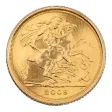
7 listings
Filters
| Product | /oz | Premium | Price | |
|---|---|---|---|---|

 Baird & Co.
|
£3,628.97 | +11.45% | £213.63 | View Deal |
|
QU
Baird & Co.
|
£3,748.05 | +15.10% | £220.64 | View Deal |
 Baird & Co.
£224.51 for 250+
Baird & Co.
£224.51 for 250+
|
£3,945.27 | +21.16% | £232.25 | View Deal |
| £4,081.67 | +25.35% | £240.28 | View Deal | |
|
QU
|
£4,106.14 | +26.10% | £241.72 | View Deal |
 Physical Gold
|
£4,196.17 | +28.86% | £247.02 | View Deal |
| £4,591.97 | +41.02% | £270.32 | View Deal |
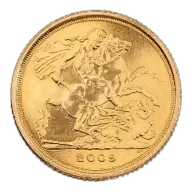
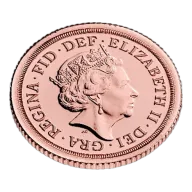

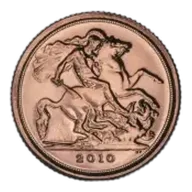

Prices are fetched automatically and may not reflect current merchant prices. Currency conversions and tax treatment are approximate. Rankings are based solely on price. We are not a dealer and accept no responsibility for transactions with listed merchants. Past performance is not indicative of future results. This site does not provide investment advice. Full disclaimer
About the 2g Sovereign Gold Coin
The Smallest CGT-Exempt Gold Coin
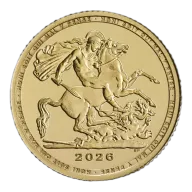
The Quarter Sovereign is the smallest denomination in the Royal Mint's sovereign family, containing 1.831 grams (0.0589 troy ounces) of fine gold at 916.7 millesimal fineness. First issued in 2009, it is the newest member of a coin family that dates back to 1817. At just 13.5 mm in diameter, smaller than a UK 5p coin, it is the most affordable entry point into CGT-exempt gold for UK investors.
The coin's appeal is almost entirely tax-driven. As UK legal tender with a face value of 25 pence, it is exempt from both VAT and Capital Gains Tax. The CGT exemption has no monetary limit and no reporting requirement. For UK taxpayers expecting to realise gains above the £3,000 annual CGT allowance, accumulating quarter sovereigns allows those gains to be entirely tax-free, regardless of the total amount.
The tradeoff is premium efficiency. Manufacturing costs per coin are roughly the same regardless of denomination, but spread across the least gold content in the sovereign range. New-issue quarter sovereigns typically carry premiums of 12-20% over melt value, compared to 3-8% for a full sovereign. Buying four quarter sovereigns costs meaningfully more than one full sovereign, despite containing the same total gold. Pre-owned quarter sovereigns from the secondary market narrow this gap to roughly 8-15% over melt.
The quarter sovereign is essentially a UK-specific product. Outside the UK, where the CGT exemption does not apply, buyers in other markets have well-established local fractional gold products with better liquidity. The 1/10oz Britannia, which contains 3.11 grams of gold and is also CGT-exempt in the UK, is the nearest competitor within the Royal Mint's own range.
Quarter Sovereign Dimensions and Weight
| Specification | Value |
|---|---|
| Fine gold content | 1.831 g (0.0589 troy oz) |
| Total weight | 1.997 g |
| Purity | 916.7 (22 carat) |
| Alloy | 91.67% gold, 8.33% copper |
| Diameter | 13.50 mm |
| Edge | Milled (reeded) |
| Face value | £0.25 (UK legal tender) |
| Manufacturer | The Royal Mint |
| First issued | 2009 |
Sovereign Family Comparison
| Denomination | Fine gold | Total weight | Diameter |
|---|---|---|---|
| Quarter Sovereign | 1.831 g | 1.997 g | 13.50 mm |
| Half Sovereign | 3.661 g | 3.994 g | 19.30 mm |
| Full Sovereign | 7.322 g | 7.988 g | 22.05 mm |
| Double Sovereign | 14.644 g | 15.976 g | 28.40 mm |
Each denomination is an exact weight multiple of the quarter sovereign. The purity and copper alloy composition are identical across all sizes. The 22-carat standard (sometimes called "crown gold") was established by Henry VIII in 1526 and has been maintained for over 500 years in sovereign-type coins. The copper alloying makes these coins harder and more scratch-resistant than 24-carat bullion coins.
Quarter Sovereign Tax Treatment
United Kingdom
VAT: Exempt. The quarter sovereign qualifies as investment gold (purity above 900 millesimal) and is therefore VAT-free at the point of purchase.
Capital Gains Tax: Exempt. Under TCGA 1992, Section 21(1)(b), UK legal tender coins are exempt from Capital Gains Tax. The quarter sovereign is UK legal tender with a face value of 25 pence. This exemption has no annual limit, no monetary threshold, and no reporting requirement. It applies to all sovereign denominations (quarter, half, full, double, quintuple) and to both modern and historic sovereigns.
SIPP: Gold bullion is eligible for UK Self-Invested Personal Pensions. Tax relief at the individual's marginal rate (up to 45%). Gold held within a SIPP is also sheltered from CGT, though for sovereign coins the CGT exemption applies regardless.
The dual exemption (VAT-free on purchase, CGT-free on disposal) is the quarter sovereign's primary selling point. No other gold product at this price point offers the same tax position in the UK.
European Union
VAT-exempt as investment gold under EU Directive 98/80/EC. The coin meets all qualifying criteria. In Germany, capital gains on gold held for more than one year are completely tax-free, making the quarter sovereign an efficient holding for German investors too.
United States
No federal sales tax. State sales tax varies; approximately 35 states exempt bullion. Capital gains on gold are taxed at the collectibles rate of up to 28%. The sovereign's 91.67% purity is below the 99.5% threshold for IRA eligibility, with no statutory exemption. Not IRA-eligible.
Canada
The 916.7 purity is above the 99.5% threshold required for GST/HST exemption on investment gold in coin form. However, Sovereigns are not specifically listed for RRSP eligibility.
Australia and New Zealand
At 916.7 fineness, the quarter sovereign falls below Australia's 99.5% GST-exemption threshold. It may attract 10% GST. In New Zealand, coins below 99.5% purity attract 15% GST. Buyers in Australasia should consider 99.99% purity alternatives for tax efficiency.
From Victorian Pattern to Modern Bullion
The quarter sovereign has an unusual history for a bullion coin. It was first proposed in 1853, when the Royal Mint produced two pattern sets for a gold quarter sovereign, one denominated at five shillings. John Herschel, then Master of the Mint, opposed the idea. He warned that "gold would be lost to the public (either through misplacing the coins or through abrasion) at fifteen times the rate for the same value of sovereigns." The coin was simply too small for practical circulation, and the patterns never entered production.
The idea lay dormant for over 150 years. By 1979, the Royal Mint had begun selling sovereign-family coins to collectors and investors rather than for circulation. Three denominations were available by 1980: the half sovereign, the full sovereign, and the double sovereign. The quarter sovereign was not included.
It was not until 2009 that the Royal Mint introduced the quarter sovereign as the fourth denomination. The first proof issue had a mintage of 13,495 pieces. Bullion versions followed with authorised mintages of 50,000 to 250,000 per year between 2009 and 2012. Production has continued annually since then in both proof and bullion finishes.
Herschel's concern about losing small coins remains valid. At 13.5 mm, the quarter sovereign is smaller than any current UK circulation coin. Modern packaging (sealed capsules, presentation cases) solves the practical problem that doomed the 1853 proposal, but careful storage remains essential. The coin that was too small for Victorian pockets found its market in 21st-century investment portfolios, where its value lies not in handling convenience but in tax efficiency.
Quarter Sovereign vs 1/10oz Britannia and 1/10oz Krugerrand
The quarter sovereign's most direct competitors are other fractional gold coins near the same price point. The comparison is shaped by a fundamental tradeoff: the quarter sovereign contains less gold but offers CGT exemption in the UK.
The 1/10oz Britannia contains 3.11 grams of fine gold at 999.9 purity, roughly 70% more gold than the quarter sovereign's 1.831 grams. The Britannia is also UK legal tender and CGT-exempt. At current prices, the 1/10oz Britannia costs approximately twice as much as a quarter sovereign. For UK investors who can afford the higher unit cost, the Britannia offers more gold per coin with the same tax advantages and better international recognition.
The 1/10oz Krugerrand also contains 3.11 grams of fine gold, though at 916.7 purity (22 carat) like the sovereign. The total coin weight is 3.393 grams. The Krugerrand is not UK legal tender, so it is not CGT-exempt. For UK buyers, the quarter sovereign beats the 1/10oz Krugerrand on tax treatment despite containing less gold.
Against the half sovereign (3.661 g fine gold, also CGT-exempt), the quarter sovereign loses on premium efficiency. Two quarter sovereigns contain the same gold as one half sovereign but cost more to buy due to higher per-coin premiums. The half sovereign's 19.3 mm diameter also makes it less prone to being misplaced. Buyers who can afford the half sovereign's price point get better value for the same tax benefit.
The quarter sovereign's specific advantage is its low absolute price. It is the cheapest CGT-exempt gold coin available from the Royal Mint, making it suitable for regular small purchases, gifts, or building a gold position incrementally without any future CGT liability.
2g Sovereign Gold Coin: frequently asked questions
-
The cheapest Quarter Sovereign we track is £213.63, about 11.4% over spot gold, available from Baird & Co. Prices move with the gold spot price, so check the comparison table above for live quotes across dealers.
-
A Quarter Sovereign weighs 2g in total and contains 1.831 grams of fine gold, equivalent to around 0.0589 troy ounces. It is struck in 22-carat crown gold (916 fineness), meaning 91.67% gold alloyed with copper for durability.
-
The Quarter Sovereign is 22-carat gold, with a fineness of 916.7 (91.67% pure gold). This crown gold alloy, using copper for the remaining 8.33%, has been the standard for British Sovereigns since the 16th century and applies to all denominations.
-
The Sovereign family runs from the Quarter (1.831g fine gold) and Half (3.661g) through the Full Sovereign (7.322g) and Double Sovereign (14.644g) to the Quintuple Sovereign (36.612g). All share the same 22-carat alloy and Pistrucci St George design; the Quarter is the smallest and most affordable entry point.
-
Yes. The Quarter Sovereign is issued by The Royal Mint with a face value of GBP 0.25, making it UK legal tender. As UK legal tender, gold Sovereign coins are exempt from Capital Gains Tax for UK investors under the Taxation of Chargeable Gains Act 1992, and no VAT applies to their purchase.