
 Chards
2 listings Prices & premiums exclude tax to compare across countries

Prices are fetched automatically and may not reflect current merchant prices. Currency conversions and tax treatment are approximate. Rankings are based solely on price. We are not a dealer and accept no responsibility for transactions with listed merchants. Past performance is not indicative of future results. This site does not provide investment advice. Full disclaimer
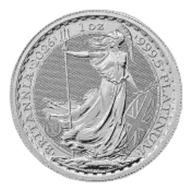
About the 1 oz Britannia Platinum Coin
The 1 oz Platinum Britannia
The Platinum Britannia is The Royal Mint's sovereign platinum bullion coin, first issued in 2018. Each 1 oz coin contains 31.21 grams of 999.5 fine platinum and carries a GBP 100 face value. For UK investors, the Britannia has one feature that no other platinum coin can match: it is exempt from Capital Gains Tax. As UK legal tender denominated in sterling, any profit on disposal is entirely tax-free, regardless of how much the metal appreciates. This exemption applies to all Britannia coins across gold, silver, and platinum.
That CGT exemption is particularly valuable for platinum because the metal carries 20% VAT on purchase in the UK. Gold bullion is VAT-exempt, but platinum and silver are not. The combination of 20% VAT on entry plus CGT on exit would make platinum bars extremely expensive for UK investors on a round-trip basis. The Britannia eliminates the exit tax entirely, meaning the 20% VAT is the only tax cost. For long-term holders who expect platinum to appreciate, the CGT savings can be substantial.
From the 2021 issue onward, the Britannia carries four anti-counterfeiting features that The Royal Mint describes as making it "the world's most visually secure bullion coin." These include a latent image that shifts between a padlock and a trident when the coin is tilted, a surface animation created by picosecond laser technology, micro-text reading "DECUS ET TUTAMEN" ("an ornament and a safeguard"), and heraldic tincture lines on Britannia's shield. All four features are visible to the naked eye under changing light angles, requiring no special equipment to verify.
The Britannia's reverse design changes annually, which distinguishes it from most sovereign bullion coins. Each year features a different artistic interpretation of the Britannia figure, with designs from artists including Philip Nathan, Jody Clark, and Marie-Alice Harel. The obverse carried Queen Elizabeth II's portrait from 2018 to 2022, transitioning to King Charles III from 2023.
Platinum Britannia Dimensions and Composition
| Property | Detail |
|---|---|
| Mint | The Royal Mint (United Kingdom) |
| Metal | Platinum |
| Purity | 999.5 (99.95%) |
| Platinum content | 31.104g (1 troy oz) |
| Total weight | 31.21g |
| Diameter | 32.69 mm |
| Thickness | 3 mm |
| Face value | GBP 100 |
| Edge | Milled (reeded) |
| First issued | 2018 |
The 999.5 purity matches all other major sovereign platinum coins. Achieving higher purity in platinum (such as the 999.9 used in gold Britannias since 2013) is not practical due to platinum's refining characteristics. Every major mint producing platinum bullion uses the 999.5 standard.
The 32.69mm diameter and 3mm thickness are identical to the gold Britannia, though the platinum version weighs slightly less overall (31.21g versus 31.21g for gold at 999.9 purity) because platinum's higher density means the same troy weight occupies a slightly different volume. In practice, the two coins are visually and dimensionally near-identical.
Security Features (2021 Onward)
| Feature | Description |
|---|---|
| Latent image | Shifts between padlock and trident depending on viewing angle |
| Surface animation | Wave-like pattern behind Britannia, created by picosecond lasers at submicron scale |
| Micro-text | "DECUS ET TUTAMEN" encircling Britannia, barely visible to the naked eye |
| Tincture lines | Heraldic line patterns on Britannia's shield depicting colours through engraving |
Platinum Britannia Tax Treatment by Country
The Britannia's tax profile is defined by its UK legal tender status, which creates a significant advantage for UK investors but has no effect in other jurisdictions where it is treated as standard platinum bullion.
- United Kingdom: CGT-exempt. Sterling legal tender coins are not chargeable assets for Capital Gains Tax. This applies to all Britannia denominations and all metals. However, 20% VAT applies on purchase for platinum (unlike gold Britannias, which are VAT-free). VAT-free vault storage (platinum held outside the UK, typically in Switzerland or Singapore) avoids the 20% VAT for as long as the metal remains in the vault; importing to the UK triggers the full VAT liability. The Britannia is also SIPP-eligible for UK pension investors.
- United States: The 999.5 purity meets the IRS threshold for platinum IRA eligibility (99.95%). Post-2018 Platinum Britannias qualify. Sales tax varies by state. Outside retirement accounts, taxed as a collectible at up to 28%.
- Canada: GST/HST exempt for platinum at 99.5% purity or above.
- Australia: GST-free for platinum at 99% purity or above. Capital gains tax applies with a 50% discount for holdings exceeding 12 months.
- New Zealand: GST-exempt for platinum at 99% purity or above. No capital gains tax.
- Singapore: GST-exempt under the Investment Precious Metals scheme for qualifying legal tender platinum coins. No capital gains tax.
- Hong Kong: No sales tax, no duties, no capital gains tax.
- South Africa: 15% VAT on platinum. No exemption.
- European Union: Standard VAT at local rates (17-27%). Platinum does not qualify under the EU Investment Gold Directive, but the Directive is irrelevant here as this is a platinum product.
The Britannia in Platinum: A Late but Significant Addition
The Royal Mint launched the gold Britannia in 1987 and the silver version in 1997, but platinum had to wait until 2018. The 21-year gap between silver and platinum reflects platinum's slow development as a retail investment metal. The first modern platinum bullion coin was the Isle of Man Noble in 1983, followed by the Australian Koala in 1987 and the Canadian Maple Leaf in 1988. The American Platinum Eagle arrived in 1997. By the time the Platinum Britannia was introduced, platinum had been trading below gold since 2015, historically unusual for a metal that commanded a premium to gold from the mid-1990s through 2014.
The 2018 launch year placed the Platinum Britannia in a wave of new sovereign platinum coins. The Austrian Platinum Philharmonic debuted in 2016, and the Australian Platinum Kangaroo also launched in 2018. These simultaneous introductions reflected growing mint interest in platinum despite (or perhaps because of) its discount to gold.
The Britannia design itself draws on imagery dating to Roman Britain. The figure of Britannia, a female personification of the British Isles, has appeared on British coinage since the reign of Charles II in 1672. Philip Nathan created the original standing Britannia design for the 1987 gold launch, and various artists have contributed new interpretations since. The 2021 redesign by Philip Nathan integrated the four security features that The Royal Mint developed using picosecond laser technology, a first for coin production worldwide.
A notable quirk of the Britannia programme is the 2014 Mule error. Approximately 17,000 gold Britannias were struck with an incorrect obverse die from the Lunar Year series. These "Mule Britannias" now command significant premiums from collectors, though they were produced entirely by accident and have no special metallic value.
Platinum Britannia vs Eagle, Maple Leaf, Kangaroo, and Philharmonic
The American Platinum Eagle is the Britannia's main competitor in the platinum coin market. The Eagle has a longer track record (1997 versus 2018) and deeper liquidity in the US market. It carries explicit statutory IRA eligibility. The Britannia's advantages are CGT exemption in the UK and the four-feature security package introduced in 2021. In practical terms, the choice is geographic: UK buyers should favour the Britannia for its tax benefits; US buyers should favour the Eagle for its IRA eligibility and domestic dealer availability.
The Canadian Platinum Maple Leaf is often the most competitively priced sovereign platinum coin, carrying slightly lower premiums than either the Eagle or the Britannia. The Maple Leaf benefits from the Royal Canadian Mint's Bullion DNA authentication system and the longest continuous production run in platinum (since 1988, with intermittent gaps). For buyers purely focused on acquiring platinum at the lowest premium, the Maple Leaf is frequently the best value.
The Australian Platinum Kangaroo shares several features with the Britannia: both launched in 2018, both change their reverse design annually, and both carry domestic tax advantages (GST-free in Australia, CGT-exempt in the UK). The Kangaroo is strongest in the Asia-Pacific market, while the Britannia dominates UK sales. The Kangaroo's micro-laser engraved letter is a simpler authentication feature than the Britannia's four-feature package.
The Austrian Platinum Philharmonic (2016) is the most popular platinum coin in continental European markets. It carries a EUR 100 face value and uses the same design as the well-known gold and silver Philharmonic. The Philharmonic's fixed design contrasts with the Britannia's annual rotation. For European buyers, the Philharmonic benefits from established dealer networks across the continent.
All five coins share 999.5 purity and are produced by sovereign mints with LBMA accreditation. Platinum bars, such as the 1 oz Valcambi platinum bar, offer lower premiums (5-10% versus 8-15% for coins) but lack the CGT exemption, security features, and sovereign mint backing. For UK investors specifically, the Britannia's CGT exemption makes it the default platinum product despite its higher premium relative to bars.
1 oz Britannia Platinum Coin: frequently asked questions
-
The cheapest 1oz Platinum Britannia we track is £1,480.38 from Chards, carrying a premium of 9.7% over the £1,348.90 platinum spot price. The Platinum Britannia is struck by The Royal Mint at 999.5 fineness and has been issued since 2018, giving it a shorter track record than the gold and silver versions.
-
As UK legal tender, all Britannia coins including the platinum version are exempt from UK Capital Gains Tax. This CGT exemption applies because sterling-denominated legal tender is not a chargeable asset under UK tax law. US investors pay up to 28% on gains from platinum coins. In Canada, 50% of any gain is included in taxable income at your marginal rate.
-
Platinum coins generally have a smaller secondary market than gold. Fewer dealers actively trade platinum bullion, trading volumes are lower, and buyer demand is narrower than for gold or silver coins. This means resale may take longer or require accepting a wider spread. Liquidity constraints are inherent to the platinum market as a whole, regardless of which coin you hold.
-
Platinum is estimated to be significantly rarer than gold in the earth's crust, and annual mining output is considerably lower. It is extracted from a small number of mining regions worldwide, whereas gold is mined more broadly across many countries. This geological scarcity is part of why the platinum market is smaller and why premiums can be higher relative to spot than those on gold bullion.