
19 listings
Filters
| Product | /oz | Premium | Price | |
|---|---|---|---|---|

 Bullion Standard
|
$4,636.52 | +5.18% | $463.66 | View Deal |
 IDC Coin and Bullion
|
$4,994.02 | +13.29% | $499.41 | View Deal |
 Golden Eagle Coins
|
$5,227.32 | +18.58% | $522.74 | View Deal |
 Golden Eagle Coins
|
$5,622.61 | +27.55% | $562.27 | View Deal |
 Golden Eagle Coins
|
$5,710.51 | +29.55% | $571.06 | View Deal |
 The Bullion Bank
|
$5,780.61 | +31.14% | $578.07 | View Deal |
 Golden Eagle Coins
|
$5,930.11 | +34.53% | $593.02 | View Deal |
 Golden Eagle Coins
|
$6,018.00 | +36.52% | $601.81 | View Deal |
 Golden Eagle Coins
|
$6,018.00 | +36.52% | $601.81 | View Deal |
 Golden Eagle Coins
|
$6,149.70 | +39.51% | $614.98 | View Deal |
 Golden Eagle Coins
|
$6,149.70 | +39.51% | $614.98 | View Deal |
 Golden Eagle Coins
|
$6,149.70 | +39.51% | $614.98 | View Deal |
 Golden Eagle Coins
|
$6,149.70 | +39.51% | $614.98 | View Deal |
 Golden Eagle Coins
|
$6,149.70 | +39.51% | $614.98 | View Deal |
 Golden Eagle Coins
|
$6,369.40 | +44.49% | $636.95 | View Deal |
 Golden Eagle Coins
|
$6,369.40 | +44.49% | $636.95 | View Deal |
 Golden Eagle Coins
|
$6,588.99 | +49.47% | $658.91 | View Deal |
 Golden Eagle Coins
|
$6,588.99 | +49.47% | $658.91 | View Deal |
 Golden Eagle Coins
|
$6,588.99 | +49.47% | $658.91 | View Deal |










Prices are fetched automatically and may not reflect current merchant prices. Currency conversions and tax treatment are approximate. Rankings are based solely on price. We are not a dealer and accept no responsibility for transactions with listed merchants. Past performance is not indicative of future results. This site does not provide investment advice. Full disclaimer
About the 1/10 oz Panda Gold Coin
The 1/10 oz Gold Panda
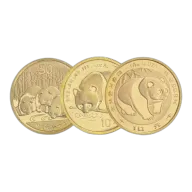
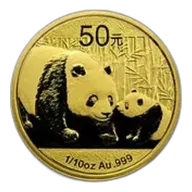
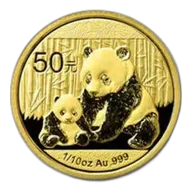
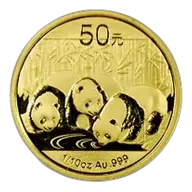
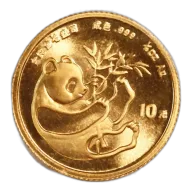
The gold Panda is the most unusual coin in the fractional bullion market. Produced by the China Gold Coin Corporation (CGCC) under the People's Bank of China, it is the only major bullion coin struck at multiple facilities (Beijing, Shanghai, Shenyang, and Shenzhen) without standardised mintmarks, the only one to have switched from troy ounces to metric grams, and the only one where counterfeiting is a significant and documented concern.
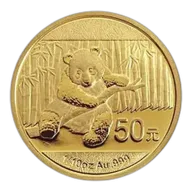
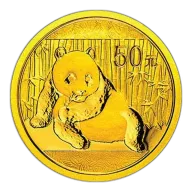
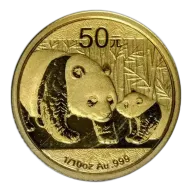
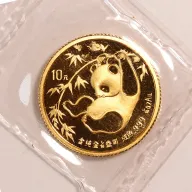
Pre-2016, the smallest standard gold Panda was a 1/10 oz coin containing 3.110 g of 999 fine gold. In 2016, China switched the entire series to metric weights: the nearest equivalent became the 3 g coin (0.0965 troy oz), containing 3.5% less gold than a standard 1/10 oz. Dealers often list both pre- and post-2016 coins under the 1/10 oz label, but the distinction matters. The 3 g coin carries a 50 yuan face value, compared to 10 yuan on the original 1/10 oz version.
The Panda's core appeal is its annually changing reverse design, featuring the giant panda in different poses. The obverse has never changed: the Hall of Prayer for Good Harvests at Beijing's Temple of Heaven complex has appeared since 1982. This combination of a fixed, culturally significant obverse and an annually varying reverse creates collector demand that pushes premiums above typical bullion levels. The 2001 and 2002 coins share an identical reverse (a design freeze that was reversed after collector backlash), making them the only exception to the annual design rule.
Buyers should be aware that the gold Panda is generally not IRA-eligible in the United States, unlike competitors from Western mints. The IRS does not recognise the CGCC as an approved foreign mint for gold IRA purposes. This catches many investors by surprise, particularly since Silver Pandas are typically accepted for IRA inclusion.
Gold Panda Specifications: Troy Ounce vs Metric Era
Pre-2016 (Troy ounce denominations, 999 fine)
| Face value | Weight | Pure gold (g) | Diameter (mm) |
|---|---|---|---|
| 5 yuan | 1/20 oz | 1.555 | 13.92 |
| 10 yuan | 1/10 oz | 3.110 | 17.95 |
| 25 yuan | 1/4 oz | 7.776 | 21.95 |
| 50 yuan | 1/2 oz | 15.552 | 27.00 |
| 100 yuan | 1 oz | 31.103 | 32.05 |
Post-2016 (Metric grams, 999 fine)
| Face value | Weight | Pure gold (g) | Diameter (mm) |
|---|---|---|---|
| 10 yuan | 1 g | 1.000 | 10.00 |
| 50 yuan | 3 g | 3.000 | 18.00 |
| 100 yuan | 8 g | 8.000 | 22.00 |
| 200 yuan | 15 g | 15.000 | 27.00 |
| 500 yuan | 30 g | 30.000 | 32.00 |
The switch to metric grams preserved the coin diameters but reduced the gold content at each price point. The 3 g coin (the post-2016 equivalent of 1/10 oz) contains 0.111 g less gold than the pre-2016 version. Physical dimensions remained unchanged to maintain compatibility with existing tubes and capsules.
The 999 fine purity (three nines) is below the 9999 standard used by the Maple Leaf, Britannia, Kangaroo, and Philharmonic. This difference is small in absolute terms (0.1% more base metal) but relevant for purity-threshold tax rules in some jurisdictions.
Gold Panda Tax and IRA Status
The Panda's tax treatment varies more than most competitors due to its 999 purity (versus the 999.9 standard) and its IRA status in the US.
United States
Gold Pandas are generally not IRA-eligible. The IRS does not recognise the CGCC as an approved foreign mint for gold IRA purposes, and the coins' semi-numismatic nature can classify them as collectibles. Some IRA custodians may accept 999+ purity sovereign coins on a case-by-case basis, but this is not guaranteed. Silver Pandas are typically accepted for IRA inclusion (meeting the 999 silver threshold). This gold/silver distinction is a notable difference from Western mints, where both metals qualify. Capital gains are taxed at the collectibles rate of up to 28%. State sales tax varies.
United Kingdom
VAT-exempt as investment gold (999 fine meets the 995+ threshold for post-1800 legal tender coins). Not CGT-exempt (not UK legal tender). Premiums are typically higher than on Britannias or Maple Leafs.
Australia
At 999 fine (99.9%), the gold Panda meets Australia's 99.5% threshold for GST-free investment gold. Capital gains tax applies with a 50% discount for holdings over 12 months.
Canada
GST/HST-exempt as investment gold. Not eligible for RRSPs or TFSAs.
European Union
Gold Pandas are VAT-exempt under the EU investment gold directive. In Germany, gains are tax-free after one year of holding.
Singapore and Hong Kong
GST-exempt in Singapore. No tax of any kind in Hong Kong. Strong demand in both markets due to regional proximity to China and cultural connection to the panda.
1/10 oz Gold Panda vs Competitors
The Panda occupies a hybrid position between bullion and collectible. Its premiums are higher than pure bullion coins, its security features are weaker, and its IRA status is restricted. The annually changing designs and cultural significance provide compensating value for collectors.
vs 1/10 oz Maple Leaf
The 1/10 oz Maple Leaf is 999.9 fine versus the Panda's 999, IRA-eligible, and carries substantially lower premiums. The Maple Leaf's Bullion DNA provides authentication technology that the Panda entirely lacks. The Maple Leaf contains a full 1/10 oz (3.11 g) of gold; the post-2016 Panda contains 3 g (3.5% less). For pure bullion investment, the Maple Leaf is the superior product on every measurable dimension except design variety.
vs 1/10 oz Kangaroo
The 1/10 oz Kangaroo shares the annually changing design appeal at 999.9 purity with lower premiums and better provenance (single mint with "P" mintmark). The Kangaroo is IRA-eligible; the Panda generally is not. The Kangaroo also contains 3.11 g of gold versus the post-2016 Panda's 3 g. The Panda's advantage is its cultural significance in Chinese-speaking markets and its established collector base for zodiac-themed designs.
vs 1/10 oz Perth Lunar
The 1/10 oz Perth Lunar competes directly for the same collector demographic: annual designs with Asian cultural themes. The Lunar is 999.9 fine, IRA-eligible, and has clearer provenance. Both carry collector premiums above bullion. The Panda has stronger brand recognition in mainland China; the Lunar has a broader international collector base and better security features (Series III includes micro-laser engraving).
Counterfeiting risk
The Panda series has been disproportionately targeted by counterfeiters compared to other major bullion coins. The annually changing designs make it harder for casual observers to spot fakes by comparison, and the absence of sophisticated security features compounds the problem. NGC has flagged that "skillful counterfeits are endangering the integrity of the Chinese Panda coin series." Buying from established dealers or purchasing NGC/PCGS-certified coins significantly reduces this risk. This counterfeiting concern does not apply at the same level to Western mint coins with advanced security technology.
1/10 oz Panda Gold Coin: frequently asked questions
-
The cheapest 1/10oz Gold Panda listed here is $463.66, stocked by Bullion Standard. That price includes a premium of 5.2% over the gold spot price, reflecting the coin's collector appeal and smaller denomination.
-
The Chinese Gold Panda is a gold bullion coin produced by the China Gold Coin Corporation, a state-owned company, and issued as legal tender of the People's Republic of China. First struck in 1982, it is notable for a new panda illustration on the reverse each year, while the Temple of Heaven obverse design has remained constant. Gold Pandas are .999 fine and come in several sizes; from 2016 the standard sizes shifted from troy ounces to metric grams.
-
A 1/10 troy ounce Gold Panda weighs 1/10 oz (3.1104 g). From 2016, China's standard Panda denominations switched to metric gram weights, so newer coins are labelled by gram weight rather than fractional troy ounces, but older 1/10 oz issues contain the same 3.110 g of .999 fine gold.
-
Gold Panda coins are legal tender of China, not of the buyer's home country, so domestic CGT exemptions that apply to locally issued coins do not generally extend to them. In the UK, gains are taxable at 18% or 24% (after the £3,000 annual exempt amount). US investors pay up to 28% on collectible coin gains. In Canada, 50% of any gain is included in taxable income. Investment gold itself is VAT-free in the UK, EU, and Canada regardless.