25 listings
Filters
| Product | /oz | Premium | Price | |
|---|---|---|---|---|

 Golden Eagle Coins
|
$4,464.05 | +1.27% | $4,464.05 | View Deal |
 Bullion Standard
|
$4,487.24 | +1.80% | $4,487.24 | View Deal |
 Coins Online
|
$4,525.20 | +2.66% | $4,525.20 | View Deal |
 IDC Coin and Bullion
|
$4,548.10 | +3.18% | $4,548.10 | View Deal |
 Golden Eagle Coins
|
$4,548.88 | +3.19% | $4,548.88 | View Deal |
|
1
BullionStar US
|
$4,550.14 | +3.22% | $4,550.14 | View Deal |
 Golden Eagle Coins
|
$4,570.85 | +3.69% | $4,570.85 | View Deal |
| $4,613.07 | +4.65% | $4,613.07 | View Deal | |
 Golden Eagle Coins
|
$4,614.80 | +4.69% | $4,614.80 | View Deal |
 Golden Eagle Coins
|
$4,615.05 | +4.69% | $4,615.05 | View Deal |
 SD Bullion
|
$4,623.86 | +4.89% | $4,623.86 | View Deal |
 Bullion Standard
|
$4,636.73 | +5.19% | $4,636.73 | View Deal |
 Golden Eagle Coins
|
$4,636.78 | +5.19% | $4,636.78 | View Deal |
 Golden Eagle Coins
|
$4,636.78 | +5.19% | $4,636.78 | View Deal |
|
20
BullionStar US
|
$4,637.72 | +5.21% | $4,637.72 | View Deal |
 Golden Eagle Coins
|
$4,645.05 | +5.38% | $4,645.05 | View Deal |
 Golden Eagle Coins
|
$4,665.05 | +5.83% | $4,665.05 | View Deal |
 Golden Eagle Coins
|
$4,680.73 | +6.18% | $4,680.73 | View Deal |
 Golden Eagle Coins
|
$4,735.05 | +7.42% | $4,735.05 | View Deal |
 Golden Eagle Coins
|
$4,745.05 | +7.64% | $4,745.05 | View Deal |
 Golden Eagle Coins
|
$4,765.05 | +8.10% | $4,765.05 | View Deal |
 IDC Coin and Bullion
|
$4,893.95 | +11.02% | $4,893.95 | View Deal |
 IDC Coin and Bullion
|
$4,894.04 | +11.02% | $4,894.04 | View Deal |
 Golden Eagle Coins
|
$4,922.46 | +11.67% | $4,922.46 | View Deal |
|
20
BullionStar US
|
$4,988.07 | +13.16% | $4,988.07 | View Deal |











Prices are fetched automatically and may not reflect current merchant prices. Currency conversions and tax treatment are approximate. Rankings are based solely on price. We are not a dealer and accept no responsibility for transactions with listed merchants. Past performance is not indicative of future results. This site does not provide investment advice. Full disclaimer
About the 1 oz Panda Gold Coin
China's Annual-Design Bullion Coin in Pre-2016 Format
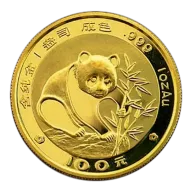
The 1 oz Gold Panda refers specifically to pre-2016 coins containing a full troy ounce (31.103 g) of .999 fine gold. In 2016, China switched the Panda programme from troy ounces to metric grams, and the standard gold coin became a 30 g piece containing 0.9645 troy ounces. This page covers the original 1 oz format, which carries a face value of 100 yuan (later 500 yuan from 2001) as legal tender of the People's Republic of China.
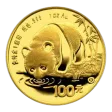
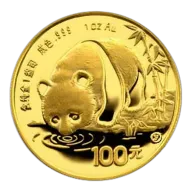
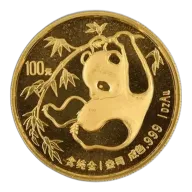
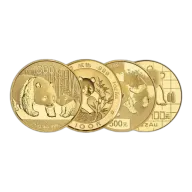
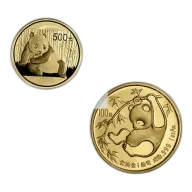
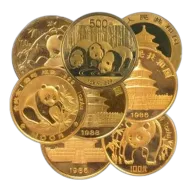
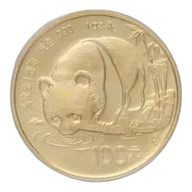
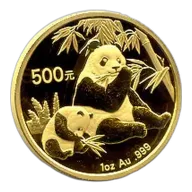
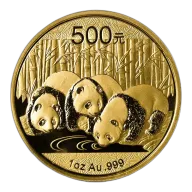
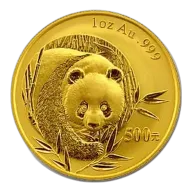
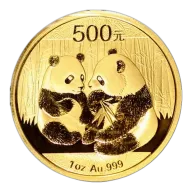
The Panda's distinguishing feature is its annually changing reverse design. Each year brings a new giant panda illustration, depicted in varying poses: eating bamboo, resting, playing, walking with cubs. This rotating design model, shared with the 1oz Perth Lunar Gold Coin but rare among bullion coins generally, gives every annual release a distinct identity. The obverse has remained unchanged since 1982: the Hall of Prayer for Good Harvests (Qinian Dian) at Beijing's Temple of Heaven complex.
The Panda occupies a hybrid position between pure bullion investment and numismatic collecting. Its annual design changes, variable mintages, and cultural significance in Chinese markets create collector premiums that coins with fixed designs do not carry. This means higher buy-in costs and wider bid-ask spreads compared to the 1oz Gold Maple Leaf or 1oz Gold Philharmonic, which are produced in large volumes with no collector surcharge.
Counterfeiting is a more significant concern with the Panda than with most comparable coins. The annually changing designs make fakes harder to spot by casual comparison, and the series lacks a digital authentication system equivalent to the Royal Canadian Mint's Bullion DNA. Buying from established dealers or purchasing NGC/PCGS-certified coins is strongly recommended.
1 oz Gold Panda Technical Details (Pre-2016)
| Attribute | Detail |
|---|---|
| Metal content | 1 troy oz (31.103 g) fine gold |
| Purity | .999 (99.9%) |
| Diameter | 32.05 mm |
| Thickness | 2.70 mm |
| Face value | 100 yuan (1982-2000); 500 yuan (2001-2015) |
| Edge | Reeded |
| Issuer | China Gold Coin Corporation (CGCC) |
| Striking facilities | Beijing, Shanghai, Shenyang, Shenzhen |
| First issued | 1982 |
Gold Panda Size Comparison (Pre-2016 vs Post-2016)
| Pre-2016 | Post-2016 | Face value | Diameter |
|---|---|---|---|
| 1 oz (31.103 g) | 30 g (0.9645 oz) | 500 yuan | 32 mm |
| 1/2 oz (15.552 g) | 15 g (0.4823 oz) | 200 yuan | 27 mm |
| 1/4 oz (7.776 g) | 8 g (0.2572 oz) | 100 yuan | 22 mm |
| 1/10 oz (3.110 g) | 3 g (0.0965 oz) | 50 yuan | 18 mm |
| 1/20 oz (1.555 g) | 1 g (0.0322 oz) | 10 yuan | 10 mm |
The switch to metric grams in 2016 reduced gold content by 3.5% for the standard denomination. Physical dimensions (diameter and thickness) remained unchanged between the old and new formats. Larger sizes (5 oz, 12 oz, 1 kg) were produced occasionally in the pre-2016 era.
Panda coins are struck at multiple facilities across China without standardised mint marks, making attribution to a specific mint difficult. Some years have subtle die differences that specialists can identify, but this is not a reliable authentication method.
Panda Tax Treatment by Country
The Panda's tax treatment varies more between jurisdictions than most sovereign gold coins, particularly regarding US retirement accounts.
- United States: Gold Pandas are generally not IRA-eligible. The IRS does not recognise the Chinese mint as an approved foreign mint for IRA purposes, and the coins' semi-numismatic character can classify them as collectibles rather than qualifying bullion. Some custodians may accept .999 purity sovereign coins under the generic bullion provision, but this is custodian-dependent. Silver Pandas are typically accepted for IRA inclusion at .999 purity. This gold-versus-silver distinction catches many investors off guard. Capital gains are taxed at the collectibles rate of up to 28%. State sales tax varies.
- United Kingdom: Gold Pandas are VAT-free as investment gold (the .999 purity and sovereign legal tender status meet the threshold). Not CGT-exempt; only UK legal tender coins qualify. Capital gains are taxed at the individual's rate, subject to the £3,000 annual allowance.
- European Union: VAT-exempt under the EU Investment Gold Directive. Germany offers complete capital gains exemption on bullion held for more than one year.
- Canada: GST/HST exempt at .999 purity (above the 99.5% threshold). Capital gains are taxed at a 50% inclusion rate. Not RRSP or TFSA eligible.
- Australia: GST-free as investment-grade gold (exceeds 99.5% purity). CGT applies with a 50% discount for holdings over 12 months.
- Singapore: GST-exempt as an Investment Precious Metal. No capital gains tax. Strong market presence due to regional proximity to China.
- Hong Kong: No sales tax, no import duty, no capital gains tax. Popular among collectors.
From Cultural Export to Collector Favourite
The Gold Panda launched in 1982, one year after the 1 oz Gold Libertad and three years after the Gold Maple Leaf. China's motivation was partly commercial (monetising domestic gold reserves) and partly diplomatic (a soft-power cultural export during a period of economic opening under Deng Xiaoping). The panda was a natural choice of motif: China's most recognisable animal and an international symbol of the country.
The annual design change was a core principle from inception. Each year's reverse depicts a new giant panda composition, a practice that has continued unbroken since 1982 with one exception. In 2001, a design freeze was announced, and the 2002 Panda carried the identical reverse design to the 2001 coin. Collector backlash was significant enough that China reverted to annual changes from 2003 onwards. The shared design makes 2001 and 2002 Pandas distinguishable only by the date on the obverse.
The silver Panda has a more complicated early history. The first silver issue in 1983 was proof-only, containing 27 grams of .900 fine silver. In 1987, purity changed to .925 sterling silver. No silver Pandas were produced in 1986 or 1988. The series settled into its current .999 fine silver standard in 1989. Early proof silver Pandas with low mintages have appreciated dramatically; the 1983 proof (mintage 10,000) commands approximately $16,430 in top grade.
The most significant change in the programme's history came in 2016, when China switched all Panda denominations from troy ounces to metric grams. The standard gold coin became 30 g (0.9645 troy ounces) rather than 1 troy ounce (31.103 g), reducing gold content by 3.5%. China cited alignment with the metric system used domestically. Critics noted that the change effectively reduced gold content while maintaining similar pricing. Physical dimensions were unchanged, making the pre-2016 and post-2016 coins visually similar but materially different.
A separate 2015 anomaly also drew criticism: that year's gold Pandas were issued without denomination, weight, fineness, or metal inscriptions, carrying only the panda image and year. This absence of standard markings was seen as both aesthetically problematic and a counterfeiting risk. The practice was not repeated.
Panda vs Maple Leaf, Kangaroo, and Britannia
The 1 oz Gold Panda's closest structural competitor is the 1oz Perth Lunar Gold Coin, which also features annually changing designs tied to Asian cultural themes. The Lunar is .9999 fine versus the Panda's .999, and is struck at a single facility (Perth Mint) with clear provenance. The Panda is produced across multiple Chinese mints without standardised mint marks. The Lunar has micro-laser engraving as a security feature from Series III; the Panda lacks any comparable digital authentication system. Both carry higher premiums than fixed-design coins due to their collector appeal, but the Lunar's single-source production and security features give it an authentication advantage.
The 1oz Gold Maple Leaf outperforms the Panda on nearly every objective metric except collectibility. The Maple Leaf is .9999 fine (versus .999), has the Bullion DNA verification system, carries lower premiums, and is unambiguously IRA-eligible. The Maple Leaf's fixed design means every year's coin is functionally identical, which is exactly the opposite of the Panda's appeal. Buyers who see bullion purely as a gold-accumulation exercise will prefer the Maple Leaf. Buyers who value the annual-design collecting dimension will find the Panda more engaging.
The 1oz Gold Britannia is .9999 fine, CGT-exempt in the UK, and carries a four-feature security suite. It is the stronger choice for UK investors on virtually every practical measure. The Panda's advantage is limited to its collector appeal and cultural significance in Asian markets.
Counterfeiting risk is the Panda's most serious practical disadvantage. The combination of annually changing designs (which make comparison harder), production across multiple facilities without clear mint marks, higher collector premiums (which incentivise counterfeiting), and less sophisticated security features creates a threat profile that exceeds any other major bullion coin. This does not make Pandas a poor investment, but it does make the choice of dealer critically important and certification (NGC/PCGS) particularly valuable for secondary-market purchases.
1 oz Panda Gold Coin: frequently asked questions
-
The cheapest 1 oz Gold Panda listed on BullionFerret right now is $4,464.05 from Golden Eagle Coins, at around 1.3% over the gold spot price of $4,408.10. Gold Pandas typically carry a higher premium than comparable coins because the design changes every year, adding a collector dimension on top of the metal content.
-
Yes. The 1 oz Gold Panda is struck in 999 fine gold (24 karat), weighing 31.1035 g. Note that from 2016 onwards the standard Panda shifted to 30 grams (0.9645 troy oz) rather than a full troy ounce, so buyers comparing pre- and post-2016 coins should check the exact weight. The purity has remained .999 throughout the series.
-
The Panda's reverse design changes every year, turning each annual issue into its own collectible and sustaining collector demand long after the year of issue. That cross-over appeal between bullion and numismatics means buyers compete not just on metal value but on the specific design, pushing premiums above those of coins with fixed reverses. Lower global distribution outside China also contributes.
-
The Gold Panda is an annual gold bullion coin produced by China Gold Coin Group Co., Ltd under the authority of the People's Bank of China. First issued in 1982, it features a fixed Temple of Heaven obverse and a new panda reverse design each year. The coin is legal tender in the People's Republic of China and is distributed through authorised dealers worldwide.