 IDC Coin and Bullion
4 listings




Prices are fetched automatically and may not reflect current merchant prices. Currency conversions and tax treatment are approximate. Rankings are based solely on price. We are not a dealer and accept no responsibility for transactions with listed merchants. Past performance is not indicative of future results. This site does not provide investment advice. Full disclaimer
About the 1 oz Pobjoy Mint Noble Platinum Coin
The Noble: The Coin That Started Platinum Bullion
The 1 oz Pobjoy Mint Noble holds a unique place in precious metals history. Issued by the Isle of Man Government and first struck in November 1983, it was the world's first platinum bullion coin created specifically for investors. Every platinum coin that followed, from the Australian Koala to the American Eagle to the Britannia, owes something to the Noble's proof of concept: that platinum could work as a retail investment metal alongside gold and silver.
The platinum Noble's production history is short. It ran for just six years, from 1983 to 1989, before being discontinued due to insufficient investor demand for platinum at the time. That brevity makes surviving examples genuinely scarce compared to continuously minted competitors. The coin carries a face value denominated simply as "ONE NOBLE" with no fixed monetary amount, following the same model as the Krugerrand and Mexican Libertad, where legal tender value floats with the metal price.
Three different private mints produced Noble coins over the years: Pobjoy Mint (1983-2016), Coin Investment Trust (2017), and Tower Mint (2018). Gold and silver variants were introduced from 1994 and continued sporadically through 2018, but the platinum Noble remains the series' most historically significant version. No regular production has occurred since 2018, and the series appears dormant.
For modern platinum buyers, the Noble is primarily a collector piece with historical significance rather than a cost-efficient bullion purchase. Its limited production window and low mintages mean premiums sit above those of current sovereign platinum coins like the Platinum Maple Leaf or Platinum Philharmonic. Buyers who value the coin's pioneering status and scarcity will find it compelling; those focused on lowest cost per ounce of platinum will look elsewhere.
Noble Platinum Coin Dimensions and Denominations
| Attribute | Value |
|---|---|
| Weight | 1 troy oz (31.10 g) |
| Purity | 999.5 (99.95% fine platinum) |
| Diameter | 32.7 mm |
| Thickness | 2.38 mm |
| Face Value | ONE NOBLE (no fixed monetary value) |
| Edge | Reeded |
| Manufacturer | Pobjoy Mint (original series) |
| Legal Tender | Isle of Man |
Available Denominations (Platinum, 1983-1989)
| Size | Weight | Diameter | Purity |
|---|---|---|---|
| 1 oz | 31.10 g | 32.7 mm | 999.5 |
| 1/2 oz | 15.55 g | 25.1 mm | 999.5 |
| 1/4 oz | 7.78 g | 22.0 mm | 999.5 |
| 1/10 oz | 3.11 g | 17.0 mm | 999.5 |
| 1/20 oz | 1.56 g | 14.0 mm | 999.5 |
Rare proof editions were also produced in 5 oz (mintage: 26 pieces in 1986) and 10 oz (15 pieces in 1988), placing them among the scarcest modern platinum coins in existence. The 1985 bullion 1 oz Noble had a mintage of 99,000, making it the most common date in the series.
Noble Platinum Coin Tax Treatment
The Noble's tax position is complicated by its Isle of Man origin. The Isle of Man is a British Crown Dependency but not part of the United Kingdom, and Noble coins are not Royal Mint legal tender. This distinction affects CGT treatment in the UK.
United Kingdom
Noble platinum coins carry 20% VAT on purchase, the same as all platinum bullion in the UK. The CGT position is less clear-cut than for Royal Mint coins. Noble coins are not automatically CGT-exempt because they are not UK legal tender struck by the Royal Mint. Some dealers have listed certain Isle of Man gold coins as CGT-exempt under specific criteria, but this interpretation should be verified with a tax adviser. By contrast, the Platinum Britannia is unambiguously CGT-exempt as UK legal tender. UK buyers seeking tax efficiency in platinum should favour the Britannia.
United States
The Platinum Noble meets the IRS purity requirement of 99.95% for self-directed precious metals IRAs, making it IRA-eligible. Capital gains are taxed at the collectibles rate of up to 28%. Most states exempt investment-grade bullion from sales tax.
Isle of Man
The Noble is legal tender on the Isle of Man at the value of its platinum content (no fixed denomination). The Isle of Man has no capital gains tax, making it one of the most favourable jurisdictions for holding bullion.
Australia and New Zealand
Both countries exempt platinum at 99% purity or above from GST. The Noble's 999.5 fineness qualifies. Australia applies CGT with a 50% discount for holdings over 12 months; New Zealand has no CGT.
Canada
Platinum at 99.5% purity or above is GST/HST-exempt. The Noble qualifies. Capital gains are taxed at a 50% inclusion rate.
Singapore and Hong Kong
Singapore exempts qualifying platinum coins (99% purity, legal tender) from GST. Hong Kong charges no sales tax, duties, or CGT on bullion.
The World's First Platinum Investment Coin
Before 1983, no government or semi-sovereign entity had struck platinum specifically for investors. Platinum was an industrial metal used in automotive catalytic converters, jewellery, and laboratory equipment, but it had no dedicated retail investment product. Small bars from Japanese dealer Tanaka Kogyo existed from the late 1970s, but there was no platinum coin equivalent of the Krugerrand or Maple Leaf.
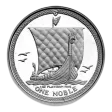
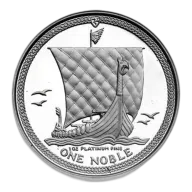
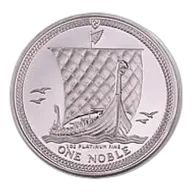
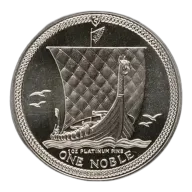
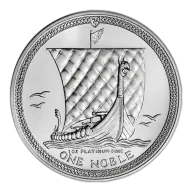
The Isle of Man Government changed this by authorising the Noble in 1983. The coin was produced by Pobjoy Mint, a private mint based in Surrey, England, that held the contract for Isle of Man coinage. The reverse design depicted a Viking longship with four birds and the Isle of Man's triskelion (three-legged coat of arms), reflecting the island's Norse heritage. The obverse carried a portrait of Queen Elizabeth II.
The coin's name reached back to the 14th century: the original Noble was an English gold coin introduced by Edward III. The platinum Noble adopted this medieval reference while pioneering an entirely new metal for the numismatic investment market.
Five sizes were offered, from 1/20 oz to 1 oz, giving investors fractional access at a time when platinum traded in the $300-$500 range. The 1 oz coin was the anchor product, and its 999.5 fineness established the purity standard that every subsequent platinum coin would adopt. Production ran through 1989, but demand never reached the levels that gold coins achieved, and the platinum Noble was discontinued after six years.
The coin's impact outlasted its production. The Australian Koala followed in 1988, the Maple Leaf in 1988, and the American Eagle in 1997, each building on the template the Noble had established. In 1996, Pobjoy Mint produced what it claimed was the world's first holographic coin, a Noble featuring a holographic sail on the Viking ship. Gold and silver Nobles continued sporadically until 2018, produced by Pobjoy Mint, Coin Investment Trust, and Tower Mint in succession.
Noble vs Maple Leaf, Koala, and Eagle
The Noble exists in a different category from current-production platinum coins. Its limited six-year run (1983-1989) and secondary-market-only availability place it closer to a collectible than a standard bullion product. Comparing it to active coins is still useful, because buyers choosing between a Noble and a current sovereign issue are making a specific trade-off between historical significance and practical investment efficiency.
| Feature | Noble | Maple Leaf | Koala | Eagle |
|---|---|---|---|---|
| Production Years | 1983-1989 | 1988-present | 1988-2000 | 1997-present |
| Purity | 999.5 | 999.5 | 999.5 | 999.5 |
| Current Production | No | Yes | No | Yes |
| Face Value | No fixed value | $50 CAD | $100 AUD | $100 USD |
| IRA Eligible | Yes | Yes | Yes | Yes |
The Platinum Maple Leaf is the closest competitor in terms of era: both entered the market in the late 1980s as pioneers. The Maple Leaf survived because the Royal Canadian Mint's institutional resources and global distribution could sustain production through periods of low demand. The Pobjoy Mint, as a private operation, did not have that resilience. Today, the Maple Leaf trades at standard bullion premiums; the Noble commands a collector premium reflecting its scarcity and historical status.
The Perth Mint Koala shares the Noble's status as a discontinued platinum series (1988-2000). Both are now secondary-market-only. The Koala was the first platinum coin from a national mint, arriving five years after the Noble and benefiting from the Perth Mint's stronger dealer network in Asian markets. Both appeal to collectors of discontinued platinum coins.
The American Platinum Eagle is the most liquid platinum coin in the US market and trades at standard bullion premiums. It offers none of the Noble's scarcity or historical interest but provides the deepest buyer pool and tightest bid-ask spreads. For pure investment purposes, the Eagle or Maple Leaf will always be more cost-efficient than a Noble carrying a collector premium.
1 oz Pobjoy Mint Noble Platinum Coin: frequently asked questions
-
The cheapest 1 oz Platinum Noble currently listed is $1,907.41, from IDC Coin and Bullion, sitting around 5.6% over the $1,806.00 platinum spot price. Prices move with the platinum market, so check the comparison table above for the latest figures from all dealers.
-
The Platinum Noble is a 99.95% pure platinum bullion coin issued by the Isle of Man Government, produced by several mints over its history (primarily Pobjoy Mint from 1983 to 2016). First minted in November 1983, it was the first platinum coin created specifically for investors. The reverse features a Viking longship, reflecting the Isle of Man's Norse heritage. Platinum production ran from 1983 to 1989; the series has not had regular production since 2018.
-
Platinum coins trade in a much smaller market than gold. Fewer dealers stock them, trading volumes are lower, and bid-ask spreads tend to be wider. The Platinum Noble is also an irregular series (last produced in 2018), so liquidity is narrower still compared with annually minted coins like the American Platinum Eagle or Canadian Platinum Maple Leaf. These are factual market characteristics, not a recommendation about whether to buy.
-
By annual mine output, platinum is significantly rarer than gold. Global platinum production is a fraction of gold's yearly output, making it a scarce investment metal by supply. The 1 oz Noble at 99.95% purity represents essentially pure platinum by weight.