7 listings
Filters
| Product | /oz | Premium | Price | |
|---|---|---|---|---|
|
1-
 Austin Rare Coins & Bullion
|
$1,898.25 | +5.11% | $1,898.25 | View Deal |
 Bullion Standard
|
$1,969.45 | +9.05% | $1,969.45 | View Deal |
 Golden Eagle Coins
|
$1,985.44 | +9.94% | $1,985.44 | View Deal |
 IDC Coin and Bullion
|
$1,987.59 | +10.05% | $1,987.59 | View Deal |
| $1,997.65 | +10.61% | $1,997.65 | View Deal | |
 First National Bullion
|
$2,071.88 | +14.72% | $2,071.88 | View Deal |
| $2,077.82 | +15.05% | $2,077.82 | View Deal |


Prices are fetched automatically and may not reflect current merchant prices. Currency conversions and tax treatment are approximate. Rankings are based solely on price. We are not a dealer and accept no responsibility for transactions with listed merchants. Past performance is not indicative of future results. This site does not provide investment advice. Full disclaimer
About the 1 oz Philharmonic Platinum Coin
The Platinum Philharmonic: Vienna's Cultural Bullion Coin
The 1 oz Platinum Philharmonic from the Austrian Mint is one of the newest major sovereign platinum coins, first struck in 2016. It shares its design with the gold and silver Philharmonic series, which dates back to 1989 and has sold tens of millions of coins across both metals. The platinum version extends the same cultural identity, depicting the pipe organ of Vienna's Musikverein Golden Hall on the obverse and an ensemble of instruments from the Vienna Philharmonic Orchestra on the reverse.
The coin contains one troy ounce of 999.5 fine platinum, the universal standard for platinum bullion. It carries a face value of 100 EUR and is legal tender in Austria, though it cannot be spent at face value in other eurozone countries. The Austrian Mint (Munze Osterreich) traces its history to 1194, when Duke Leopold V of Austria used silver from Richard the Lionheart's ransom to establish large-scale coin production in Vienna, giving the mint one of the most unusual founding stories in the industry.
In the European market, the Philharmonic tends to trade at competitive premiums compared to other sovereign platinum coins. Its euro denomination and the Austrian Mint's strong distribution relationships across continental Europe and Japan give it natural market advantages in those regions. For US and Canadian buyers, the Platinum Maple Leaf or American Eagle may be more readily available.
The Philharmonic's limitation, relative to competitors like the Platinum Britannia, is the absence of dedicated anti-counterfeiting technology. The coin relies on the complexity of its detailed engraving and the Austrian Mint's reputation rather than features like latent images or laser micro-engraving. For most retail buyers purchasing from reputable dealers, this is not a practical concern, but it is a differentiator in the specifications.
Philharmonic Platinum Specifications
| Attribute | Value |
|---|---|
| Weight | 1 troy oz (31.103 g) |
| Purity | 999.5 (99.95% fine platinum) |
| Diameter | 37.0 mm |
| Face Value | 100 EUR |
| Edge | Reeded |
| Manufacturer | Austrian Mint (Munze Osterreich) |
| Legal Tender | Austria |
| First Year | 2016 |
The Philharmonic is the widest of the major 1 oz platinum coins at 37.0 mm diameter, compared to 32.7 mm for the American Eagle, 32.69 mm for the Britannia, and 30.0 mm for the Maple Leaf. This larger diameter gives the coin a distinctive visual presence and is a consequence of the design's high level of detail, which requires more surface area for the engraved instruments.
Platinum Philharmonic Denominations
The platinum version is available in two sizes, unlike the gold Philharmonic's five denominations.
| Size | Weight | Diameter | Face Value | First Year |
|---|---|---|---|---|
| 1 oz | 31.103 g | 37.0 mm | 100 EUR | 2016 |
| 1/25 oz | 1.244 g | 13.0 mm | 4 EUR | 2016 |
The 1/25 oz denomination was introduced alongside the 1 oz as an affordable entry point for new platinum investors, following the same approach used for the gold Philharmonic's 1/25 oz (introduced 2014). Fractional platinum carries substantially higher premiums than the 1 oz coin.
Design Details
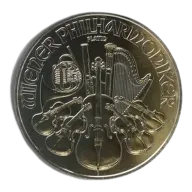
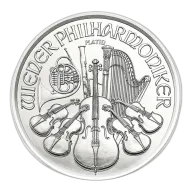
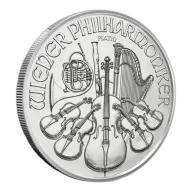
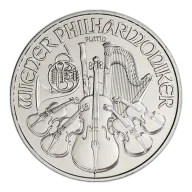
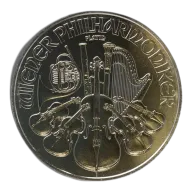
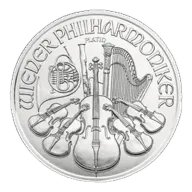
The obverse depicts the Rieger organ of the Musikverein's Golden Hall, built in 1907, in a hall renowned as one of the finest concert venues in the world. The reverse shows a cello at centre, flanked by four violins, with a Vienna horn (Wiener Horn), bassoon, and harp behind. The Vienna horn is specifically a Vienna horn, not a standard French horn, reflecting the orchestra's commitment to historically informed performance. Both designs are by Thomas Pesendorfer, Austrian Mint engraver, and have remained unchanged since the series launched in 1989 across all three metals.
Philharmonic Platinum Tax Treatment by Country
The Platinum Philharmonic follows the general platinum tax treatment in each jurisdiction. Its 999.5 purity meets investment-grade thresholds everywhere they exist, but platinum does not receive the preferential VAT exemption that gold enjoys in the UK and EU.
Austria and the EU
Platinum coins are subject to standard VAT across the EU, ranging from 17% (Luxembourg) to 27% (Hungary). In Austria, this is 20%. There is no investment platinum exemption equivalent to the EU Investment Gold Directive that makes gold coins VAT-free. Some EU countries apply the margin scheme (Differenzbesteuerung in Germany) to second-hand platinum coins, which can reduce the effective VAT. The Philharmonic is legal tender only in Austria, not across the eurozone.
United Kingdom
Platinum carries 20% VAT in the UK. The Philharmonic is not CGT-exempt because it is not UK legal tender. Only Royal Mint coins carry CGT exemption. The Platinum Britannia is the tax-efficient alternative for UK residents.
United States
The Platinum Philharmonic is IRA-eligible. Its 999.5 purity meets the IRS minimum for platinum in self-directed retirement accounts. Capital gains are taxed as collectibles at up to 28%. The Philharmonic generally trades at lower premiums than the American Eagle in US markets.
Canada
Platinum at 99.5% purity or above is GST/HST-exempt. The Philharmonic is not eligible for Canadian registered accounts (RRSPs, TFSAs) as it is not issued by a Canadian mint.
Australia
Investment-grade platinum at 99% purity or above is GST-free. The Philharmonic qualifies. Capital gains tax applies with a 50% discount for holdings over 12 months.
Singapore and Hong Kong
Singapore exempts qualifying platinum coins from 9% GST as Investment Precious Metals. Hong Kong charges no sales tax, duties, or capital gains tax. Both are among the most favourable jurisdictions for platinum purchases.
New Zealand
Platinum at 99% purity or above is GST-exempt. No capital gains tax applies.
Philharmonic Platinum vs Britannia, Maple Leaf, and Eagle
The Philharmonic competes with the three other regularly produced 1 oz sovereign platinum coins. All share 999.5 fineness and legal tender status, but they differ in pricing, market positioning, security features, and tax treatment.
| Feature | Philharmonic | Britannia | Maple Leaf | Eagle |
|---|---|---|---|---|
| First Year | 2016 | 2018 | 1988 | 1997 |
| Diameter | 37.0 mm | 32.69 mm | 30.0 mm | 32.7 mm |
| Face Value | 100 EUR | £100 GBP | $50 CAD | $100 USD |
| Design | Fixed (orchestra) | Annual variation | Fixed (maple leaf) | Fixed (eagle) |
| Security Features | Detailed engraving only | Standard | Bullion DNA | Standard |
| UK CGT Exempt | No | Yes | No | No |
| US IRA Eligible | Yes | Yes | Yes | Yes |
The Philharmonic's primary advantage is its competitive pricing and strong European distribution. Among the four coins, it tends to carry premiums comparable to or below the Maple Leaf, making it one of the most cost-efficient sovereign platinum options. Its cultural design, celebrating one of the world's great orchestras, is also one of the most visually distinctive among bullion coins, which gives it appeal beyond pure metal accumulation.
The Britannia is the strongest competitor for UK residents because of its CGT exemption, a benefit no other platinum coin offers. Outside the UK, this advantage disappears and the Britannia competes on premium and liquidity alone.
The Maple Leaf brings the longest production history (1988) and the most advanced security technology (Bullion DNA individual coin verification). For investors who prioritise authentication certainty and secondary market depth, the Maple Leaf remains the benchmark platinum coin in North America.
The American Eagle dominates the US market through institutional recognition and the deepest domestic secondary market. It is the most liquid platinum coin for American investors but typically carries higher premiums than the Philharmonic or Maple Leaf. Buyers outside the US will find less premium advantage to the Eagle.
The Philharmonic's main weakness is its lack of dedicated security features. It has no equivalent of the Maple Leaf's Bullion DNA, the Britannia's latent image suite, or even a mintmark-level security element. For buyers purchasing from established dealers with documented supply chains, this matters less than it might appear. For secondary market or private purchases, coins with verifiable security features offer an additional layer of confidence.
1 oz Philharmonic Platinum Coin: frequently asked questions
-
The cheapest 1oz Platinum Philharmonic we track is $1,898.25, about 5.1% over the $1,806.00 platinum spot price. Austin Rare Coins & Bullion is currently the lowest-cost option. Struck by Austria's Münze Österreich from 99.95% fine platinum, this coin carries a face value of 100 EUR and has been issued annually since 2016.
-
Dealers are currently charging around 5.1% over the $1,806.00 platinum spot price, with Austin Rare Coins & Bullion offering the keenest rate. Platinum bullion typically carries wider spreads than gold or silver because the market is smaller and dealer inventories thinner, so comparing live offers before buying makes a meaningful difference.
-
The Platinum Philharmonic is a 1 oz bullion coin struck by Münze Österreich (Austrian Mint) and issued as legal tender in Austria with a face value of 100 EUR. First released in 2016, it carries the same design as the gold and silver versions: the pipe organ of Vienna's Musikverein on the obverse and an ensemble of Philharmonic Orchestra instruments on the reverse.
-
The 1oz Platinum Philharmonic is struck from 999.5 fine platinum, equivalent to 99.95% purity. It weighs one troy ounce (31.1035 g) and meets the purity threshold for investment platinum in most major markets, including the US IRA minimum of 99.95% for platinum.
-
Platinum has a narrower dealer market than gold or silver. We currently track 7 dealers carrying the 1oz Platinum Philharmonic, compared to far larger pools for equivalent gold and silver coins. Bid-ask spreads tend to be wider, and resale is generally slower. Buyers who prioritise liquidity often find gold coins easier to trade quickly.