7 listings
Filters
| Product | /oz | Premium | Price | |
|---|---|---|---|---|

 Bullion Standard
|
$67.71 | +0.12% | $67.71 | View Deal |
 IDC Coin and Bullion
|
$74.86 | +10.69% | $74.86 | View Deal |
 IDC Coin and Bullion
|
$74.86 | +10.69% | $74.86 | View Deal |
 IDC Coin and Bullion
|
$79.61 | +17.72% | $79.61 | View Deal |
 IDC Coin and Bullion
|
$81.73 | +20.85% | $81.73 | View Deal |
 IDC Coin and Bullion
|
$86.50 | +27.91% | $86.50 | View Deal |
 IDC Coin and Bullion
|
$86.61 | +28.07% | $86.61 | View Deal |
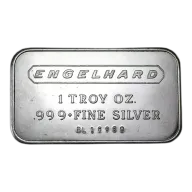
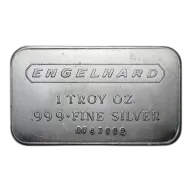

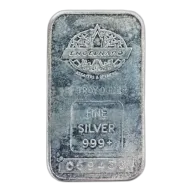
Prices are fetched automatically and may not reflect current merchant prices. Currency conversions and tax treatment are approximate. Rankings are based solely on price. We are not a dealer and accept no responsibility for transactions with listed merchants. Past performance is not indicative of future results. This site does not provide investment advice. Full disclaimer
About the 1 oz Engelhard Bar Silver Bar
Engelhard Silver Bars at 1 oz
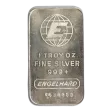
Engelhard silver bars occupy a unique position in the bullion market: they are discontinued products from a defunct refiner that trade at persistent collector premiums above their metal content. Engelhard Industries was founded in 1902 in Newark, New Jersey, and became the world's largest precious metals smelter by the 1950s. Retail bar production ran from the late 1960s through approximately 1986, when the company exited the retail bullion business to focus on industrial catalysts. BASF acquired Engelhard in 2006 for US$5 billion. No new bars have been produced in roughly four decades.
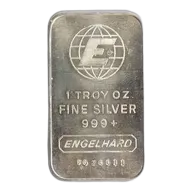
The 1 oz size is the most collected Engelhard format, with over 40 documented varieties catalogued by the AllEngelhard.com community. These span the full production history: landscape-orientation bars with extruded finishes from the late 1960s, Canadian-stamped editions from Engelhard Industries of Canada (1968-early 1970s), the portrait-orientation 'E' globe logo bars that dominate the 1981-1986 period, and the final Eagle logo design from the last production year. Dealers list these under varying descriptions ("Design Varies," "Elongated Logo," "Frosted Back"), reflecting the breadth of varieties that reach the secondary market.
Approximately 4 million 1 oz bars were originally produced, but a significant number were melted during the 1979-1980 silver price spike (the Hunt Brothers era, when silver reached $49.45/oz). Surviving bars are rarer than the original production run implies, and collector demand has sustained premiums of $5-20+ over spot for common varieties, with rare types commanding far more. The premium is for provenance and scarcity, not metal quality. All Engelhard bars contain .999 fine silver, the same purity as any modern generic bar.
Charles Engelhard Jr., who consolidated the family businesses into Engelhard Industries in 1958, is widely cited as the inspiration for Ian Fleming's James Bond villain Auric Goldfinger, a detail that adds cultural cachet to the brand among collectors.
Engelhard 1 oz Silver Bar Varieties and Specifications
| Attribute | Detail |
|---|---|
| Weight | 1 troy ounce (31.1035 g) |
| Purity | .999 fine silver |
| Manufacturer | Engelhard Industries (Newark, NJ, USA) |
| Production era | Late 1960s to approximately 1986 |
| Documented varieties | 40+ distinct types |
| Serial numbers | Nearly all bars; two known unnumbered varieties |
| Production methods | Cast (poured), pressed, and extruded |
| Legal tender | No |
Variety Overview
AllEngelhard.com catalogues the 1 oz bars into major categories based on production era and design features:
- Landscape varieties (late 1960s): Elongated octagon hallmarks with an extruded finish. The earliest commercial production and among the rarest survivors.
- Canadian varieties (1968-early 1970s): Stamped "Engelhard Industries of Canada." Separately collected from US-made bars.
- Portrait varieties (1981-1986): The most commonly found category. Features the Wide 'E' globe logo and Large 'E' designs in portrait orientation.
- Eagle logo (1986): The final design produced before Engelhard exited retail bullion. Identified by an eagle motif replacing the globe logo.
- Art bars: Including the 1976 Sports Series (six designs) and various corporate or institutional commissions.
Serial Number Formats
Serial numbers follow era-specific formats: numerical-only codes with 5-6 digits for most varieties, and letter-prefix codes (PA, PB, FG series) for specific production runs. The "PB" prefix uses 6 digits, while most other prefixed series use 5. Serial number format is one of the primary authentication markers, and counterfeits frequently fail on font details, spacing, and format consistency for the claimed variety.
Tax Treatment of Engelhard Silver Bars
Engelhard bars carry no legal tender status. They are privately refined .999 fine silver bars subject to standard silver tax treatment in all jurisdictions. The collector premiums they command make the capital gains tax treatment particularly relevant.
United Kingdom
Subject to 20% VAT on purchase and CGT on disposal (18% or 24%, £3,000 annual allowance). The EU margin scheme may apply when purchasing through EU-based dealers, since Engelhard bars are definitively second-hand goods. This could reduce the effective purchase tax compared to buying new silver bars at full VAT. UK legal tender silver coins like the 1 oz Silver Britannia avoid CGT.
United States
Most states exempt investment-grade silver from sales tax. The .999 purity meets IRA fineness requirements, though custodian approval varies. Capital gains are taxed at the collectibles rate of up to 28%. Because Engelhard bars are bought and sold at premiums significantly above spot, capital gains calculations are based on the actual purchase and sale prices, including the collector premium component.
Canada
GST/HST-exempt for silver at 99.9% purity or above.
Australia and New Zealand
Australia exempts silver at 99.9% purity from GST. New Zealand exempts fine silver at 99.9% from GST with no capital gains tax.
European Union
Silver bars carry standard VAT (17-27% by country). Germany's Differenzbesteuerung (margin scheme) applies to second-hand goods and is commonly used by German dealers for vintage silver bars, potentially reducing effective VAT.
Singapore and Hong Kong
Singapore's IPM scheme covers silver at 99.9% purity. Hong Kong has no sales tax or capital gains tax.
From Newark Refinery to Collector Favourite
The Engelhard story begins in 1902, when Charles W. Engelhard Sr. purchased the Charles F. Croselmire Company in Newark, New Jersey. In 1904, he acquired Baker and Co., a platinum smelter also based in Newark, and in 1905 established the Hanovia Chemical and Manufacturing Company. These acquisitions built the foundation of what would become the dominant precious metals refiner in the United States.
His son, Charles Engelhard Jr., consolidated the family holdings into Engelhard Industries, Inc. in 1958 and listed the company on the New York Stock Exchange. Under his leadership, Engelhard grew into the world's largest precious metals smelter, processing gold, silver, platinum, and palladium for industrial, monetary, and investment applications. The company processed gold for the US Treasury and was involved in the refining of South African gold during the apartheid era. Engelhard Jr.'s wealth and lifestyle are widely cited as Ian Fleming's inspiration for Auric Goldfinger in the 1959 novel.
Retail silver bar production began in the late 1960s and expanded through the 1970s, spanning the Hunt Brothers' attempted silver market corner of 1979-1980 that drove silver to $49.45/oz before the COMEX changed its rules. That price spike triggered mass meltdowns of silver products, including Engelhard bars, paradoxically increasing the long-term collector value of the bars that survived. Production continued through the early 1980s with the introduction of the portrait-orientation 'E' globe logo designs, and the final bars bearing the Eagle logo were produced in 1986.
Engelhard exited the retail bullion market in the late 1980s to focus on its industrial catalyst business, which had become the company's core revenue stream. In 2006, after a hostile bid, BASF acquired Engelhard for US$5 billion. The company was renamed BASF Catalysts LLC on 1 August 2006, ending the Engelhard name after over a century of operation. The bars remain in circulation on the secondary market, with the AllEngelhard.com community maintaining the definitive reference catalogue for authentication and variety identification.
Engelhard vs Johnson Matthey and Modern Silver Bars
Johnson Matthey is the other major historic refiner whose bars circulate on the secondary market. Both produced .999 fine, serial-numbered bars across similar size ranges during overlapping production eras, and both ceased retail bar production (JM's bullion arm was sold to Asahi in 2015). Engelhard 1 oz bars generally command higher collector premiums than equivalent JM pieces. The premium gap reflects Engelhard's wider variety of documented types, the Goldfinger association, and the dedicated collector infrastructure at AllEngelhard.com that catalogues and authenticates varieties.
Against modern 1 oz silver bars from current LBMA refiners like PAMP Suisse, Valcambi, or Argor-Heraeus, the distinction is fundamental. Modern Swiss bars offer sealed assay packaging, digital authentication (PAMP's VeriScan), and LBMA provenance at modest premiums over spot. Engelhard bars offer historical provenance, serial-number-based authentication, and collector premiums that can be multiples of the spot-based premium on a modern bar. The modern bar is the practical choice for silver investment; the Engelhard bar is a collectible with embedded silver value.
Compared to generic silver bars from Sunshine Minting, SilverTowne, or Asahi, the premium gap is even wider. Generic bars trade at 5-10% over spot. Common Engelhard bars carry premiums of $5-20+, and rare varieties command far more. A buyer focused purely on accumulating silver weight would never choose Engelhard at current pricing. A collector who views the bar as part investment and part historical artefact sees the premium as buying a piece of twentieth-century American industrial history from a company that no longer exists.
1 oz Engelhard Bar Silver Bar: frequently asked questions
-
The cheapest 1oz Engelhard silver bar currently listed across 2 dealers is $67.71 from Bullion Standard. That price is 0.1% over the live silver spot. Engelhard bars are vintage secondary-market items and typically trade at a higher premium than modern generic 1oz bars due to collector demand for the discontinued American refinery brand.
-
Engelhard's retail silver bar production ran from the late 1960s through approximately 1986, covering the Hunt Brothers silver boom era. The company then exited the retail bullion market to focus on industrial catalysts. BASF acquired Engelhard in 2006 and renamed it BASF Catalysts LLC. No new Engelhard silver bars have been produced since the 1980s; all bars in circulation today are vintage secondary-market pieces.
-
Engelhard ceased retail bar production in the mid-1980s, so supply is fixed and declining. A significant number of bars were melted during the 1979-1980 silver price spike, reducing surviving stock further. Collector demand for the historical American brand, the variety of documented types (over 40 distinct 1oz varieties alone), and the bars' connection to the Hunt Brothers silver market drive premiums well above what an equivalent modern generic bar would fetch, with rarer varieties commanding the highest uplifts.
-
Engelhard bars are among the most counterfeited silver bars in the secondary market, particularly the 100oz size. Key authentication checks: verify the serial number format against AllEngelhard.com's definitive pages for the specific variety (numerical-only vs. letter-prefix formats differ by era and size), confirm correct weight on a calibrated scale, and inspect font consistency and edge finishing for the production period claimed. Most fakes fail on font details or serial number formatting. A dealer with XRF equipment can confirm .999 silver content. Most 1oz bars carry serial numbers; two known 1oz varieties do not.