 Golden State Mint



Prices are fetched automatically and may not reflect current merchant prices. Currency conversions and tax treatment are approximate. Rankings are based solely on price. We are not a dealer and accept no responsibility for transactions with listed merchants. Past performance is not indicative of future results. This site does not provide investment advice. Full disclaimer
About the 1 oz Aztec Calendar Silver Round
The 1 oz Aztec Calendar Silver Round
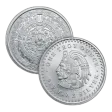
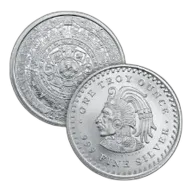
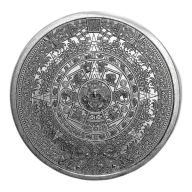
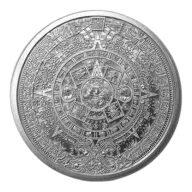
The 1 oz Aztec Calendar silver round is Golden State Mint's best-known design and one of the most distinctive products in a round market dominated by patriotic American themes. The obverse reproduces the Aztec Sun Stone, the 25-ton carved basalt disk displayed at the National Museum of Anthropology in Mexico City, with the solar deity Tonatiuh at its centre. The reverse carries a portrait of Cuauhtemoc, the last Aztec Emperor of Tenochtitlan, in a feathered headdress.
As a round rather than a coin, it carries no face value and no sovereign backing, and that is precisely its appeal on price. Silver rounds typically trade at 5 to 10 percent over spot, between bars and the 15 to 25 percent premiums on government-minted 1 oz coins. The Aztec Calendar is among the lowest-premium ways to buy .999 silver with a design more interesting than a plain generic round, which is why it has a strong following among stackers.
The design even contributes to authentication. The Sun Stone's intricate relief, with its ring of 20 day signs and directional arrows, is difficult to reproduce convincingly; counterfeits typically show softer detail in the complex calendar pattern. The round is continuously produced with no year dates and no mintage caps, so it is bought for metal and design rather than scarcity. Buyers who want the same artwork in larger formats can step up to the 5 oz Aztec Calendar round or the 10 oz bar version.
Aztec Calendar 1 oz Round Specifications
| Specification | Detail |
|---|---|
| Weight | 1 troy oz (31.1 g) |
| Purity | .999 fine silver |
| Diameter | 39.3 mm |
| Thickness | 3.2 mm |
| Edge | Reeded |
| Mint | Golden State Mint (United States) |
| Packaging | Tubes of 20 |
| Legal tender | None (privately minted round) |
The 1 oz round anchors a broad family of sizes: silver versions run from 1/10 oz (in tubes of 50) through 1/4 oz, 1/2 oz, 1 oz, 2 oz, and 5 oz rounds, with 5 oz and 10 oz also offered in bar format, plus copper versions in multiple sizes. No gold version is documented. All silver pieces share the .999 fineness and the same Sun Stone and Cuauhtemoc design elements.
There are no serial numbers, assay cards, or anti-counterfeiting technology on the round itself. Verification relies on weight, the 39.3 mm by 3.2 mm dimensions, and standard silver tests such as specific gravity or the magnet slide test, with the crispness of the calendar relief acting as an informal quality check.
Tax Treatment of the Aztec Calendar Round by Country
Because this is a privately minted round with no legal tender status, it never benefits from coin-specific tax breaks, and as silver it misses the gold exemptions too.
- United States: the primary market, and the friendliest one. No federal sales tax, and roughly 35 states exempt bullion, with a handful applying dollar thresholds. The .999 fineness meets the IRS requirement for silver in self-directed IRAs (99.9 percent or higher), and Golden State Mint lists the round as IRA-approved, though eligibility ultimately depends on the custodian. Long-term gains are taxed at the collectibles rate of up to 28 percent.
- United Kingdom: 20 percent VAT on purchase and CGT liability on sale. Unlike a silver Britannia, a round has no legal tender status to earn the CGT exemption, making it a hard sell against sovereign coins for UK buyers.
- European Union: full national VAT applies, typically 17 to 27 percent, and the margin scheme offers no help since new rounds are not second-hand coins.
- Canada: the federal GST/HST exemption covers silver refined to 99.9 percent or higher in bar, ingot, coin, or wafer form; at .999 the metal clears the purity bar comfortably.
- Singapore: the Investment Precious Metals exemption requires silver of 99.9 percent or higher in qualifying form; no capital gains tax applies in any case.
- Hong Kong: no sales tax, no import duty, no capital gains tax.
The Sun Stone, From Tenochtitlan to Silver
The artwork this round reproduces is one of the most recognised objects of the pre-Columbian world. The Aztec Sun Stone (Piedra del Sol) was carved from basalt in the late Postclassic period, around 1502 to 1521, likely under the reign of Motecuhzoma II. It measures 3.58 metres across, is 98 cm thick, and weighs roughly 25 tons. Despite its popular name, modern scholarship holds that it was never a functioning calendar; it is interpreted as a solar disk symbolising rulership, and possibly a ceremonial basin or ritual altar. A date glyph of 13 Reed near the top corresponds both to a mythological creation date and to the historical year 1427 CE.
The stone was lost for centuries after the Spanish conquest, buried in the central plaza of Mexico City, which was built over the ruins of Tenochtitlan. It was rediscovered in December 1790 and now sits in the National Museum of Anthropology in Mexico City. It has since become one of the most reproduced pre-Columbian artworks anywhere, appearing on Mexico's old 20 centavo coin in simplified form.
The reverse portrait is equally pointed: Cuauhtemoc ruled Tenochtitlan from 1520 to 1521 and led the resistance against Hernan Cortes. He remains a national hero in Mexico and a symbol of indigenous resistance to colonialism. Golden State Mint, founded in 1974 by Jim Pavlakos and now run with his son Andrew from operations in Southern California and Sanford, Florida, has made the design one of its signatures across five decades of continuous private minting.
Aztec Calendar vs Libertad, Sovereign Coins, and Generic Rounds
The natural comparison is the 1 oz silver Libertad, Mexico's sovereign bullion coin. The Libertad brings legal tender status, low mintages, and investment-grade credibility, but at much higher premiums. The Aztec Calendar round delivers Mexican and Aztec thematics at a fraction of the cost; the choice is essentially collector credibility versus ounces per dollar.
Against mainstream sovereign coins such as the American Silver Eagle or Britannia, the round wins on price (5 to 10 percent over spot versus 15 to 25 percent for government coins) and loses on liquidity and premium recovery. A round bought at 8 percent over spot might sell back at 4 to 6 percent over; a coin bought at 20 percent might recover 15 to 18 percent. Buyers planning to resell through dealers recover more with coins; buyers maximising metal up front do better with rounds.
Within the round market, the Aztec Calendar competes with the ubiquitous 1 oz Buffalo round and Walking Liberty generics, plus branded pieces from Sunshine Minting and SilverTowne. Golden State Mint's version trades at similar or slightly higher premiums than plain generics on the strength of its design popularity, and while several private mints have produced Aztec-themed rounds, GSM's is the most established and widely recognised. It suits stackers who want their silver to look like something without paying sovereign-coin premiums.
1 oz Aztec Calendar Silver Round: frequently asked questions
-
The Aztec Calendar silver round is produced by Golden State Mint (GSM), a private US mint founded in 1974. GSM is headquartered in Sanford, Florida. These rounds are not legal tender and carry no face value.
-
The current cheapest price for a 1oz Aztec Calendar silver round listed here is $76.88, which is 13.7% over the $67.63 silver spot price. As a .999 fine silver round, its intrinsic value moves with the silver market. The comparison table above shows all available dealer prices.
-
The obverse reproduces the Aztec Sun Stone (Piedra del Sol), a carved basalt disk created in the late 15th century during the Aztec empire. The central figure is Tonatiuh, the Aztec solar deity, surrounded by 20 day symbols. The reverse depicts Cuauhtemoc, the last Aztec emperor. The original Sun Stone is displayed at the National Museum of Anthropology in Mexico City.
-
Golden State Mint produces the Aztec Calendar design in 1/10 oz, 1/4 oz, 1/2 oz, 1 oz, and 2 oz round formats, as well as 5 oz and 10 oz bar formats, all in .999 fine silver. There are also copper versions. The series has no mintage limit and is continuously produced without annual date changes.