 IDC Coin and Bullion



Prices are fetched automatically and may not reflect current merchant prices. Currency conversions and tax treatment are approximate. Rankings are based solely on price. We are not a dealer and accept no responsibility for transactions with listed merchants. Past performance is not indicative of future results. This site does not provide investment advice. Full disclaimer
About the 5 oz Aztec Calendar Silver Round
The 5 oz Aztec Calendar Silver Round
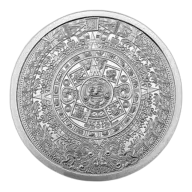
The 5 oz Aztec Calendar from Golden State Mint is the format where this design works best. The Aztec Sun Stone's intricate detail, with its 20 day-sign symbols, four directional arrows, and central Tonatiuh figure, benefits enormously from the larger planchet. At 5 oz (155.5 grams), the relief depth and detail resolution are substantially improved over the 1 oz and 2 oz versions, which compress the same design elements into a smaller area.
The original artifact that inspired this design is remarkable in itself. The Aztec Sun Stone is a 25-ton basalt disk measuring 3.58 metres in diameter, carved during the late Postclassic period (c. 1502-1521), most likely under the reign of Motecuhzoma II. Despite its popular name, modern scholarship suggests it was not a functioning calendar but rather a solar disk symbolising rulership, possibly used as a ceremonial basin or ritual altar. It was rediscovered in December 1790, buried in what was once the central plaza of Tenochtitlan (now Mexico City's Zocalo), and now resides at the National Museum of Anthropology.
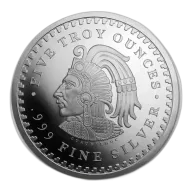
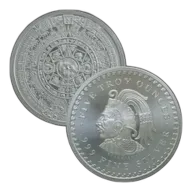
Golden State Mint produces this round in .999 fine silver with no year dates and no mintage limits. It is a continuously produced bullion product, not a limited edition or annual issue. The reverse features Cuauhtemoc, the last Aztec emperor of Tenochtitlan, who ruled during 1520-1521 and led the resistance against the Spanish conquest. He remains a national hero in Mexico, commemorated in place names across the country. The combination of these two images creates one of the most culturally distinctive designs in the private mint silver market.
5 oz Aztec Calendar Specifications
| Attribute | Value |
|---|---|
| Weight | 5 troy oz (155.517 g) |
| Purity | .999 fine silver |
| Manufacturer | Golden State Mint |
| Edge | Reeded |
| Face value | None (private mint round) |
| Year/date | None (undated, continuous production) |
| Mintage | Unlimited |
The 5 oz Aztec Calendar is available in both round and bar formats. The round version is coin-shaped with a reeded edge; the bar version is rectangular with the same design elements. Both are .999 fine silver from the same production line.
Authentication follows standard silver bullion methods: weight verification, dimensional measurement, specific gravity testing, and XRF analysis. The piece carries no serial number, assay card, or anti-counterfeiting technology. The complexity of the Sun Stone design provides some informal counterfeit resistance, as the fine relief details are technically difficult to replicate in mass-produced fakes. Golden State Mint stamps its name, exact weight, and purity on each piece.
The Full Aztec Calendar Size Range
| Size | Metal | Format |
|---|---|---|
| 1/10 oz | Silver (.999) | Round |
| 1/4 oz | Silver (.999) | Round |
| 1/2 oz | Silver (.999) | Round |
| 1 oz | Silver (.999) | Round |
| 2 oz | Silver (.999) | Round |
| 5 oz | Silver (.999) | Round and bar |
| 10 oz | Silver (.999) | Bar |
Tax Treatment of the 5 oz Aztec Calendar
The Aztec Calendar is a privately minted round with no legal tender status. Tax treatment follows standard rules for silver bullion in each jurisdiction, with no product-specific exemptions.
- United States: Golden State Mint lists the round as IRA-approved. The .999 purity meets the IRS Section 408(m) threshold for silver held in a Precious Metals IRA, though custodian acceptance varies. Capital gains on sale are taxed at the collectibles rate (up to 28% for holdings over one year). Sales tax is state-dependent: roughly 35 states exempt bullion, with partial exemptions in California (above $2,000), Florida (above $500), and New York, Massachusetts, and Louisiana (above $1,000).
- United Kingdom: Silver bullion is subject to 20% VAT. The Aztec Calendar, as a private mint round without UK legal tender status, has no CGT exemption. Gains are taxed at the individual's CGT rate (18% or 24%), with the £3,000 annual allowance. The 20% VAT on purchase makes UK silver buying expensive, and VAT-free vault storage schemes (where silver remains offshore) are the main workaround.
- Canada: Silver at .999 purity qualifies for GST/HST exemption. Capital gains are taxed at a 50% inclusion rate.
- Australia: Silver at 99.9%+ purity qualifies for GST exemption as investment-grade precious metal. A 50% CGT discount applies for holdings over 12 months.
- Singapore: Investment Precious Metals at 99.9%+ silver purity are GST-exempt. No capital gains tax.
- Hong Kong: No sales tax, no import duty, no capital gains tax on precious metals.
- South Africa: Silver bullion carries 15% VAT, with no exemption (unlike gold Krugerrands, which are zero-rated).
5 oz Aztec Calendar vs Alternatives
The 5 oz Scottsdale Stacker is the Aztec Calendar's primary competitor at this weight. The Stacker's interlocking mechanism provides a functional storage advantage that no flat round can match, and Scottsdale Mint's branding carries strong recognition among US dealers. The Aztec Calendar counters with one of the most visually distinctive designs in the round market. Both are .999 silver at comparable premiums from US private mints; the choice comes down to whether the buyer values the stacking mechanism or the design more highly.
The 5 oz Incuse Indian, also from Golden State Mint, offers a different aesthetic. The incuse (sunken relief) technique gives the Indian Head design a distinctive look where the art sits below the rim, protecting it from contact wear. The Aztec Calendar uses standard raised relief. Both are GSM products at .999 fineness with equivalent premiums. Buyers drawn to Golden State Mint's range often collect across both series.
The 5 oz Sunshine Eagle from Sunshine Minting brings the MintMark SI anti-counterfeiting feature, which no GSM or Scottsdale product can match. For buyers who prioritise verifiable authentication, the Sunshine round's decoder-lens verification system is a unique advantage. Premiums on Sunshine products tend to be competitive with or slightly below the Aztec Calendar.
Against sovereign 5 oz coins like the America the Beautiful series (US Mint, 2010-2021, now secondary market only) or the Mexican 5 oz Libertad, the Aztec Calendar offers significantly lower premiums but no legal tender status or government backing. The ATB coins, at 76.2mm diameter, are substantially larger than any private mint round and carry collector premiums for popular designs. The 5 oz Libertad has extremely limited annual mintages and commands premiums well above its metal content. The Aztec Calendar serves buyers who want 5 oz of .999 silver at the lowest practical cost in round format, with a design that happens to share Mesoamerican cultural roots with the Libertad.
5 oz Aztec Calendar Silver Round: frequently asked questions
-
The cheapest 5oz Aztec Calendar round we track is $376.90, about 11.5% over the silver $67.63 spot price. The round contains five troy ounces of .999 fine silver, so its value scales directly with silver's spot price.
-
The Aztec Calendar round is made by Golden State Mint, a private US mint founded in 1974 and headquartered in Sanford, Florida. Golden State Mint produces the Aztec Calendar in multiple sizes from 1/10oz to 10oz; the 5oz round is available in the same .999 fine silver at the same design as the smaller sizes.
-
The obverse reproduces the Aztec Sun Stone (Piedra del Sol), a carved basalt disk created in the late 15th century and now held at the National Museum of Anthropology in Mexico City. The design centres on Tonatiuh, the Aztec solar deity, surrounded by a ring of 20 day-signs representing the Aztec month. The reverse depicts Cuauhtemoc, the last Aztec emperor, in a traditional feathered headdress.