 Monument Metals


Prices are fetched automatically and may not reflect current merchant prices. Currency conversions and tax treatment are approximate. Rankings are based solely on price. We are not a dealer and accept no responsibility for transactions with listed merchants. Past performance is not indicative of future results. This site does not provide investment advice. Full disclaimer
About the 2 oz Incuse Indian Silver Round
Sunken Relief Design Inspired by Roosevelt-Era Gold Coins
The 2 oz Incuse Indian silver round from Golden State Mint uses a technique found on no other widely produced bullion product: the design elements are sunken below the flat surface rather than raised above it. This incuse (recessed) format was pioneered on the US $2.50 Quarter Eagle and $5 Half Eagle gold coins minted from 1908 to 1929, designed by Bela Lyon Pratt at the commission of President Theodore Roosevelt. The original coins were the most controversial US coins of their era; the American Numismatic Association's journal called them "a triumph of mediocrity" at launch, though they are now highly collectible.
The sunken relief provides a genuine practical advantage for bullion handling. Because the design sits below the rim, rounds can be stacked directly without design surfaces touching, reducing scratching and wear over time. The flat field acts as a protective border around the detailed imagery. This makes the Incuse Indian one of the more durable round designs for long-term storage in tubes or stacks.
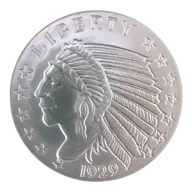
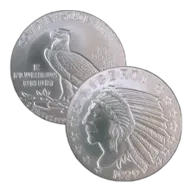
Golden State Mint's version is a tribute to, not an exact replica of, the original Pratt design. The obverse features a Native American chief in full feathered headdress with "LIBERTY" above. The reverse shows a standing eagle with "IN GOD WE TRUST" and "E PLURIBUS UNUM" flanking the bird, "GOLDEN STATE MINT" along the upper edge. At .999 fine silver and 2 troy ounces, the round provides 62.207 grams of pure silver in this distinctive recessed format.
2 oz Incuse Indian Technical Details
| Attribute | Value |
|---|---|
| Weight | 2 troy oz (62.207 g) |
| Purity | .999 fine silver |
| Diameter | Approximately 47 mm |
| Edge | Reeded |
| Design style | Incuse (sunken relief) |
| Mint | Golden State Mint (USA) |
| Face value | None (private mint round) |
| Original design | Bela Lyon Pratt (1908) |
Incuse Indian Size Range
| Size | Weight | Metal | Purity |
|---|---|---|---|
| 1/10 oz | 3.11 g | Silver | .999 |
| 1/4 oz | 7.78 g | Silver | .999 |
| 1/2 oz | 15.55 g | Silver | .999 |
| 1 oz | 31.10 g | Silver | .999 |
| 2 oz | 62.21 g | Silver | .999 |
| 5 oz | 155.5 g | Silver | .999 |
| 1 oz | 31.10 g | Gold | .9999 |
| 1/10 oz | 3.11 g | Gold | .9999 |
The gold Incuse Indian rounds are .9999 fine (four nines), one purity grade higher than the silver versions. Packaging follows GSM's standard: singles in flips, tubes of 20 for the 1 oz silver, and monster boxes of 500 rounds for bulk orders. Copper versions are also available across the size range at .999 purity.
Tax Treatment for the Incuse Indian Round
Private mint rounds from Golden State Mint carry no legal tender status. The incuse design technique does not affect tax classification; these are treated identically to any other .999 silver round for tax purposes.
- United States: No federal sales tax. State exemptions apply in approximately 35 states. Capital gains at the 28% collectibles rate. GSM states these are "IRA Approved" on their product pages, and the .999 silver (or .9999 gold) purity meets the IRS Section 408(m) minimum. However, IRA eligibility depends on custodian acceptance of private mint products; not all custodians maintain GSM on their approved lists.
- United Kingdom: 20% VAT on silver rounds. No CGT exemption (not UK legal tender). Private rounds offer no tax advantage over bars.
- Canada: GST/HST exempt for precious metals at 99.9%+ purity. The .999 silver qualifies. No RRSP eligibility for private mint rounds.
- Australia: GST-free for investment-grade silver at 99.9%+ purity from accredited sources.
- European Union: Standard VAT at local rates (17-27%). No investment exemption for silver products.
- New Zealand: GST-exempt for fine silver at 99.9%+ purity.
- Singapore: GST-exempt under the IPM scheme at 99.9%+ purity.
- Hong Kong: No sales tax, no import duty, no capital gains tax.
From Roosevelt's Controversial Commission to Modern Bullion
The incuse coin format has a specific origin: President Theodore Roosevelt's campaign to beautify American coinage in the early 1900s. Roosevelt considered US coins artistically inferior to ancient Greek and Roman examples. He commissioned sculptor Augustus Saint-Gaudens for the $10 and $20 gold pieces, and separately engaged Bela Lyon Pratt for the $2.50 and $5 denominations. The concept of sunken-relief coinage came from William Sturgis Bigelow, a Boston physician and art collector who suggested the technique to Pratt.
The original 1908 coins provoked immediate controversy. Charles Barber, the Mint's chief engraver, opposed the design on production grounds. Critics raised hygiene concerns, arguing that dirt would accumulate in the recesses and spread disease (a claim that proved entirely unfounded). The American Numismatic Association publicly criticised the aesthetics. Despite this opposition, the coins ran for 21 years from 1908 to 1929, and they remain the only incuse coins ever produced by the US federal government.
James Earle Fraser reportedly used three Native American models for the original nickel-era Indian design: Iron Tail (Lakota), Two Moons (Cheyenne), and Big Tree (Kiowa). The "Black Diamond" bison on the Buffalo Nickel reverse was reportedly modelled on a specific animal at the New York Central Park Zoo. GSM's Incuse Indian draws from this same design tradition, adapting the imagery into a recessed format that echoes Pratt's federal coins rather than Fraser's raised-relief nickel.
Golden State Mint has produced the Incuse Indian since the 1980s, capitalising on the public-domain status of early 20th-century US coin designs. The continuous production run of over three decades means these rounds are well-established in the secondary market, with dealers across the US handling them routinely.
Incuse Indian vs Other GSM Rounds and Sovereign Alternatives
Within Golden State Mint's product line, the Incuse Indian commands a marginally higher premium than the 2 oz GSM Buffalo due to its more distinctive design and the practical benefit of wear-protected imagery. Both contain identical metal (.999 silver, same weight, same manufacturer) and will trade at similar buyback prices. The choice is design preference and handling characteristics: the Buffalo uses conventional raised relief; the Indian uses the unique sunken format.
Against the 2 oz GSM Silver Eagle, again the metal content is identical. The Silver Eagle offers patriotic eagle imagery in standard relief. The Incuse Indian offers historical numismatic reference in recessed relief. Neither has security features beyond the GSM hallmark stamp.
Against sovereign coins at the 2 oz silver weight, the Incuse Indian cannot compete on investment fundamentals. A 2 oz sovereign coin (such as from the Royal Mint's Tudor Beasts series) offers legal tender status, CGT exemption in the UK, government security features, and established global liquidity. The Incuse Indian's advantages are limited to lower purchase premiums and the distinctive design format. For stackers focused on maximising silver weight per dollar in the US market, the lower premium makes this a rational choice over sovereign products. For investors in VAT jurisdictions (UK, EU) where private rounds receive identical tax treatment to sovereign coins on the purchase side, the calculus shifts toward sovereign products that at least offer CGT advantages or better resale premiums.
2 oz Incuse Indian Silver Round: frequently asked questions
-
The cheapest 2oz Golden State Mint Incuse Indian silver round on this page costs $137.76, about 5.4% over the $65.38 silver price. The round contains 2 oz of .999 fine silver, so its underlying value moves with the silver spot price.
-
The design pays tribute to the 1908-1929 US $2.50 and $5 Indian Head gold coins, the only incuse (sunken-relief) coins ever issued by the US federal government. Golden State Mint's version keeps the incuse format: the design elements are recessed below the flat surface rather than raised in relief. This protects the design from contact wear and gives the round a distinctive look.
-
It is a private silver round produced by Golden State Mint, a private US mint based in California. It carries no face value and is not legal tender anywhere. Private rounds like this are valued for their silver content rather than any government backing.