

Prices are fetched automatically and may not reflect current merchant prices. Currency conversions and tax treatment are approximate. Rankings are based solely on price. We are not a dealer and accept no responsibility for transactions with listed merchants. Past performance is not indicative of future results. This site does not provide investment advice. Full disclaimer
About 1/10 oz Gold Bars
The 1/10oz Gold Weight Class
A tenth of a troy ounce is 3.1103 grams of gold, the smallest weight produced in volume by every major mint. At a gold spot price of $4,200, a 1/10oz piece trades in the region of $462 to $495 before dealer margin, which makes this the lowest-cost entry point into gold ownership short of gram-denominated bars. Buyers at this weight fall into a few distinct groups: first-time gold owners testing the market with a small outlay, gift buyers, and stackers who value maximum divisibility in their holdings.
The honest economic picture is that this convenience is expensive. Die work, quality control, and packaging cost nearly as much for a tenth-ounce piece as for a full ounce, but those fixed costs are spread over one-tenth the gold. Accumulating one ounce of gold through ten 1/10oz pieces costs roughly $400 more than buying a single 1oz gold bar outright. Stretch that to ten ounces bought entirely in tenths and the extra premium runs to $3,500 to $4,000.
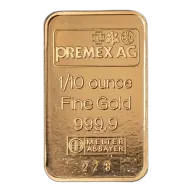
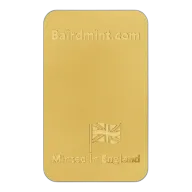
There is a further wrinkle specific to bars: 1/10oz gold bars exist but are uncommon. At this size the market strongly prefers coins for their recognisability and government backing, so anyone shopping this weight class should compare bar listings against the sovereign coin alternatives before committing. For pure cost efficiency, the better question is usually whether to step up the weight scale rather than which tenth-ounce product to pick.
Premiums at 1/10oz: The Top of the Scale
Tenth-ounce gold carries the highest relative premiums of any standard bullion weight. Fractional gold coins at 1/10oz typically run 10-20% over spot, with the 1/10oz American Gold Eagle quoted at 10-18%. Small gold bars in the 1g to 5g range sit in similar territory at 10-25% over spot. Compare that with the other end of the bar market, where 100g bars trade at 2-4% and kilo bars at 1-2%, and the cost of going small becomes clear.
The cause is manufacturing arithmetic, not dealer opportunism. Producing a tenth-ounce piece requires nearly the same die work, quality control, and packaging as a one-ounce piece, so the fixed cost is divided across a tenth of the metal. The percentage premium rises accordingly as the weight falls.
The premium hierarchy up the weight scale, drawn from typical market conditions, looks like this:
- 1g-5g gold bars: 10-25% over spot
- 1/10oz fractional coins: 10-20% over spot
- 1/4oz fractional coins: 7-12% over spot
- Generic 1oz bars from branded refiners: 1-4% over spot
- 100g bars: 2-4% over spot
- Kilo bars: 0.5-2% over spot
Resale compounds the problem. Tenth-ounce pieces show the widest bid-ask spreads among fractional sizes, so sellers should expect to recover less of the premium they paid than they would on a 1oz gold coin. The premium paid going in is largely a sunk cost.
What Is Actually Sold at 1/10oz
The first thing to understand about this weight class is that bars are the minority option. 1/10oz gold bars exist but are uncommon; at this size, coins are strongly preferred for their recognisability and government backing. Most of the buying activity at the tenth-ounce mark happens in sovereign mint coins, so they are the natural benchmark for any bar listing here.
The major government coins at this weight are:
- 1/10oz American Gold Eagle: $5 face value, 22 karat, introduced in 1986 as part of the original Eagle programme. The most popular fractional gold coin in the world.
- 1/10oz Gold Britannia: £10 face value, 24 karat, and CGT-exempt for UK buyers at roughly £300-£350.
- 1/10oz Canadian Gold Maple Leaf: 24 karat, from the Royal Canadian Mint.
- 1/10oz South African Krugerrand: 22 karat.
- 1/10oz Austrian Philharmonic and 1/10oz Australian Kangaroo: both 24 karat.
- Chinese Gold Panda 3g: the closest metric equivalent to a tenth ounce.
On the bar side, the small-bar market is dominated by gram denominations rather than the tenth-ounce mark itself. The LBMA-accredited refiners that anchor the retail bar market, PAMP Suisse, Valcambi, Argor-Heraeus, Heraeus, Perth Mint, and the Royal Canadian Mint, produce small minted bars sealed in tamper-evident assay cards carrying a serial number, weight, purity, and the refiner's hallmark. The PAMP Suisse Fortuna range, for example, spans sizes from 1g up to 1kg. Anyone set on small gold bars rather than coins will mostly be choosing among these gram-weight pieces.
Selling and Storing Tenth-Ounce Gold
Liquidity at this weight is best described as variable. All major dealers will buy 1/10oz sovereign gold coins, but the buyback price relative to spot is less favourable than for larger coins, and the bid-ask spreads are the widest of any fractional weight. Liquidity is strongest for the American Gold Eagle and Gold Britannia; less common coins at this weight change hands less readily. One factor works in the seller's favour: the low price point of roughly $500 attracts a broad base of potential buyers, which partially offsets the wide spreads.
For the uncommon bars at this size, the rules of the wider small-bar market apply. Minted bars come sealed in assay cards from the refiner, and breaking that seal reduces resale value because the bar may then need re-assaying. Keep sealed bars intact until the point of sale.
Tube and packaging conventions for the coins are well established. 1/10oz American Gold Eagles ship in sealed US Mint tubes of 50 coins, while 1/10oz Gold Britannias come in tubes of 25. The coins themselves are tiny, around 16.5mm in diameter for the Eagle and Britannia, smaller than a UK 5p coin. That makes them extremely compact, a full mint tube of 50 Eagles weighs just 155g, and extremely easy to lose. Capsules or mint tubes are essential for loose pieces, both to keep track of them and to protect surfaces. The small size also makes tenth-ounce gold portable and easy to conceal, which is part of its appeal for some buyers.
1/10 oz Gold Bars: frequently asked questions
-
A 1/10 oz gold bar contains 1/10 oz of gold. The melt value derives from the current spot price of $4,408.10 per troy oz multiplied by 0.1, but actual bar prices from 6 dealers across 6 listings include a fabrication premium. Use the comparison table on this page to see live offers and find the lowest-premium deal.
-
A 1/10 oz gold bar weighs 1/10 oz (3.11 grams). The troy ounce used in precious metals equals 31.1035 grams, so one-tenth of that is 3.1104 grams. Note that 10 grams is not the same as 1/10 troy oz: a 10g bar is roughly 3 times heavier.
-
Fabrication costs such as die work, assay certification, and packaging are largely fixed per bar regardless of size. Spread across only 3.11 grams of gold, those costs represent a larger share of the total price than they would for a 1 oz or 10 oz bar. This per-unit overhead is the main reason smaller bars consistently trade at a higher percentage above spot.
-
Reporting requirements vary by country and transaction size. In the UK, HMRC does not require you to report purchases, but gains on disposal must be declared if they exceed your annual CGT allowance of £3,000. In the US, dealers may file IRS reports for certain cash transactions; capital gains on disposal are taxable. In Canada, 50% of any gain is included in taxable income. Check the rules in your jurisdiction before buying.
-
Yes, particularly at this small size. LBMA-accredited brands are accepted by most dealers worldwide and resell at tighter spreads. Less-recognised brands can attract wider buy-sell spreads or be refused by some dealers. For 1/10 oz bars the brand premium gap over generic alternatives tends to be proportionally larger than for 1 oz or heavier bars.