 StoneX Bullion
3 listings
Filters


 BullionStar

 Bullion Beasts
Prices are fetched automatically and may not reflect current merchant prices. Currency conversions and tax treatment are approximate. Rankings are based solely on price. We are not a dealer and accept no responsibility for transactions with listed merchants. Past performance is not indicative of future results. This site does not provide investment advice. Full disclaimer
About the 100g Kinebar Gold Bar
The 100g Kinebar: Banknote Security on a Gold Bar
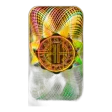
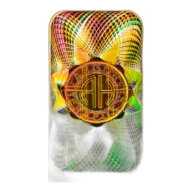
The 100g Kinebar is a minted gold bar from Argor-Heraeus, one of Switzerland's largest precious metals refiners, distinguished by a Kinegram embossed directly into the gold surface. The Kinegram is a diffractive optically variable image device (DOVID), the same technology used to secure banknotes and government identity documents in countries worldwide. It produces shifting colours and patterns when viewed from different angles, and because it is physically embossed into the gold (engravings less than 0.0015mm deep), it cannot be peeled off, transferred, or replicated with standard counterfeiting techniques.
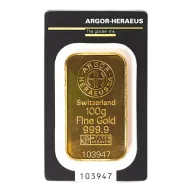
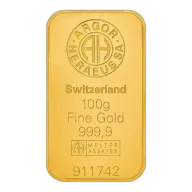
At 100 grams (3.2151 troy ounces), this bar sits at the premium-efficient end of the gram bar range, where premiums over spot drop to roughly 2-4%. The 100g size was not part of the original 1994 Kinebar launch; it was added in 2012, eighteen years after the 1g through 1oz range debuted. The bar is refined to 999.9 fine gold (four nines) and individually serialised, with each serial number matching the sealed assay card from Argor-Heraeus's certified assayer.
The practical advantage of the Kinebar over other security-enhanced bars is visual self-verification. The 100g PAMP Suisse bar uses Veriscan technology, which requires a smartphone app and database connection to authenticate. The 100g Royal Canadian Mint bar uses Bullion DNA, which requires proprietary reader equipment at participating dealers. The Kinegram on a Kinebar can be confirmed at a glance, in any location, without equipment or connectivity. For peer-to-peer transactions and quick verification, this is a meaningful difference.
The premium for Kinegram security is modest. Kinebars typically trade only a few dollars per ounce above standard Argor-Heraeus bars of the same weight, making the authentication feature nearly free relative to the total value of a 100g gold bar.
100g Kinebar Specifications
| Attribute | Value |
|---|---|
| Weight | 100g (3.2151 troy oz) |
| Purity | 999.9 fine gold (24 karat) |
| Dimensions | 49.7 x 28.5 x 3.9 mm |
| Manufacturer | Argor-Heraeus SA, Switzerland |
| Edge | Smooth |
| Face value | None (not legal tender) |
| Serialisation | Individual serial number on each bar |
| Packaging | Sealed tamper-evident assay card |
Security Features
The defining feature is the Kinegram on the reverse surface. This is a diffractive optical element created through sub-micron engravings in the gold itself. The technology is manufactured by OVD Kinegram AG, a Swiss company that supplies the same security technology to government agencies for banknotes and passports. The Kinebar is one of very few commercial applications of this government-grade security platform.
Each bar also carries an individual serial number engraved on the obverse, matching the serial on the sealed assay card. The assay card is a tamper-evident blisterpack that shows visible signs of interference if opened. The certificate confirms weight, purity, metal content, and is signed by Argor-Heraeus's sworn assayer.
The Kinegram is permanent. Because it is created through physical surface topology rather than applied materials, the holographic effect cannot wear off over time. A Kinebar from 1994 displays the same optical effect as one produced in 2025.
Kinebar Size Range
| Size | Year introduced |
|---|---|
| 1g | 1994 |
| 2g | 1994 |
| 5g | 1994 |
| 10g | 1994 |
| 20g | 1994 |
| 1 oz (31.1g) | 1994 |
| 50g | 2012 |
| 100g | 2012 |
100g Kinebar Tax Treatment by Country
As a 999.9 fine gold bar from an LBMA-accredited refiner, the 100g Kinebar qualifies for investment gold tax exemptions in every major bullion market. The bar is not legal tender, which has CGT implications in the UK.
- United Kingdom: VAT-exempt as investment gold (995+ purity threshold met). Subject to Capital Gains Tax on profits at 18% (basic rate) or 24% (higher rate), with a GBP 3,000 annual CGT allowance. Gold bars are never CGT-exempt in the UK; only UK legal tender coins such as Britannias and Sovereigns carry that exemption. SIPP-eligible for tax-relieved pension investment.
- United States: No federal sales tax. Most states exempt investment bullion from state sales tax. IRA-eligible: Argor-Heraeus is an LBMA/COMEX-approved refiner, and the 999.9 purity exceeds the IRS 99.5% threshold for precious metals IRAs. Capital gains on bullion held over one year are taxed at the collectibles rate (up to 28%), not the lower stock capital gains rates.
- European Union: VAT-exempt as investment gold under EU Council Directive 98/80/EC (gold bars 995+ purity, 1g minimum). CGT varies by member state; notably, Germany exempts gains after a one-year holding period.
- Canada: GST/HST-exempt on gold bars at 99.5%+ purity. RRSP-eligible through an approved custodian. Capital gains taxed at 50% inclusion rate.
- Australia: GST-free for investment-grade gold at 99.5%+ purity. Subject to CGT, with a 50% discount for holdings over 12 months.
- New Zealand: GST-exempt for gold bars at 99.5%+ purity.
- Singapore: GST-exempt under the Investment Precious Metals (IPM) scheme for gold at 99.5%+ purity from LBMA-accredited refiners. No capital gains tax.
- Hong Kong: No VAT, no import duty, no capital gains tax.
- South Africa: Investment gold is VAT-exempt. CGT applies at a 40% inclusion rate for individuals.
100g Kinebar vs PAMP Fortuna, Valcambi, and Perth Mint
The 100g gold bar market at the retail level is dominated by Swiss refiners and a handful of sovereign mints. The Kinebar competes directly with the 100g PAMP Fortuna, the 100g Valcambi bar, and the 100g Perth Mint bar. All four are 999.9 fine gold, LBMA-accredited, and sealed in assay card packaging.
The core differentiator is authentication technology. The Kinebar's Kinegram is optically self-verifying: tilt the bar and the holographic pattern shifts visibly, with no equipment needed. PAMP's Veriscan system maps each bar's microscopic surface topology and stores it in a database, verified via an iOS app or Canon scanner. This is technically more sophisticated but requires connectivity and either a specific scanner model or an iPhone. The Royal Canadian Mint's Bullion DNA system requires a proprietary reader at participating dealers. Valcambi and Perth Mint bars rely primarily on serial numbers and tamper-evident packaging, without an integrated verification technology.
On premiums, the Kinebar sits between the PAMP Fortuna (which commands the highest premiums among branded 100g bars, driven by the iconic Lady Fortuna design and global brand recognition) and Valcambi (which typically offers the lowest premiums among major Swiss refiners). The premium difference between a 100g Kinebar and a standard 100g Argor-Heraeus bar is small, typically only a few dollars.
For UK buyers specifically, neither the Kinebar nor any of these competitors is CGT-exempt. The 100g Royal Mint Britannia bar is the only 100g gold bar that carries legal tender status, making it CGT-exempt. Buyers choosing between refiner bars in the UK are trading purely on premium, brand, and security features.
Argor-Heraeus processes approximately 400 tonnes of gold annually and has held LBMA accreditation since 1961. The refinery's origins trace to 1951 in Mendrisio, Switzerland. The Kinegram technology was originally introduced to the retail market in December 1993 through Union Bank of Switzerland (UBS), which at the time owned Argor-Heraeus. UBS retains the Kinebar trademark. This institutional lineage, combining a major Swiss refinery with banknote-grade security technology, gives the Kinebar a distinctive position in a market where most competitors differentiate primarily on design and packaging.
100g Kinebar Gold Bar: frequently asked questions
-
The cheapest 100g Argor-Heraeus Kinebar listed by dealers we track is $14,400.70, sitting around 3.1% over the $4,408.10 gold spot price. StoneX Bullion currently has the best price. That 100g of 999.9 fine gold also carries the Kinegram hologram, which adds a small premium over a plain bar of the same weight.
-
A Kinebar is a minted gold bar produced by Argor-Heraeus of Switzerland, distinguished by a Kinegram, a diffractive optical security element embossed directly into the gold surface. Unlike a holographic sticker, the Kinegram cannot be peeled off; it is physically part of the bar. The same technology secures banknotes and government documents. Each bar also carries a unique serial number and comes in a tamper-evident assay card blisterpack.
-
The 100g Argor-Heraeus Kinebar is 999.9 fine gold, also written as 24 carat or four nines. At that fineness, the bar is as close to pure gold as commercially produced bars get. All Kinebars, regardless of size, are struck to this 999.9 standard and certified by Argor-Heraeus's sworn assayer.
-
Three checks work together. First, tilt the bar: the Kinegram on the reverse should shift colour and produce moving optical patterns; these engravings are less than 0.0015 mm deep and extremely hard to replicate. Second, confirm the serial number on the bar's obverse matches the number on the sealed assay card. Third, Argor-Heraeus provides online serial number verification through their website. Buying from an established dealer eliminates most counterfeiting risk at the outset.
-
The 100g Argor-Heraeus Kinebar measures approximately 49.7 mm long, 28.5 mm wide, and 3.9 mm thick, roughly the footprint of a credit card but shorter and noticeably thicker. At 100 grams it weighs about the same as a small chocolate bar. Gold's high density means even 100g occupies a surprisingly small volume compared with base metals of the same weight.