 StoneX Bullion


 BullionStar
Prices are fetched automatically and may not reflect current merchant prices. Currency conversions and tax treatment are approximate. Rankings are based solely on price. We are not a dealer and accept no responsibility for transactions with listed merchants. Past performance is not indicative of future results. This site does not provide investment advice. Full disclaimer
About the 50g Kinebar Gold Bar
The 50g Kinebar from Argor-Heraeus
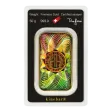
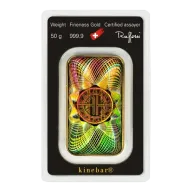
The 50g Kinebar is a 999.9 fine gold bar from Argor-Heraeus, the Swiss refiner that processes roughly 400 tonnes of gold annually. It carries a Kinegram, a diffractive optical element embossed directly into the gold surface, making it one of the few bullion products that can be visually authenticated without any equipment. The Kinegram is not a sticker or applied hologram; it is part of the bar itself, created by sub-micron engravings less than 0.0015 mm deep that produce shifting colours and patterns when the bar is tilted.
The Kinegram technology comes from OVD Kinegram AG, a Swiss company that supplies the same optical security devices used on banknotes and government identity documents. The Kinebar is an unusual commercial application of what is otherwise exclusively government-grade security technology. The name itself is a portmanteau: Kinegram plus bar.
Argor-Heraeus introduced the Kinebar in December 1993 through Union Bank of Switzerland (UBS), which retains the trademark. The original launch included sizes from 1g to 1 oz; the 50g size was not added until 2012, eighteen years later. At 50 grams (1.6075 troy ounces), this bar sits at the weight where premium efficiency sharpens considerably. Premiums on 50g gold bars typically run 3-6% over spot, roughly half the premium on 10g bars. The Kinebar adds only a modest premium over a standard Argor-Heraeus bar for the Kinegram security feature.
Kinebar 50g Specifications and Security Features
| Attribute | Value |
|---|---|
| Weight | 50 grams (1.6075 troy oz) |
| Purity | 999.9 (24 karat) |
| Manufacturer | Argor-Heraeus SA, Mendrisio, Switzerland |
| Format | Minted bar |
| Edge | Smooth |
| Serialisation | Individual serial number on obverse |
| Assay | Certified by Argor-Heraeus Sworn Assayer |
| Packaging | Tamper-evident blisterpack with assay card |
| Security | Kinegram diffractive optical element on reverse |
| Size introduced | 2012 |
| Face value | None (not legal tender) |
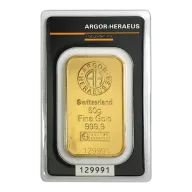
The obverse carries the Argor-Heraeus logo, "Switzerland" country of origin, weight and purity markings, the melter/assayer marking, and the individual serial number. The reverse is dominated by the Kinegram, which covers the full surface. The bar comes sealed in a transparent blisterpack capsule with an assay card that includes the matching serial number, weight, purity, and metal content certification.
Kinegram Security
The Kinegram works through physical surface topology rather than applied materials. Sub-micron engravings create optical effects that shift with viewing angle. Because the effect is structural (part of the gold), it is permanent and cannot wear off, peel, or be transferred to another bar. The technology is extremely difficult to replicate, as it requires the same precision manufacturing used for banknote security features. This makes the Kinebar one of the easiest gold bars to authenticate at a glance, without specialist equipment or database access. No other precious metals manufacturer uses the Kinegram technology; it is a registered trademark exclusive to the Kinebar product line.
Kinebar Tax Treatment by Country
The 50g Kinebar qualifies for investment gold tax exemptions in all major markets. As a 999.9 fine gold bar from an LBMA-accredited Swiss refiner, it meets the purity thresholds universally. The Kinegram security feature has no bearing on tax treatment; it is the weight and purity that determine eligibility.
- United Kingdom: VAT-exempt on purchase. Subject to Capital Gains Tax at 18% or 24% on disposal, with a £3,000 annual allowance. Gold bars do not receive the CGT exemption available to UK legal tender coins. SIPP-eligible for pension investment.
- United States: IRA-eligible. Argor-Heraeus is LBMA and COMEX-approved, and the 999.9 purity exceeds the Section 408(m) threshold (99.5%). Most states exempt bullion from sales tax. Long-term gains taxed at the 28% collectibles rate. Must be stored with an IRS-approved custodian for IRA purposes.
- European Union: VAT-exempt as investment gold under EU Directive 98/80/EC. In Germany, gains on gold held for more than 12 months are completely free of capital gains tax.
- Switzerland: VAT-exempt on investment gold. Argor-Heraeus is a domestic Swiss refiner based in the Canton of Ticino.
- Canada: GST/HST-exempt at 99.5%+ purity. RRSP-eligible through approved custodians.
- Australia: GST-free for investment-grade gold at 99.5%+ purity.
- Singapore: GST-exempt under the Investment Precious Metals (IPM) scheme. No capital gains tax.
- Hong Kong: No sales tax, no import duty, no capital gains tax.
- New Zealand: GST-exempt for gold at 99.5%+ purity.
From Banknote Security to Bullion
The Kinebar concept emerged from a collaboration between Argor-Heraeus and OVD Kinegram AG, both Swiss companies. OVD Kinegram had developed diffractive optical security elements for government use, primarily for banknotes and identity documents. Applying the same technology to a gold bar was a novel idea in 1993, when bullion products offered little beyond weight, purity, and a serial number as authentication.
Union Bank of Switzerland (UBS) brought the first Kinebars to market in December 1993, with retail sales beginning in 1994. The initial range covered the standard metric sizes from 1g to 1 oz (31.1g). UBS, which at that time owned Argor-Heraeus, trademarked the Kinebar name and retains that trademark today.
For eighteen years the product line stayed at those original sizes. The 50g and 100g Kinebars were not introduced until 2012, responding to demand from investors who wanted the Kinegram security at higher weight classes without jumping to the less common kilogram format. The addition filled a gap: the 50g Kinebar offered the holographic verification at a weight where premium efficiency is meaningfully better than the 1 oz bar.
The Kinegram pattern itself has been refined over the decades as optical technology advanced, but the fundamental design layout has remained consistent since 1994. Each size uses the same security approach, and unlike coins, there are no annual design variations. A 50g Kinebar from 2012 looks substantially identical to one from 2025, differing only in subtle engraving refinements and the serial number.
Argor-Heraeus traces its own origins to 1951 and has grown into one of the world's largest gold refiners. The Kinebar remains its most distinctive retail product, standing apart in a market where most gold bars are differentiated only by the refiner's name and logo.
Kinebar 50g vs PAMP, RCM, and Standard Bars
The 50g Kinebar's primary differentiator is its authentication method. In a market where most bars rely on assay cards and serial numbers, the embedded Kinegram provides instant visual verification. Competing products take different approaches to the same problem.
The 50g PAMP Suisse Rosa bar comes from the other leading Swiss refiner. PAMP's flagship Lady Fortuna series uses Veriscan technology, which maps each bar's microscopic surface topology and stores it in a database for smartphone-based verification. The Rosa series, however, does not include Veriscan, so authentication relies on the assay card and serial number. Both bars are 999.9 fine, LBMA-accredited, and come in tamper-evident packaging. PAMP typically carries a slightly higher brand premium; the Kinebar's Kinegram is arguably more practical for point-of-sale authentication since it requires no app or database access.
The 50g RCM Gold Bar from the Royal Canadian Mint offers a different security philosophy. RCM uses Bullion DNA, a proprietary system that encodes encrypted registration data in a privy mark, verifiable with a dedicated reader at participating dealers. The RCM bar also features micro-engraved maple leaf marks and year micro-engraving. The DNA system is technically sophisticated but requires proprietary hardware, unlike the Kinebar's equipment-free visual check. RCM bars carry sovereign mint backing, which some buyers prefer over private refiner products.
A standard Argor-Heraeus 50g bar (without the Kinegram) is also available. The Kinebar's premium over the standard bar is typically only a few dollars, making the security upgrade inexpensive relative to the bar's value at the 50g weight. For buyers who already favour Argor-Heraeus, the Kinebar is a straightforward upgrade. For the 50g Umicore bar or 50g IGR bar, neither offers a comparable built-in security feature; authentication depends entirely on the assay card and the buyer's trust in the brand.
50g Kinebar Gold Bar: frequently asked questions
-
The cheapest 50g Argor-Heraeus Kinebar tracked here is $7,228.99, around 3.5% over the $4,408.10 gold spot price for 50g of 999.9 fine gold. Prices vary by dealer, so the comparison table above shows the current spread across retailers.
-
A Kinebar is an Argor-Heraeus gold bar with a Kinegram, a diffractive optical security element embossed directly into the gold surface (not a sticker). The Kinegram produces shifting colours and patterns when tilted, using the same sub-micron engraving technology applied to banknotes and government documents. Each bar also carries an individual serial number and a certified assay card. The security feature adds a modest premium over a standard minted bar.
-
Kinebars are produced by Argor-Heraeus, a precious metals refiner headquartered in Mendrisio, Switzerland. Argor-Heraeus traces its origins to 1951 and is accredited by the LBMA and CME. The Kinegram security element was first introduced in 1993, developed using optical technology from OVD Kinegram AG, also Swiss-based. UBS holds the Kinebar trademark, reflecting the product's origins as a UBS initiative through Argor-Heraeus.