




Prices are fetched automatically and may not reflect current merchant prices. Currency conversions and tax treatment are approximate. Rankings are based solely on price. We are not a dealer and accept no responsibility for transactions with listed merchants. Past performance is not indicative of future results. This site does not provide investment advice. Full disclaimer
About 1g Gold Coins
1 Gram Gold Coins: The Entry Point to Physical Gold
One gram gold coins represent the smallest standard denomination in the bullion coin market. At roughly the cost of a modest dinner, they are the lowest-priced way to own a sovereign-minted gold coin with legal tender status, government-backed weight and purity guarantees, and the security features that come with products from established national mints.
The trade-off is cost efficiency. Manufacturing, assaying, packaging, and distribution costs are roughly fixed regardless of coin size. Spread across a single gram of gold, those costs push premiums to 8-15% over spot, compared to 3-5% on a 1 oz gold coin. Buying 31 individual 1g coins instead of a single 1 oz coin would cost hundreds of dollars more for the same amount of gold. This makes 1g coins a poor choice for systematic accumulation and a deliberate choice for specific purposes: gifts, introductory purchases, maximum divisibility, or simply owning gold at the lowest possible total outlay.
The most widely available 1g gold coins come from the Royal Canadian Mint (both individual coins and the divisible MapleGram sheets), the Chinese Panda, and the Armenian Noah's Ark. Perth Mint Lunar series and the American Eagle also appear at this weight, though with more limited availability. All carry the same fundamental economics: high percentage premiums offset by low absolute cost and sovereign mint backing.
Premium Costs at One Gram
Premiums on 1g gold coins run 8-15% over spot, the highest of any standard bullion coin weight. At current gold prices, that translates to roughly $8-15 in premium on a coin worth approximately $100 in metal content. The percentage sounds steep, and it is; but the absolute dollar amount is modest compared to the premium on larger coins.
The economics become clear when scaling up. A single 1 oz Gold Maple Leaf at a 3% premium contains 31.1 grams of gold. Buying 31 individual 1g coins at 12% premium each would cost roughly $280 more for the same gold weight. That gap represents the accumulated per-unit overhead of striking, packaging, and distributing 31 separate coins instead of one.
Among 1g coins, the 1g Panda and 1g Noah's Ark tend to sit at the lower end of the premium range, reflecting their positioning as value-oriented bullion. The 1g Maplegram from the Royal Canadian Mint carries a slight premium above individual coins due to the divisible sheet packaging and assay certificate, but offers the convenience of purchasing multiple grams in a single transaction. The 1g Perth Lunar commands higher premiums due to limited mintages and collector appeal from the annual zodiac designs.
For buyers whose primary concern is premium efficiency, the clear path is to save toward a larger denomination. Moving from 1g to even a 1/4 oz gold coin roughly halves the premium percentage. A 1/2 oz coin halves it again. The 1g coin serves buyers for whom the total purchase price, not the premium percentage, is the binding constraint.
Major 1g Gold Coins
The 1g gold coin market is more active than its niche status might suggest, with products from several major mints competing for buyers at this weight class.
The 1g Chinese Gold Panda is the most widely traded 1g gold coin. Struck in .999 fine gold with a 10 yuan face value, it benefits from the Panda programme's global dealer network and its annual design changes, which sustain collector interest alongside bullion demand. Among 1g coins, the Panda typically offers competitive premiums.
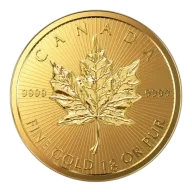
The 1g Gold Maple Leaf from the Royal Canadian Mint is struck in .9999 fine gold with a C$0.50 face value. At 8mm diameter, it is among the smallest government-issued gold coins in production. Individual coins carry the same radial-line security features as the full-size Maple Leaf. The related MapleGram packages 25 of these coins into a divisible blister pack with individual assay, offering a convenient way to buy multiple grams while maintaining the option to separate and sell them individually.
The 1g Noah's Ark from the Central Bank of Armenia (manufactured by Geiger Edelmetalle in Germany) is struck in .9999 fine gold with a 100 Armenian Dram face value. It benefits from the Noah's Ark series' strong European distribution and competitive pricing. The coin comes in a security capsule that can only be opened by destruction, providing tamper-evidence alongside the certificate of authenticity.
The 1g Perth Mint Lunar adds an annual zodiac animal design to the 1g format. At .9999 purity with an AUD $5 face value, it targets buyers who want collector potential alongside their bullion. Limited mintages mean specific years can appreciate above standard bullion pricing.
The 1g American Eagle is an unusual entry. At .9167 fine (22 karat), it matches the purity of the full-size Gold Eagle rather than the .999+ standard of its competitors. The coin still contains exactly 1 gram of pure gold, with copper and silver alloy making up the balance, so the total coin weight slightly exceeds 1 gram.
Resale and Practical Considerations
Liquidity for 1g gold coins depends heavily on the brand. Coins from recognised sovereign mints in sealed original packaging are accepted by most established dealers. The Maple Leaf, Panda, and Noah's Ark all have active buyback markets through the dealers who sell them.
Buyback prices reflect the premium economics of the weight class. A dealer paying spot or slightly above spot for a 1g coin means the seller absorbs most or all of the original premium. On secondary markets such as collector forums and private sales, brand-name 1g coins can trade at premiums that recover more of the original cost, but the transaction is slower and carries more friction than selling to a dealer.
Intact assay packaging is important for resale at this weight. A 1g coin removed from its sealed card or capsule loses the tamper-evident authentication that makes quick dealer transactions possible. For MapleGram sheets, individual grams maintain their sealed state when separated from the perforated blister pack, preserving resale value.
Storage is effortless. A 1g gold coin in its assay card is roughly credit-card sized but thinner. The coin itself is approximately 8-16mm in diameter depending on the mint. Dozens can fit in a small safe or drawer. The assay packaging should be protected from bending or water damage, as it serves as the coin's primary proof of authenticity for resale purposes.
For gift giving, which is a significant driver of 1g coin sales, the small size and low cost make them accessible to recipients who might not otherwise own physical gold. The sovereign mint packaging, legal tender status, and accompanying certificates give the gift a sense of substance and authenticity that plain gram bars lack.
1g Gold Coins: frequently asked questions
-
The spot value of 1 gram of gold is $4,408.10 divided by 31.1035 (grams per troy ounce). Retail prices from dealers are higher, reflecting a premium over spot that is typically larger on smaller weights. 6 dealers list 14 1g gold coin products on this page for a direct price comparison.
-
6 dealers offer 14 1g gold coin products tracked on BullionFerret. Prices and premiums vary across retailers, so comparing before buying can save money. The table above shows each dealer's current price; click through to buy directly from the retailer of your choice.
-
A 1 gram gold coin is very small, roughly the size of a small fingernail. The exact dimensions depend on the mint and design, but all 1g coins are noticeably smaller than a 1oz coin. They are often sold in assay cards or capsules to protect them and make handling easier.
-
In the UK, gains on gold coins are generally subject to CGT at 18% or 24% above the £3,000 annual allowance. In the US, gold is classed as a collectible and long-term gains are taxed at up to 28%. In Canada, 50% of any gain is included in taxable income.