

Prices are fetched automatically and may not reflect current merchant prices. Currency conversions and tax treatment are approximate. Rankings are based solely on price. We are not a dealer and accept no responsibility for transactions with listed merchants. Past performance is not indicative of future results. This site does not provide investment advice. Full disclaimer
About the American Prospector Silver
The Engelhard American Prospector
The American Prospector is a .999 fine silver round produced by Engelhard Corporation from 1982 to 1987. Engelhard was founded by Charles W. Engelhard Sr. in 1902 in Newark, New Jersey, and grew to become the world's largest refiner and fabricator of platinum, gold, and silver. The Prospector was its flagship retail product, designed to bring .999 fine silver to individual investors during the early years of the modern bullion market.
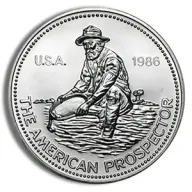
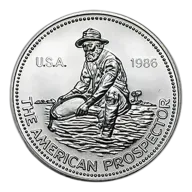
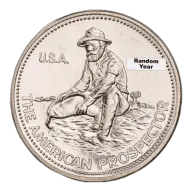
The obverse depicts Claude Chana (1811 to 1882), a French immigrant who was the first person to officially find gold in Auburn, California, on 22 March 1848, just two months after James Marshall's more famous discovery at Sutter's Mill. Chana is shown kneeling and panning for gold with a pick and pan, against a mountain landscape with a beaded outer border. The reverse changed partway through the series: the 1982 to 1984 "Large E" era featured Engelhard's interlocking globe logo, while the 1984 to 1987 "Eagle" era replaced this with a bald eagle clutching an olive branch. The 1984 date exists in both variants, making it a transitional year.
Engelhard ceased retail bullion production in the late 1980s, likely unable to compete with the American Silver Eagle launched in 1986. Why buy a private mint round when the US government offered a legal tender coin at similar premiums? Engelhard was wholly acquired by BASF in 2006 for $5 billion. In August 2025, BASF and MKS PAMP Group announced a revival of the Engelhard brand, with new Prospector rounds and cast bars entering production.
Original Engelhard Prospectors are no longer just bullion. Vintage rounds carry collector premiums of 30% to 100% or more above spot, depending on year, variant, and condition. The 2025 revival rounds, produced by MKS PAMP under licence, will trade at bullion-adjacent premiums as new production, while vintage originals maintain their collector value. This creates an unusual two-tier market for the same design.
American Prospector Specifications
Original Production (1982 to 1987)
| Size | Weight | Diameter | Thickness | Purity |
|---|---|---|---|---|
| 1 oz | 31.10 g | 39.00 mm | 2.90 mm | .999 fine silver |
| 1/2 oz | 15.55 g | -- | -- | .999 fine silver |
| 1/4 oz | 7.78 g | -- | -- | .999 fine silver |
| 1/10 oz | 3.11 g | -- | -- | .999 fine silver |
Fractional sizes (1/10, 1/4, and 1/2 oz) were produced only in 1985. Mintage estimates from the AllEngelhard.com census indicate most 1 oz year/variant combinations exceeded 75,000 pieces, while 1985 fractional rounds were in the 10,000 to 50,000 range. Genuine proof versions are extremely rare, estimated at fewer than 250 to 500 pieces per year.
2025 Revival Production (BASF / MKS PAMP)
| Product | Weight | Purity | Notes |
|---|---|---|---|
| 1 oz silver round | 31.10 g | .999 fine silver | Proof-like finish |
| 1/10 oz gold round | 3.11 g | .9999 fine gold | Limited to 5,000 pieces |
| 3 oz silver cast bar | 93.31 g | .999 fine silver | First Engelhard cast bar in 20+ years |
The 2025 rounds faithfully replicate the original obverse and Large E logo reverse. They are produced by MKS PAMP (LBMA-accredited) and packaged in replica Engelhard-branded tubes.
Engelhard Prospector Tax Treatment by Country
The American Prospector is a private mint round, not government-issued legal tender. It carries no face value. This limits its tax advantages compared to sovereign mint coins like the American Silver Eagle or Silver Maple Leaf.
Country-by-Country Summary
- United States: Subject to state sales tax (varies by state; approximately 35 states exempt bullion, some with minimum purchase thresholds). Not confirmed as IRA eligible. IRS rules require precious metals in retirement accounts to be from specifically listed mints or meet strict refiner accreditation criteria. Original Engelhard rounds may have qualified when Engelhard held active LBMA/COMEX accreditation; the 2025 PAMP-produced revival rounds benefit from PAMP's current accreditation but should be confirmed with a custodian. Capital gains taxed at the collectibles rate of up to 28%.
- United Kingdom: 20% VAT on purchase. No CGT exemption (not UK legal tender, not legal tender of any country). Silver rounds receive no tax advantages in the UK.
- Canada: Subject to GST/HST. Rounds without legal tender status may not qualify for the standard bullion exemption in all cases.
- Australia: May qualify for GST exemption at 999 purity if in a tradeable bar/coin form with manufacturer's mark. ABC and Perth Mint products are more straightforward for Australian tax treatment.
- EU: Subject to local VAT rates. No investment exemption for private mint silver rounds.
- Singapore: May qualify for IPM exemption if meeting the 99.9% purity requirement, though sovereign coins are more reliably exempt.
- Hong Kong: No sales tax, import duty, or capital gains tax.
Claude Chana, Engelhard, and the Birth of the Retail Bullion Round
The American Prospector appeared during a pivotal period for precious metals. The Hunt brothers' attempted silver corner had driven the price to $49.45/oz in January 1980 before collapsing, and the early 1980s saw a new generation of retail investors seeking physical silver. Engelhard, already the world's largest precious metals refiner, entered the retail market with the Prospector in 1982.
The choice of Claude Chana as the obverse figure was fitting. Chana's 1848 gold discovery in Auburn Ravine predated the California Gold Rush by months and established Auburn as "Gold Country." The design evokes the individual prospector, pan in hand, seeking fortune in the raw earth, an image that resonated with small investors buying physical metal.
The reverse underwent a significant change mid-series. From 1982 to 1984, the back displayed Engelhard's distinctive interlocking "E" globe logo. In 1984, production transitioned to a bald eagle with "ENGELHARD" text, creating the "Eagle logo" era that ran through 1987. The 1984 transitional year exists in both variants, and three slightly different 1985 varieties are distinguished by date font width and water detail rendering differences.
The arrival of the American Silver Eagle in 1986 effectively ended Engelhard's retail bullion business. Government-backed legal tender coins from the US Mint carried an authenticity and brand advantage that private rounds could not match. Engelhard ceased retail production by the late 1980s, though its industrial refining operations continued until the company's acquisition by BASF in 2006.
Charles Engelhard Jr., son of the founder, is widely believed to have inspired Ian Fleming's James Bond villain Auric Goldfinger. Fleming knew Engelhard socially, and the parallels (a German-surnamed magnate obsessed with precious metals) are difficult to dismiss. Engelhard Jr. died in 1971, before the bullion coin era he might have dominated.
The 2025 revival, announced at the ANA World's Fair of Money in Oklahoma City, marks one of the first instances of a defunct bullion brand being resurrected by its corporate successor. BASF's partnership with MKS PAMP combines the Engelhard name with PAMP's Swiss manufacturing capability and LBMA accreditation. The revival rounds replicate the original design down to relief height and typography, packaged in replica moulded tubes.
Engelhard Prospector vs American Silver Eagle and Other Rounds
The Engelhard Prospector occupies a unique space between bullion and collectible. Original 1982 to 1987 rounds command premiums that place them well above generic silver rounds but also above most sovereign coins. A vintage 1 oz Prospector might trade at 50% to 100% above spot, compared to 20% to 30% for an American Silver Eagle and 5% to 10% for a generic round. This "Engelhard premium" reflects brand nostalgia, discontinued scarcity, and the collector market for vintage Engelhard products (their 100 oz silver bars are particularly sought after).
The 2025 revival changes this dynamic. New-production Prospector rounds from PAMP will trade at premiums more typical of branded rounds, making the design accessible again at bullion-adjacent pricing. Vintage originals may see their collector premiums increase further as the market distinguishes between new and original production.
Against the American Silver Eagle, the Prospector lacks legal tender status, IRA eligibility, and government backing. The Eagle is the clear choice for investors seeking liquidity, tax advantages, and universal acceptance. The Prospector appeals to a different buyer: one who values the Engelhard heritage, the vintage design aesthetic, or who is building a collection of pre-Eagle era silver.
Compared to modern generic rounds from Sunshine Minting, Silvertowne, or Asahi, original Prospectors trade at a significant collector premium. Generic rounds typically sell at 5% to 10% above spot with tight spreads, making them the most cost-efficient way to buy silver. The Prospector's premium is entirely driven by brand and history rather than metal content or security features, since the original rounds have no anti-counterfeiting technology. This is a meaningful risk: Engelhard Prospector rounds are among the most commonly counterfeited silver rounds, with the 1984 Large E variant being the most targeted. Weight and dimension verification or Sigma Metalytics testing is recommended for any secondary-market purchase.
American Prospector Silver: frequently asked questions
-
The American Prospector is a series of privately minted bullion rounds produced by Engelhard Corporation between 1982 and 1987, available in gold, silver, and platinum. The obverse depicts a gold prospector panning for metal, referencing the American mining tradition. The series is now discontinued, though a revival was announced in 2025. BullionFerret tracks 13 listings from 11 dealers.
-
Vintage Engelhard Prospectors trade well above the underlying metal spot price due to their discontinued status and collector demand. The secondary-market premium varies by year, variant, and condition. BullionFerret compares 13 active listings from 11 dealers so you can see the current price spread across available pieces.
-
Engelhard produced silver American Prospector rounds from 1982 to 1987, with some sources citing production through 1988. Fractional sizes (1/10, 1/4, and 1/2 oz) were made in 1985 only. The series was discontinued in the late 1980s, likely as the American Silver Eagle (launched 1986) drew retail buyers to a government-backed alternative. In 2025, BASF and MKS PAMP announced a revival of the Engelhard brand and Prospector design.
-
Three factors sustain the secondary-market premium: Engelhard ceased bullion production in the late 1980s, so genuine vintage rounds are in fixed supply; the Engelhard brand carries strong recognition among experienced stackers; and the varied year and logo variants attract collector interest beyond pure metal value. These dynamics apply to bars and rounds alike, and are commonly described as the 'Engelhard premium' in the secondary market.
-
Counterfeits are a known problem, particularly the 1984 'Large E' logo variant. Key checks: weight should be 31.10 g (1 oz), diameter 39 mm, and the beaded border and logo details should be sharply defined. Proof-like rounds presented in air-tite capsules warrant extra scrutiny, as genuine Engelhard proofs were produced in very small numbers. A Sigma Metalytics tester can verify silver content non-destructively, and purchasing from reputable dealers reduces risk.