1 product · 2 deals Prices & premiums exclude tax to compare across countries
Filters
| Product | /oz | Premium | Price (ex. tax) | |
|---|---|---|---|---|

2 deals
|
$128.69 |
+93.04%
+132% inc.VAT
|
$82.75
£74 inc.VAT
|
Compare |
Prices are fetched automatically and may not reflect current merchant prices. Currency conversions and tax treatment are approximate. Rankings are based solely on price. We are not a dealer and accept no responsibility for transactions with listed merchants. Past performance is not indicative of future results. This site does not provide investment advice. Full disclaimer
About 20g Silver Bars
The 20 Gram Silver Bar Format
The 20 gram silver bar sits in a niche between the smallest gram-denominated bars (1g to 10g) and the more substantial 50g and 100g formats. At 0.643 troy ounces, it contains slightly more silver than a half-ounce bar but is priced and marketed within the metric gram system that dominates European and Asian bullion markets. For silver buyers specifically, this weight represents a very modest outlay, making it one of the lowest-cost entry points into physical silver ownership from a recognised refiner.
The 20g weight is far more established in gold than in silver. In gold, brands like PAMP Suisse, Valcambi, and Argor-Heraeus all produce popular 20g bars because the value (roughly $2,100 at 2026 gold prices) makes it a meaningful investment unit. In silver, the same weight is worth approximately $21 at current prices, which limits its appeal as a serious accumulation tool. Buyers choosing 20g silver bars are typically purchasing sets, building a collection of branded bars from different refiners, or buying gifts rather than stacking metal for long-term investment.
The manufacturers producing at this weight tend to be European and Middle Eastern refiners with strong gram-denominated product lines. Swiss refiners like Argor-Heraeus and PAMP Suisse (Fortuna), German producers like Geiger Edelmetalle, and Turkish refiners like Nadir Refinery all offer 20g silver bars. These bars are typically minted (stamped) rather than cast, sealed in assay cards or blister packs, and carry serial numbers.
Practical Considerations at This Weight
Premiums on 20g silver bars are significantly higher in percentage terms than on larger formats. Because the fabrication cost of minting, packaging, and assay-carding a small bar is largely fixed regardless of metal content, and because the base metal value is so low (under $25), the manufacturing overhead represents a much larger fraction of the total price. Buyers should expect premiums considerably above the 4-8% typical for 10 oz silver bars, making this weight unsuitable for cost-efficient silver accumulation.
Storage is trivial. A 20g silver bar in its assay card is smaller than a credit card and weighs essentially nothing. This makes the format suitable for safe deposit boxes, small home safes, or even envelope storage. Unlike larger silver bars, there is no practical storage burden at this weight.
Liquidity is the main concern. The 20g silver bar is not a standard trading unit in any major market. Dealers focused on troy-ounce products (the majority in the US, UK, Canada, and Australia) may not actively quote this size or may offer unfavourable buyback spreads. Resale is most straightforward through European dealers who regularly stock gram-denominated silver, or through the original retailer. Bars from LBMA-accredited refiners in original sealed packaging will always find a buyer, but the bid-ask spread will be wider than for standard sizes like 1 oz or 10 oz.
Premium Dynamics for 20 Gram Silver Bars
The economics of 20g silver bars are dominated by a single factor: the fixed cost of production is high relative to the contained metal value. Minting a bar, engraving a serial number, sealing it in an assay card, and packaging it for retail costs roughly the same whether the bar contains $20 or $2,000 worth of metal. At the 20g silver level, that fixed cost translates into percentage premiums that dwarf those on larger bars.
For context, the premium hierarchy for silver bars typically runs from around 8-15% for 1 oz bars, 4-8% for 10 oz bars, 3-6% for 1 kg bars, and 2-5% for 100 oz bars. At the 20g level (0.643 oz), premiums are comparable to or higher than 1 oz bars because the bar is smaller in metal content but requires similar production effort. Brand-name bars from Swiss or German refiners will sit at the upper end of this range due to their additional security features and packaging quality.
The practical implication is that buyers of 20g silver bars are paying substantially more per gram of silver than those purchasing at standard weights. This makes the format poorly suited to bulk accumulation. If the primary goal is maximising silver weight per dollar spent, stepping up to 1 oz bars or preferably 10 oz bars delivers meaningfully more metal for each dollar of premium paid.
One factor that partially offsets the high percentage premium is the low absolute premium. Because the bar costs so little in total, even a 15-20% premium represents only a few dollars in actual money. Buyers purchasing a single bar as a gift, a collector piece, or an introduction to physical silver may reasonably consider this acceptable. The cost calculus changes entirely for anyone looking to accumulate meaningful quantities.
Key 20g Silver Bar Products
The 20g silver bar market is served primarily by European and Middle Eastern refiners who maintain full gram-denominated product lines. Unlike the troy-ounce market where dozens of mints compete, the 20g silver space has relatively few participants, and products tend to reflect each refiner's broader brand identity and security philosophy.
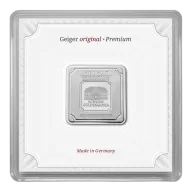
The 20g Geiger Edelmetalle Geiger Original bar stands out for its distinctive square format and extensive security features. The bar includes UV-reactive LEV logo coating, individual serial numbers, reeded edges (unusual for a bar), and a high-relief pearl-finish surface. Geiger is the only private mint in Germany and operates from Schloss Guldengossa, an 18th-century baroque castle near Leipzig. Their bars are among the most security-intensive in the retail bullion market.
The 20g Argor-Heraeus bar comes from one of Switzerland's five LBMA referee panel members for gold refining (and LBMA-accredited for silver). Their bars feature clean Swiss design, sealed assay card packaging, and individual serial numbers. Argor-Heraeus has been refining precious metals since 1951 in Mendrisio, Switzerland, and is now a subsidiary of the Heraeus Group.
The 20g Nadir Refinery bar represents the Turkish refining sector. Established in 1993, Nadir produces bars for both the domestic Turkish market and international distribution. Their bars are .999 fine silver in standard assay packaging. Turkey's geographic position between Europe and Asia gives Nadir access to both market systems.
The 20g PAMP Suisse Fortuna features the iconic Lady Fortuna design that makes PAMP the most recognised bar brand globally. PAMP's CertiPAMP packaging and Veriscan authentication technology provide strong anti-counterfeiting assurance, though this comes at a brand premium above less decorated competitors.
Resale and Storage Realities
Liquidity for 20g silver bars is narrower than for standard troy-ounce products. The format occupies a gap between established trading sizes: too small to attract dealers who focus on ounce-denominated inventory, and below the value threshold where most buyback programs become cost-effective for the dealer. This does not mean 20g bars are unsellable, but sellers should expect wider bid-ask spreads and potentially fewer immediate offers compared to selling a 1 oz or 10 oz silver bar.
Several factors improve resale prospects. Bars from LBMA-accredited refiners (Argor-Heraeus, PAMP Suisse, Valcambi) retain the broadest dealer acceptance because the hallmark guarantees authenticity without independent testing. Bars in original sealed assay packaging command better buyback prices than loose bars. The European dealer network, where gram-denominated products are standard inventory, offers more natural liquidity than North American or Australian dealers who stock primarily in troy ounces.
For online resale, peer-to-peer platforms can sometimes recover more of the original premium paid, particularly for collectible or security-featured bars like Geiger Original squares. However, this introduces counterparty risk and shipping costs that may negate the benefit at such low values.
Storage Characteristics
At 20 grams, storage is a non-issue. The bar itself is smaller than a matchbox, and in its assay card packaging it approximates the size of a credit card. Even accumulating dozens of 20g bars would not present meaningful space requirements. They fit easily into home safes, safe deposit boxes, or any secure storage solution.
Silver does tarnish when exposed to sulphur compounds in the atmosphere, but bars sealed in their original assay cards or blister packs are protected from this. Leaving bars in sealed packaging is recommended for both preservation and resale value. Anti-tarnish strips are unnecessary while packaging remains intact.
The relevant storage consideration at this weight is cost proportionality. Professional vault storage or safe deposit box rental represents a significant annual cost relative to the value of the stored metal. A single 20g silver bar worth approximately $21 would be uneconomical to store professionally. This weight class only makes practical sense for home storage or as part of a larger collection stored together.
20g Silver Bars: frequently asked questions
-
A 20g silver bar contains 20 divided by 31.1035 troy oz of fine silver, roughly 0.643 troy oz. Multiply that by the live silver spot price of $67.63 per troy oz to get the intrinsic metal value. Dealer retail prices will be a little higher to cover fabrication and distribution costs.
-
Fine silver marked .999 is 99.9% pure silver by weight, with trace amounts of other metals making up the remaining 0.1%. This is the standard purity for investment-grade bullion bars and is recognised by major exchanges and refineries worldwide as meeting the benchmark for tradeable silver.
-
Purchase taxes on silver bars vary by country. In the UK, silver bars carry 20% VAT. In Canada, silver bars are subject to GST/HST (0%). In Australia, silver bars attract GST (0%). US buyers face state-level sales tax rules that differ from state to state.
-
This page lists 4 offers from 4 dealers for 20g silver bars. Sort by price or premium over spot in the table above to identify the keenest deal available right now.
- 20g Argor-Heraeus Silver Bar
- 20g Credit Suisse Silver Bar
- 20g Fortuna Silver Bar
- 20g Geiger Original Silver Bar
- 20g Kundan Refinery Lakshmi Ganesh Silver Bar
- 20g MMTC-PAMP Lakshmi Ganesh Silver Bar
- 20g Nadir Refinery Silver Bar
- 20g Rosa Silver Bar
- 20g Silver Bar
- Pre-Owned 20g Heraeus Silver Bar
- Pre-Owned 20g PAMP Suisse Silver Bar
- Pre-Owned 20g Silver Bar