6 products · 27 deals
Filters




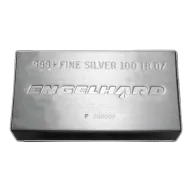

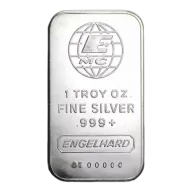

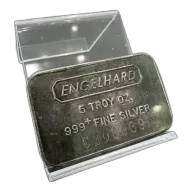
Prices are fetched automatically and may not reflect current merchant prices. Currency conversions and tax treatment are approximate. Rankings are based solely on price. We are not a dealer and accept no responsibility for transactions with listed merchants. Past performance is not indicative of future results. This site does not provide investment advice. Full disclaimer
About the Engelhard Silver Bars Silver
A Discontinued Refinery with an Active Collector Market
Engelhard silver bars are products of a company that no longer exists, yet they trade at consistent premiums above modern equivalents. Charles W. Engelhard Sr. founded the company in 1902 by purchasing the Charles F. Croselmire Company in Newark, New Jersey. By the 1950s, Engelhard was the world's largest precious metals smelter. The company produced retail silver bars from the late 1960s through approximately 1986, then exited the retail bullion market to focus on industrial catalysts. BASF acquired Engelhard in 2006 for US$5 billion, and the company was renamed BASF Catalysts LLC.
Every Engelhard bar is .999 fine silver, the same purity as modern bullion bars. The difference is provenance: no new Engelhard bars will ever be produced, and a significant number of the original production run were melted during the 1979-1980 silver price spike when silver hit approximately $50 per ounce. This combination of a closed production window and destruction of existing stock makes surviving bars genuinely scarcer than their original mintage numbers suggest.
The collector market for Engelhard bars is well-organised. AllEngelhard.com, a community-maintained reference, catalogues over 40 distinct 1 oz bar varieties alone, spanning landscape-orientation extruded bars from the late 1960s through portrait-orientation struck bars from the mid-1980s. Rare varieties with fewer than 50 known survivors command premiums many multiples above spot. Even common varieties trade at a consistent $5-20+ premium per ounce over the spot silver price, a margin that reflects historical demand rather than metal content.
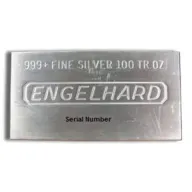
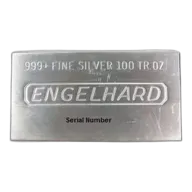
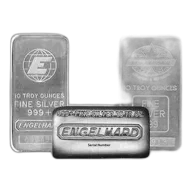
Available sizes range from the 1 oz Engelhard bar through the 100 oz Engelhard bar, with intermediate sizes at 5 oz, 10 oz, 20 oz, and 50 oz. Uncommon sizes (2 oz, 3 oz, 4 oz, 7 oz) were also produced and carry substantial additional premiums for their rarity.
Engelhard Bar Varieties and Identification
All Engelhard retail silver bars are .999 fine silver. Sizes produced include 1 oz, 2 oz, 3 oz, 4 oz, 5 oz, 7 oz, 10 oz, 25 oz, 50 oz, 100 oz, and 1,000 oz Good Delivery bars. No standard dimensions were published across the production run, as bar profiles varied significantly across the 40+ documented varieties in the 1 oz class alone.
Production Methods
Engelhard used three production methods: cast (poured), pressed, and extruded. Weight and purity are identical across methods; the difference is in finish and surface texture. Cast bars have a rougher, more organic appearance with visible pour lines. Pressed bars have clean, flat surfaces. Extruded bars have a distinctive smooth profile characteristic of the earliest production runs.
Serial Numbers
Nearly all Engelhard bars carry a unique serial number, which serves as the primary authentication marker. Serial number formats vary by era and production facility: numerical-only formats (5-6 digits) appear on earlier bars, and letter-prefix formats (PA, PB, FG series for 1 oz; P, S, W, C prefixes for 100 oz) appear on later production. Two known 1 oz varieties exist without serial numbers but are otherwise identical to serial-numbered bars. The "PB" prefix uniquely uses 6 digits where most others use 5.
Major Variety Categories (1 oz)
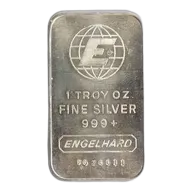
- Landscape varieties (late 1960s): Elongated octagon hallmarks, extruded finish. The earliest retail Engelhard bars.
- Canadian varieties (1968-early 1970s): Stamped "Engelhard Industries of Canada."
- Portrait varieties (1981-1986): Wide 'E' globe logo, Large 'E' designs, Eagle logo (final 1986 production), Maple Leaf Canadian editions, Australian and Sheffield Smelting editions.
- Art and commemorative bars: 1976 Sports Series (6 designs), corporate/institutional bars, dealer counterstamps (Colonial, IMPEX, ROYAL).
Authentication
Genuine Engelhard bars show consistent fonts and spacing specific to their production era. The hallmarks ('E' mark for later bars, bull-and-bear logo for commercial bars) and edge finishing are era-specific. AllEngelhard.com maintains a definitive reference of known counterfeits. The 100 oz size is the most frequently counterfeited. Verification centres on serial number format, font details, and edge quality for the specific variety claimed.
Tax Treatment of Engelhard Silver Bars
Engelhard bars are private-mint products with no legal tender status in any jurisdiction. Tax treatment follows the general rules for silver bullion bars.
United States: The .999 purity meets the IRS fineness requirement for precious metals IRAs. Some dealers list Engelhard bars as IRA-eligible, though acceptance is custodian-specific. Capital gains are taxed at the collectibles rate of up to 28%. The collector premiums that Engelhard bars carry above spot do not change the tax classification; gains are calculated on the actual sale price minus the acquisition cost. Sales tax varies by state, with approximately 35 states exempting bullion.
United Kingdom: Subject to 20% VAT on purchase, with no exemption for silver bullion of any kind. On disposal, capital gains tax applies at the individual's marginal rate. No CGT exemption is available because Engelhard bars are not UK legal tender. The annual CGT allowance (currently £3,000) applies. For UK buyers, the 20% VAT plus CGT exposure makes silver bars less tax-efficient than gold bullion (which is VAT-free) and less efficient than Silver Britannia coins (which are CGT-exempt).
Canada: Silver at .999 purity is exempt from GST/HST. No distinction is made between current-production and discontinued bars for this purpose. Capital gains follow the standard 50% inclusion rate.
Australia: Silver bars at 99.9% purity qualify as investment-grade and are GST-free. CGT applies on disposal with a 50% discount for holdings over 12 months.
European Union: Silver bars attract the full local VAT rate, typically 17-27% depending on the country. The margin scheme in Germany and the Netherlands applies only to pre-owned items, and secondary-market Engelhard bars may qualify under dealer interpretation.
Singapore: Investment Precious Metal silver at 99.9% purity in bar form of at least 0.5 troy ounces is exempt from 9% GST. No capital gains tax.
Hong Kong: No sales tax, import duty, or capital gains tax on silver bullion.
From Newark Smelter to James Bond Villain
The Engelhard story begins in 1902 when Charles W. Engelhard Sr. purchased the Charles F. Croselmire Company in Newark, New Jersey. Two years later he acquired Baker & Co., a platinum smelter also in Newark, and in 1905 established Hanovia Chemical and Manufacturing Company. His son, Charles Engelhard Jr., consolidated the family holdings into Engelhard Industries, Inc. in 1958 and took the company public on the New York Stock Exchange.
Charles Engelhard Jr. became one of the wealthiest men in the world through precious metals. His lifestyle and business dealings are widely cited as the inspiration for Ian Fleming's James Bond villain Auric Goldfinger. The connection between the real industrialist and the fictional character has contributed to the Engelhard brand's enduring mystique among collectors.
Retail silver bar production ran from the late 1960s through approximately 1986. Approximately 4 million 1 oz bars were produced in total across all varieties. The production period spanned the Hunt Brothers silver boom of 1979-1980, during which silver prices spiked to nearly $50 per ounce. A significant proportion of Engelhard bars were melted during this period by holders cashing in on the price spike, paradoxically increasing the long-term collector value of bars that survived. The company processed gold for the US Treasury and was involved in the refining of South African gold during the apartheid era.
Engelhard exited the retail bullion market in the late 1980s to refocus on industrial catalysts and advanced materials. The company continued to operate as a major industrial precious metals processor until BASF, the German chemical conglomerate, acquired it in 2006 through a hostile takeover bid valued at US$5 billion. On 1 August 2006, Engelhard was officially renamed BASF Catalysts LLC, ending over a century of the Engelhard name in precious metals.
The collector market for Engelhard bars emerged organically as the finite supply became apparent. AllEngelhard.com, a community-maintained reference, became the definitive catalogue of varieties and the standard reference for authentication. The site documents over 40 distinct 1 oz varieties and maintains an "Investment Rating" system that rates bars on a rarity scale, with some varieties having fewer than 50 known survivors.
Engelhard vs Johnson Matthey, Modern Bars, and Sovereign Coins
The most natural comparison for Engelhard bars is Johnson Matthey (JM), the other major refiner that produced retail silver bars during the same era. Both companies struck .999 fine bars with serial numbers, and both ceased retail bar production (JM's bullion arm was sold to Asahi Refining in 2015). Engelhard bars generally command higher collector premiums than equivalent JM bars. The premium gap reflects several factors: Engelhard has a greater variety of documented types (40+ for 1 oz alone), the Goldfinger cultural connection adds cachet, and the earlier exit from production (mid-1980s vs 2015 for JM) means Engelhard bars have had longer to become scarce through meltdowns and attrition.
Against modern generic silver bars from Sunshine Minting, Asahi, or other current refiners, the difference is entirely in collector value. A new 10 oz generic bar trades at a small premium over spot, typically 4-8%. An Engelhard 10 oz bar in the same weight and purity trades at a substantially higher premium because of its provenance and finite supply. The silver content is identical; the additional cost buys historical significance and a collector market with decades of established demand.
Against sovereign-mint coins like the Silver Britannia or Silver Maple Leaf, Engelhard bars occupy a different category entirely. Sovereign coins offer legal tender status, government-guaranteed weight and purity, and in some jurisdictions, tax advantages that bars cannot access. The Britannia's CGT exemption for UK taxpayers is a structural advantage no bar can match. Engelhard bars offer something sovereign coins do not: the appeal of a discontinued product with documented history and an organised collector community. These are different value propositions serving different buyer motivations.
Counterfeiting is a meaningful concern for Engelhard bars, more so than for most modern bullion products. The 100 oz size is particularly targeted. Authentication relies on knowledge of the correct serial number format, font consistency, and edge quality for the specific variety claimed. The AllEngelhard community provides detailed references for known counterfeits. Buyers purchasing Engelhard bars should use reputable dealers and verify against the published variety guides.
Engelhard Silver Bars Silver: frequently asked questions
-
An Engelhard bar's minimum value is its silver content: weight in troy ounces multiplied by silver spot price. In practice, most Engelhard bars sell above that floor due to collector demand. We track 8 dealers and 30 listings, so you can see where current offers sit relative to spot.
-
Engelhard exited retail silver bar production in the mid-1980s, so the supply is permanently fixed. No new bars are being made. Significant quantities were also melted during the 1979-1980 silver price spike, reducing surviving stock further. Collectors and stackers alike seek them for their historical significance and the wide variety of documented types, which drives premiums well above those of modern generic bars.
-
Engelhard's retail silver bar production ran from the late 1960s through approximately 1986, when the company exited the bullion market to concentrate on industrial catalysts. The business was later acquired by BASF in 2006 and renamed BASF Catalysts LLC. No Engelhard silver bars have been produced since the mid-1980s.
-
Key authentication markers include correct font style and spacing for the production era, accurate serial number format (numerical-only or letter-prefix depending on the variety), proper weight, and correct edge finish. AllEngelhard.com maintains a definitive catalogue of known varieties and a reference on known counterfeits. Fakes typically fail on font details, serial number format, or edge quality.
-
Nearly all Engelhard silver bars carry a unique stamped serial number. Formats vary by size and era: 1 oz bars use numerical-only (5-6 digit) or letter-prefix series (PA, PB, FG, and others); 100 oz bars use P, S, W, or C prefixes. Two known 1 oz varieties exist without serial numbers but are otherwise identical to their serial-numbered counterparts.