0 products · 0 deals
Filters
No products match your filters.
Prices are fetched automatically and may not reflect current merchant prices. Currency conversions and tax treatment are approximate. Rankings are based solely on price. We are not a dealer and accept no responsibility for transactions with listed merchants. Past performance is not indicative of future results. This site does not provide investment advice. Full disclaimer
About the Fiji Samurai Silver
Scottsdale Mint's Japanese-Themed Fiji Legal Tender
The Fiji Samurai is a silver bullion series produced by Scottsdale Mint under licence from the Government of Fiji. Launched in 2018 as the "Samurai Archives" programme, the series draws its designs from Japanese ukiyo-e woodblock art, depicting historical samurai figures on Fijian legal tender coins and bars. The inaugural release featured Taira no Kiyomori, the 12th-century military leader who established Japan's first samurai-dominated government.
Scottsdale Mint struck the Fiji Samurai in .9999 fine silver (four nines purity), a step above the .999 standard used on most of their other products. That purity places it alongside the 1oz Silver Maple Leaf in fineness, though the Samurai's limited 15,000-piece mintage for the BU coin makes it a fundamentally different proposition from mass-market bullion. A colourised proof version was also produced with just 1,500 pieces.
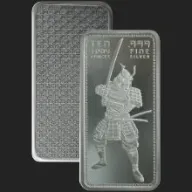
The series is available as both 1oz silver coins and 10oz silver bars, giving buyers options across different weight classes. The bars carry the same Japanese-inspired design language, with the Scottsdale Mint lion hallmark providing brand authentication. All pieces carry a $1 FJD face value, making them legal tender of the Republic of Fiji, a common arrangement for Pacific island nations that licence their sovereign status to private mints.
The Samurai Archives was announced as an annual programme with each year featuring a different historical samurai, but no second release has been confirmed after 2018. Collector forums noted the absence of a 2019 issue, and no further releases appeared through 2025. This stalled status is not unusual for licensed Pacific island coin programmes, which depend on ongoing commercial viability, but it does mean the existing issues are the only ones available.
Fiji Samurai Specifications by Format
| Attribute | 1 oz Coin (BU) | 1 oz Coin (Proof) |
|---|---|---|
| Weight | 1 troy oz (31.1 g) | 1 troy oz (31.1 g) |
| Purity | .9999 fine silver | .9999 fine silver |
| Diameter | 38.6 mm | 38.6 mm |
| Face value | $1 FJD | $1 FJD |
| Edge | Reeded | Reeded |
| Finish | Brilliant Uncirculated | Proof with selective colour |
| Mintage | 15,000 | 1,500 |
| Legal tender | Fiji | Fiji |
The 15,000 BU mintage is very low by bullion coin standards. For comparison, the Silver Britannia and Silver Maple Leaf are struck in the millions each year. The Fiji Samurai sits firmly in the collector-bullion hybrid category, where limited availability supports secondary market premiums above the metal's intrinsic value.
The .9999 purity is a notable choice from Scottsdale Mint. Most silver bullion, including the Silver Britannia and Silver Philharmonic, uses the .999 standard. Four-nines purity has practical implications for tax treatment in some jurisdictions and meets the stricter thresholds applied by certain IRA custodians in the US.
Bars in the series are available at 1 oz and 10 oz, with the same .999 purity standard that Scottsdale uses across most of its bar range. The 10 oz bar format provides a lower-premium entry point for buyers interested in the series design but seeking more metal per unit of premium paid.
Fiji Samurai Tax Treatment by Country
The Fiji Samurai carries a $1 FJD face value, making it legal tender of the Republic of Fiji. Despite this official status, the coins are struck in the US by Scottsdale Mint, a common arrangement for small Pacific island nations. The legal tender designation affects tax treatment differently depending on the buyer's jurisdiction.
- United States: The .9999 silver purity exceeds the IRS Section 408(m) minimum of 99.9% for silver held in a precious metals IRA, making the coin eligible for tax-deferred or tax-free retirement accounts (Traditional or Roth IRA). State sales tax treatment varies, with roughly 35 states exempting investment bullion from sales tax. Capital gains on silver are taxed at the collectibles rate of 28% maximum for long-term holdings, with short-term gains taxed as ordinary income.
- United Kingdom: Silver bullion is subject to 20% VAT regardless of legal tender status, since the Fiji Samurai is not UK legal tender. There is no CGT exemption for foreign legal tender coins in the UK; only UK legal tender coins such as the Silver Britannia qualify for CGT exemption. Pre-owned pieces may be available under the margin scheme from some dealers, reducing the effective VAT burden.
- Canada: Silver bullion at 99.9% purity or above is exempt from GST/HST under the Excise Tax Act. The Fiji Samurai's .9999 purity comfortably meets this threshold. Capital gains are subject to the 50% inclusion rate.
- Australia: Silver bullion at 99.9% purity or above qualifies as GST-free investment-grade precious metal. The .9999 Fiji Samurai meets this requirement. Capital gains tax applies with a 50% discount for holdings over 12 months.
- New Zealand: Fine silver at 99.9% purity or above is GST-exempt. No capital gains tax applies, though the IRD may treat profits as taxable income if the purchase was made with intent to resell.
- Singapore: Silver bars and coins at 99.9% purity or above that are or were legal tender qualify as Investment Precious Metals, exempt from the 9% GST. The Fiji Samurai's legal tender status and purity should meet IPM criteria. No capital gains tax applies in Singapore.
Taira no Kiyomori and the Samurai Archives
The 2018 Fiji Samurai Archives coin depicts Taira no Kiyomori (1118-1181), a figure who reshaped the political landscape of medieval Japan. Kiyomori rose from the warrior aristocracy of the late Heian period to become the most powerful man in Japan, establishing the first samurai-dominated government and effectively ending centuries of direct Imperial rule. His story, immortalised in The Tale of the Heike, one of the foundational works of Japanese literature, charts both the heights of military ambition and its eventual unravelling.
The coin's reverse design draws directly from a 19th-century woodblock print by Utagawa Hiroshige, titled "Taira no Kiyomori's Spectral Vision" (c. 1845). Hiroshige is one of the most celebrated ukiyo-e artists in Japanese history, best known for his landscape series The Fifty-three Stations of the Tokaido. The original artwork referenced on the coin is held by the Metropolitan Museum of Art in New York. By basing the design on a specific historical work rather than a generic samurai illustration, Scottsdale Mint grounded the coin in documented artistic and historical tradition.
The obverse features the Fijian coat of arms, a heraldic design featuring two Fijian warriors flanking a shield, surrounded by traditional Japanese decorative patterns that bridge the coin's dual Fijian-Japanese identity. This fusion of Pacific and Japanese visual elements is distinctive among bullion coins, where obverse designs typically reflect only the issuing nation's heraldry.
Scottsdale Mint announced the Samurai Archives as a multi-year programme, with each annual release intended to spotlight a different historical samurai figure. The concept was sound: Japan's samurai history offers centuries of documented individuals whose stories resonate with international audiences. However, no second release materialised. Collector forums noted the gap by 2019, and the series has remained dormant through 2025. This pattern is not unique to the Samurai Archives; several Scottsdale Mint programmes for Pacific island nations have been single releases or short-lived, depending on market reception and ongoing commercial arrangements.
Fiji Samurai vs Other Scottsdale Mint and Themed Silver Coins
The Fiji Samurai occupies a specific niche: a limited-mintage, thematically ambitious silver coin from a private mint, using Pacific island legal tender status. Comparing it to alternatives clarifies where it fits in a buyer's decision.
Against the Fiji Taku, the other major Fiji-denominated silver bullion series, the difference is fundamental. The Taku (minted by the New Zealand Mint, 2010-2013) was a mass-market bullion product with uncapped mintages and straightforward pricing. The Fiji Samurai, with its 15,000-coin cap and artistic design ambitions, is aimed at the collector-bullion crossover market where premiums above spot are part of the proposition. Buyers seeking the cheapest Fijian legal tender silver will find the Taku more suitable on the secondary market; buyers seeking a distinctive design in low mintage will prefer the Samurai.
Within Scottsdale Mint's own range, the Fiji Terracotta Warriors is the closest sibling. Both use Fiji legal tender status, both are struck by Scottsdale, and both lean into historical-cultural themes. The Terracotta Warriors is a 5 oz coin with an antique finish and a 5,000-piece mintage, making it an even more collector-focused product. The Samurai's 1 oz format is more accessible as a stacking unit, but neither series competes with high-liquidity sovereign mint bullion on resale ease.
Against sovereign mint competitors at the 1oz weight class, the trade-offs are clear. The Silver Philharmonic and Silver Kangaroo offer unlimited mintages, sovereign mint backing, and deep secondary market liquidity at lower premiums. The Fiji Samurai's .9999 purity matches the Maple Leaf but the Samurai cannot match any of these products on resale ease or dealer recognition. The Samurai's appeal is its unusual design, limited availability, and the specificity of its historical subject matter, not its efficiency as a silver accumulation vehicle.
For buyers specifically drawn to Japanese-themed bullion, options are limited. Japan's own mint produces commemorative coins, but these are primarily for domestic collectors and rarely enter international dealer inventories. The Fiji Samurai remains one of very few silver bullion products that directly references Japanese historical art and figures, giving it a distinct identity that generic bullion products cannot replicate.
Fiji Samurai Silver: frequently asked questions
-
The Fiji Samurai series is a Japanese-themed silver coin programme produced by Scottsdale Mint in Arizona under licence from the Government of Fiji. The inaugural 2018 release depicts Taira no Kiyomori, a 12th-century military leader, with artwork inspired by ukiyo-e woodblock print style. Issued as Fiji legal tender with a $1 FJD face value, it was struck in .9999 fine silver in two formats: a 15,000-mintage BU coin and a 1,500-mintage colourised proof.
-
Yes, and to a higher standard than most silver bullion. Fiji Samurai coins are struck in .9999 fine silver (four nines), meaning 99.99% pure silver. This exceeds the .999 (three nines) fineness used for most silver bullion products. They are produced by Scottsdale Mint in Arizona and carry official Fiji legal-tender status, though they are not circulating Fijian currency.
-
BullionFerret currently tracks 1 dealer listing Fiji Samurai silver coins across 2 offers. Because the series produced only a single release in 2018 (a 2019 coin was announced but never issued), all available stock comes from secondary market holdings. Availability varies and can be limited given the low combined mintage of 16,500 coins across both variants.