3 products · 3 deals Prices & premiums exclude tax to compare across countries



Prices are fetched automatically and may not reflect current merchant prices. Currency conversions and tax treatment are approximate. Rankings are based solely on price. We are not a dealer and accept no responsibility for transactions with listed merchants. Past performance is not indicative of future results. This site does not provide investment advice. Full disclaimer
About the Hawksbill Turtle Silver
A 15-Year Pacific Island Bullion Programme
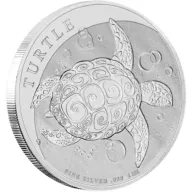
The Hawksbill Turtle is one of the longest-running bullion programmes in the Pacific Islands, launched in 2010 and still in production. The series is produced by the New Zealand Mint in Auckland and issued as legal tender of Niue, a self-governing territory in free association with New Zealand. The coin features the critically endangered hawksbill turtle (Eretmochelys imbricata), native to the tropical waters of the South Pacific, where it is known locally as the "Taku."
The standard 1 oz silver coin contains 31.1 g of 999 fine silver with an NZD $2 face value and an annual mintage of 350,000 pieces. This mintage sits in the middle ground between mass-market sovereign coins like the Maple Leaf (millions per year) and limited series like the Perth Mint Emu (30,000). The result is a coin that trades at premiums competitive with budget sovereign coins while retaining government legal tender status.
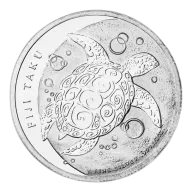
The series began as the "Fiji Taku" in 2010, issued for the Republic of Fiji. Political instability in Fiji prompted a transition to Niue issuance in 2014, with the coin rebranded as the "Niue Hawksbill Turtle" and the denomination changed from Fijian dollars to NZD. The design remained largely unchanged through the transition, making the Fiji-era coins (2010-2013) compatible in stacks and collections with the Niue-era pieces.
Larger formats include the 2 oz and 5 oz silver coins, as well as gold versions from 1/4 oz to 1 oz at 9999 fine gold. The coin is available through major US dealers (APMEX, JM Bullion) and Canadian dealers, with competitive premiums relative to more established names.
Hawksbill Turtle Silver Specifications
| Size | Weight | Purity | Diameter | Face Value | Mintage |
|---|---|---|---|---|---|
| 1/2 oz | 15.55 g | 999 fine silver | - | $1 NZD | - |
| 1 oz | 31.1 g | 999 fine silver | 40.5 mm | $2 NZD | 350,000/year |
| 2 oz | 62.2 g | 999 fine silver | - | $5 NZD | - |
| 5 oz | 155.5 g | 999 fine silver | - | $10 NZD | 50,000 |
Gold versions are struck in 9999 fine gold and carry higher face values: $250 NZD for the 1 oz gold coin (post-2016; earlier issues used $200 NZD). Fractional gold versions (1/4 oz, 1/2 oz) are also produced.
Packaging
Silver coins are available in individual plastic flips, tubes of 20, and master boxes of 500 coins. The tube and monster box format follows the same conventions used by the major sovereign mints, making the Hawksbill Turtle compatible with standard bullion storage systems.
Design and Authentication
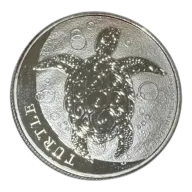
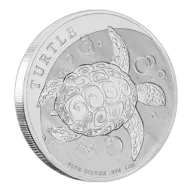
The reverse features a detailed hawksbill turtle swimming, with the overlapping shell texture (scutes) providing a design-level authentication element that is difficult to replicate accurately. The coin combines mirror and frosted finishes on the gold versions for visual contrast. No specific named anti-counterfeiting technology (latent images, micro-engraving) has been documented for this series.
Tax Treatment for the Hawksbill Turtle
United States
The Hawksbill Turtle is IRA-eligible for both silver (999 fine) and gold (9999 fine) versions. It qualifies as a sovereign government-backed legal tender coin meeting IRS purity requirements under Section 408(m). This is a key advantage over private-mint rounds and bars that cannot be held in a precious metals IRA. State sales tax follows standard bullion exemptions, with approximately 35 states exempting investment silver. Capital gains are taxed at the collectibles rate (up to 28% long-term).
New Zealand
As Niue legal tender denominated in NZD, the coin benefits from New Zealand's tax framework. Fine silver at 99.9%+ purity is GST-exempt (the 999 purity meets this threshold). New Zealand has no formal capital gains tax, though the IRD may treat profits as income if bullion was acquired with the purpose of resale.
United Kingdom
Silver Hawksbill Turtle coins are subject to 20% VAT on purchase. Gold versions are VAT-exempt as investment gold meeting the purity threshold. The coins are not UK legal tender, so they receive no CGT exemption. UK buyers wanting CGT-exempt silver should consider the Silver Britannia instead.
Canada
Silver at 99.9%+ purity is exempt from GST/HST. The Hawksbill Turtle's 999 purity qualifies comfortably. As sovereign foreign legal tender, the coin is treated as qualifying bullion.
Australia
The GST exemption threshold for silver in Australia is 99.9%, which the Hawksbill Turtle's 999 fineness meets. Investment bullion in a tradeable form from a recognised source qualifies for GST-free treatment.
Singapore and Hong Kong
Singapore's IPM scheme exempts qualifying silver coins (legal tender, 99.9%+ purity) from 9% GST. The Hawksbill Turtle's Niue legal tender status and 999 purity should meet both criteria. Hong Kong has no sales tax or capital gains tax on precious metals.
From Fiji Taku to Niue Turtle
The series launched in 2010 as the "Fiji Taku," with the hawksbill turtle design produced by the New Zealand Mint for the Republic of Fiji. "Taku" is the Fijian word for the hawksbill turtle. The early coins (2010-2012) carried a Queen Elizabeth II portrait inside a circle on the obverse, with "FIJI" and the denomination. The reverse showed the hawksbill turtle swimming with the "FIJI TAKU" inscription.
In 2013, the final Fiji-issued year, the Queen's portrait was replaced by the Coat of Arms of Fiji on the obverse, reflecting Fiji's republican leanings following a series of military coups. This made the 2013 coin the only issue in the series without a royal portrait on the obverse.
The transition to Niue in 2014 was driven by Fiji's political instability. The redesigned obverse featured a larger Ian Rank-Broadley portrait of Queen Elizabeth II without the enclosing circle, with inscriptions changed to "NIUE" and the denomination in NZD. The reverse retained the turtle design but replaced "TAKU" with "TURTLE" to broaden international recognition. The design quality remained consistent through the transition, making the series visually cohesive across its Fiji and Niue eras.
Niue (population approximately 1,600) is one of the most prolific coin-licensing nations in the world, authorising international mints to produce legal tender coins under its name and generating revenue from licensing fees. The Hawksbill Turtle is the most established and longest-running of these Niue programmes. From 2016 onward, the Sunshine Mint in Idaho, USA, has shared production duties with the New Zealand Mint, an unusual arrangement for sovereign bullion programmes. Post-2022 issues are expected to carry a King Charles III portrait on the obverse.
Hawksbill Turtle vs Competing Silver Bullion Coins
The Hawksbill Turtle's closest competition comes from coins in a similar premium bracket that offer government legal tender backing. The Austrian Philharmonic consistently trades at among the lowest premiums of any sovereign silver coin and has much higher mintage, making it the stronger choice for pure cost efficiency. The Hawksbill Turtle's advantage is its more distinctive design and the annual collectibility factor, though the turtle design has remained essentially fixed (unlike the Philharmonic's equally unchanging design).
Against the Perth Mint Silver Kangaroo, the Hawksbill Turtle trades at comparable premiums. Both have uncapped or high-volume mintages targeting the bullion stacker market. The Kangaroo benefits from Perth Mint's stronger brand recognition and 9999 purity (vs the Turtle's 999), plus the micro-laser security feature. The Turtle's appeal is its unique Pacific Island provenance and the marine conservation theme.
Compared to the Silver Britannia, the Hawksbill Turtle lacks the Britannia's CGT exemption for UK buyers and its four-feature security suite. For US buyers, however, the Turtle's IRA eligibility puts it on equal footing with most sovereign coins, and its premiums may be lower than the Britannia's. The Canadian Maple Leaf offers higher purity (9999 vs 999) and MintShield anti-tarnish technology, with deeper global liquidity.
The Hawksbill Turtle's fixed-design model (same turtle, different year) aligns it with the Maple Leaf and Philharmonic approach rather than the annual-change model used by the Kookaburra or Emu. This makes it primarily a bullion stacker's coin rather than a collector piece, with competitive premiums and IRA eligibility as its strongest selling points in the US market.
Hawksbill Turtle Silver: frequently asked questions
-
The Hawksbill Turtle is a long-running bullion series produced by the New Zealand Mint, issued as legal tender of Niue. First launched in 2010 (as the Fiji Taku), it transitioned to Niue issuance in 2014. The reverse depicts the critically endangered hawksbill sea turtle in a consistent design across all years. Available in silver and gold, the series targets bullion stackers with competitive premiums. We track 3 listings across dealers.
-
Hawksbill Turtle coin prices track the live precious metals spot price. We list 3 products from 3 dealers so you can compare premiums side by side. The series typically carries modest premiums, reflecting its positioning as a pure bullion product rather than a collector piece.
-
The Hawksbill Turtle silver series is available in 1 oz, 2 oz, and 5 oz sizes, all in .999 fine silver. Gold versions are produced in 1/4 oz, 1/2 oz, and 1 oz. We track 3 listings in total across weights and years. The 1 oz silver coin is produced in the largest annual quantities and trades in tubes of 20.
-
The Hawksbill Turtle silver coins are .999 fine silver (three nines), the standard for investment-grade silver bullion. This meets the purity threshold for IRA eligibility in the US and for GST-free treatment in New Zealand and Canada. Gold versions are .9999 fine gold. The consistent purity across all years makes the series straightforward to verify and trade.