

Prices are fetched automatically and may not reflect current merchant prices. Currency conversions and tax treatment are approximate. Rankings are based solely on price. We are not a dealer and accept no responsibility for transactions with listed merchants. Past performance is not indicative of future results. This site does not provide investment advice. Full disclaimer
About the Incuse Indian Silver
A Sunken-Relief Tribute to America's Most Controversial Coin
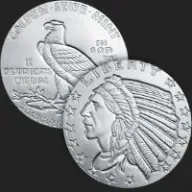
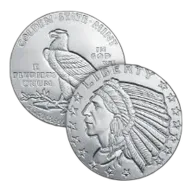
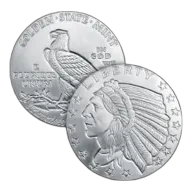
The Incuse Indian is a silver round series produced by Golden State Mint (GSM), a private US mint based in Calabasas, California. The design reproduces the incuse (sunken relief) format of the 1908-1929 US $2.50 Quarter Eagle and $5 Half Eagle gold coins, originally sculpted by Bela Lyon Pratt at the direction of President Theodore Roosevelt. In the incuse technique, design elements are recessed below the flat surface rather than raised above it, the opposite of virtually all other coins and rounds. This makes the Incuse Indian visually distinctive and practically durable, as the recessed design is shielded from contact wear when pieces are stacked.
The series is available in 1 oz, 1/2 oz, 1/4 oz, 1/10 oz, 2 oz, and 5 oz weights, all struck in 999 fine silver. Gold versions at 9999 fine gold and copper versions at 999 fine copper are also produced. These are undated generic rounds with no annual design changes, positioning them as ongoing production items rather than collectible annual issues.
The critical distinction for buyers is that Incuse Indian rounds are not legal tender. They carry no face value and no sovereign government backing. This means no IRA eligibility (despite GSM's "IRA Approved" claim, which depends on custodian acceptance), no CGT exemptions, and no tax advantages beyond standard state-level bullion exemptions. They compete on premium pricing, trading at slightly higher premiums than the cheapest generic rounds due to the distinctive design, but well below sovereign coins like the Silver Maple Leaf or Silver Britannia.
Incuse Indian Silver Round Specifications
| Size | Weight | Purity | Diameter | Thickness | Edge |
|---|---|---|---|---|---|
| 1/10 oz | 3.11 g | 999 fine silver | ~19 mm | - | Reeded |
| 1/4 oz | 7.78 g | 999 fine silver | - | - | Reeded |
| 1/2 oz | 15.55 g | 999 fine silver | - | - | Reeded |
| 1 oz | 31.10 g | 999 fine silver | 39.3 mm | 2.8 mm | Reeded |
| 2 oz | 62.21 g | 999 fine silver | - | - | Reeded |
| 5 oz | 155.5 g | 999 fine silver | - | - | Reeded |
Design Details
The obverse features a Native American chief in a full feathered headdress with "LIBERTY" above and stars, faithfully adapting Pratt's original 1908 design. The reverse shows a standing eagle with "IN GOD WE TRUST" on the right, "E PLURIBUS UNUM" on the left, and "GOLDEN STATE MINT" along the top edge. The inscriptions differ from the original US coins, adding the GSM name and removing US government markings.
Packaging
Singles are sold in protective flips. Tubes hold 20 rounds (1 oz). Monster boxes contain 500 rounds (25 tubes of 20). Gold versions at 9999 fine are available in 1/10 oz and 1 oz.
Authentication
Each round is hallmark-stamped with exact weight and purity. The "Golden State Mint" inscription serves as a maker's mark. The incuse format itself provides some counterfeit resistance, as the sunken impression requires different tooling than standard raised-relief designs. No serial numbers, micro-engraving, or high-tech anti-counterfeiting features are present, which is standard for generic rounds.
Tax Treatment for Private-Mint Silver Rounds
As private-mint rounds with no legal tender status, Incuse Indian rounds receive the least favourable tax treatment available for silver bullion in most jurisdictions.
United States
GSM states these rounds are "IRA Approved," and the 999 silver purity does meet the IRS minimum fineness requirement for silver in a precious metals IRA. However, IRA custodians must individually accept GSM products, and acceptance is not guaranteed since the rounds lack sovereign backing. State sales tax follows standard bullion exemptions, with approximately 35 states exempting precious metals from sales tax. Capital gains are taxed at the collectibles rate (up to 28% long-term, or ordinary income rates short-term).
United Kingdom
Private-mint silver rounds face 20% VAT on purchase, the same as sovereign silver coins. On disposal, they are subject to CGT at the individual's rate (18% or 24%) above the £3,000 annual allowance. No CGT exemption applies. For UK buyers, the Silver Britannia provides CGT exemption that the Incuse Indian cannot match, making UK buyers' effective after-tax return significantly better with the Britannia despite its higher purchase premium.
Canada
Silver at 99.9%+ purity is exempt from GST/HST under the Excise Tax Act, regardless of legal tender status. The Incuse Indian's 999 purity qualifies for this exemption. No RRSP or TFSA eligibility applies without sovereign legal tender status.
Australia and New Zealand
In Australia, silver at 99.9%+ purity in a tradeable form qualifies for GST exemption. The 999 fineness meets this threshold. New Zealand exempts fine silver at 99.9%+ purity from its 15% GST. Capital gains are taxable in Australia (with a 50% discount for holdings over 12 months) and generally not taxed in New Zealand unless purchased for resale.
Singapore and Hong Kong
Singapore's IPM scheme requires legal tender status for coins, so the Incuse Indian rounds would not qualify for the coin exemption. Silver bars at 99.9%+ purity and 0.5 troy oz minimum may qualify under separate criteria, but rounds occupy an ambiguous category. Hong Kong has no sales tax on precious metals.
The Original Incuse Indian and Its Modern Interpretation
In 1908, President Theodore Roosevelt commissioned Bela Lyon Pratt to design new $2.50 Quarter Eagle and $5 Half Eagle gold coins, with the concept of incuse (sunken) relief conceived by William Sturgis Bigelow. The resulting coins were among the most controversial in American numismatic history. The American Numismatic Association's official journal called them "a triumph of mediocrity" at launch. The Mint's own chief engraver, Charles Barber, opposed the design. Critics worried that dirt would accumulate in the recesses and spread disease, a concern that proved unfounded.
Despite the controversy, the incuse Indian Head gold coins ran for 21 years (1908-1929) and remain the only incuse coins ever produced by the United States Mint. They are now highly collectible, with originals commanding significant numismatic premiums. The original coins were 21.6 karat gold (90% fineness) in denominations of $2.50 and $5, with much lower weights than a modern troy ounce.
Golden State Mint's interpretation brings the incuse concept to modern bullion weights and purities. Founded in 1974 by Jim Pavlakos (originally as "Golden State Minting Corporation"), GSM operates facilities in Fullerton, California and Lake Mary, Florida. The family-run operation (later joined by son Andrew Pavlakos) has survived multiple precious metals cycles over five decades, making it one of the longer-established private mints in the US.
GSM's Incuse Indian design is a tribute, not an exact replica. The inscriptions differ from the originals, adding the GSM name and removing US government markings, while preserving the essential incuse technique and the Native American chief portrait. The rounds offer the incuse aesthetic at modern bullion weights (1/10 oz through 5 oz) and at 999 fine silver, considerably purer than the 90% silver of historical US coinage.
Incuse Indian vs Other Silver Rounds and Sovereign Coins
Within the private-mint round market, the Incuse Indian competes with the GSM Morgan round, also from Golden State Mint, and rounds from Sunshine Mint and SilverTowne. The Incuse Indian typically commands a slight premium over the cheapest generic rounds due to its distinctive incuse format and established recognition. Sunshine Mint rounds include the proprietary MintMark SI security feature, which provides verification that the Incuse Indian lacks. The choice between them comes down to design preference versus authentication confidence.
Compared to sovereign coins, the trade-offs are clear. The Canadian Silver Maple Leaf at 9999 purity offers government backing, IRA eligibility, MintShield anti-tarnish technology, and deep global liquidity. The Austrian Philharmonic is typically one of the cheapest sovereign coins available. The Silver Britannia provides CGT exemption for UK buyers. All three carry premiums of 12-20% over spot in normal markets, compared to 8-15% for the Incuse Indian. The premium saved on rounds is real but comes at the cost of sovereign backing, recognition on resale, and tax advantages in certain jurisdictions.
The Incuse Indian's unique advantage is the incuse technique itself. The sunken design elements sit below the flat rim, meaning rounds can be stacked without the design surfaces touching. This reduces scratching and wear, a practical benefit for buyers who store large quantities of silver in tubes or boxes. No sovereign mint silver coin currently uses the incuse format, making this a genuine differentiator rather than a marketing claim.
For US buyers building a position in silver at the lowest possible cost per ounce, private-mint rounds like the Incuse Indian deliver more metal per dollar than any sovereign coin. For buyers who prioritise resale liquidity, international recognition, or tax-advantaged retirement accounts, sovereign coins are the safer choice. Many silver buyers hold both: sovereign coins for the core position and rounds for additional accumulation at lower premiums.
Incuse Indian Silver: frequently asked questions
-
The Incuse Indian series is a line of private-mint bullion rounds produced by Golden State Mint (GSM), a US-based mint. The design pays tribute to the 1908 US Quarter Eagle and Half Eagle gold coins, themselves designed by Bela Lyon Pratt under President Theodore Roosevelt's coinage beautification programme. GSM rounds are not government-issued coins and carry no face value or legal tender status.
-
Incuse means the design is pressed inward, sitting below the flat surface of the round rather than raised above it. This is the opposite of virtually all other struck coins and rounds, where the design stands in relief. On an incuse round, the flat field sits higher than the design elements, which shields the details from contact wear during handling and storage.
-
Incuse Indian silver rounds trade close to the live silver spot price plus a small private-mint premium. With 3 dealers tracked on this page, you can compare exact asking prices directly in the listings above. Premiums vary by quantity and seller, so tube and monster-box orders typically cost less per round than singles.
-
Silver Incuse Indian rounds are .999 fine silver; gold versions are .9999 fine gold. Both metals are available in multiple sizes, including 1 oz, 1/2 oz, 1/4 oz, and 1/10 oz fractional options, plus a 2 oz silver round.
-
Incuse Indian rounds are private-mint products with no legal tender status or government backing, so they face lower production and distribution costs than sovereign coins. Government-issued coins such as the American Silver Eagle carry mandated face values and higher striking standards, which adds to their cost. Private rounds like the Incuse Indian trade closer to spot, though at the cost of lower resale liquidity outside the US.