9 products · 44 deals
Filters
| Product | /oz | Premium | Price | |
|---|---|---|---|---|
| $4,447.80 | +0.90% | $44,477.98 | View Deal | |

10 deals
|
$4,450.05 | +0.95% | $44,500.51 | Compare |

2 deals
|
$4,468.23 | +1.36% | $44,682.22 | Compare |
| $4,454.61 | +2.26% |
$44,546.07
S$56,948
|
View Deal | |

20 deals
|
$4,478.11 | +3.06% |
$44,781.08
£33,558
|
Compare |

4 deals
|
$4,504.40 | +3.66% |
$45,044.00
£33,756
|
Compare |

3 deals
|
$4,536.89 | +4.30% |
$45,368.87
A$63,721
|
Compare |

2 deals
|
$4,534.63 | +4.36% |
$45,346.31
£33,982
|
Compare |
| $5,144.38 | +16.70% | $51,443.80 | View Deal |



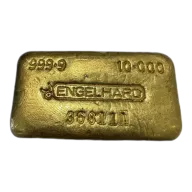
Prices are fetched automatically and may not reflect current merchant prices. Currency conversions and tax treatment are approximate. Rankings are based solely on price. We are not a dealer and accept no responsibility for transactions with listed merchants. Past performance is not indicative of future results. This site does not provide investment advice. Full disclaimer
About 10 oz Gold Bars
Who Buys 10oz Gold Bars
A 10oz gold bar contains 311.035 grams of fine gold, putting it among the largest formats most retail dealers stock. At roughly $30,000 or more per bar at current prices, this is a high-value purchase aimed squarely at wealthier investors building large positions, not at buyers making regular smaller purchases. The format sits between the 1oz gold bar, the standard retail unit, and the 1kg bar that anchors the top end of the retail market.
The economic case is straightforward. Premiums on gold bars scale inversely with size, so a single 10oz bar costs less per ounce than ten separate 1oz bars of the same metal. The trade-off is concentration: the entire position lives in one object, and selling it is an all-or-nothing transaction. Buyers who may need to liquidate in stages are usually better served by several smaller bars, even at a slightly higher total premium.
Standard purity for retail gold bars is 999.9 fine. That comfortably clears the 995 threshold for investment gold, which means a 10oz bar is VAT-exempt in the UK and across the EU, and GST-exempt in Canada, Australia, New Zealand and Singapore at the relevant purity thresholds. UK buyers should note one wrinkle: bars are VAT-exempt on purchase but, unlike UK legal tender coins, they are not exempt from Capital Gains Tax on sale. On a bar of this value, gains above the GBP 3,000 annual allowance are taxable at 18-24% depending on income, which can outweigh the premium saved at purchase.
10oz Gold Bar Premiums on the Weight Scale
Gold bars carry the lowest premiums of any gold form, and 10oz bars sit near the bottom of the range. Research across major dealers puts 10oz gold bars at very low premiums of 1-3% over spot. For comparison, 1oz minted bars run 1-4% over spot, cast bars 1-3%, and the scale steepens sharply as bars get smaller: 100g bars run 2-4%, while 1g bars can reach 15-25% over spot. At the top of the retail range, 1kg bars offer the lowest percentage premium at 1-2%.
In other words, a 10oz bar captures most of the premium efficiency available in gold bars. Moving up to a kilo bar shaves the range slightly, but the step up in capital outlay is significant for a marginal saving. Moving down to 1oz bars preserves flexibility at a modestly wider premium band.
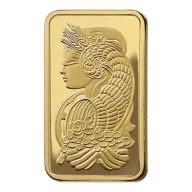
The savings compound at scale. A $100,000 allocation placed in bars rather than coins can save $2,000-4,000 in premiums, and large-format bars like the 10oz are where that gap is widest. Finish matters too: cast bars, poured into moulds with a rougher finish, are cheaper than minted bars of the same weight, which are cut from rolled sheet, polished, and usually sealed in assay card packaging. Brand carries a cost as well. PAMP Suisse Fortuna bars command a modest premium over generic refiner bars on the strength of brand recognition and the Fortuna design.
Major 10oz Gold Bars and Their Refiners
Ten ounce gold bars are a less common product than their silver counterparts, simply because the unit cost restricts the buyer pool. The refiners that do produce them are the established names: PAMP Suisse, Valcambi, the Royal Canadian Mint, and the Perth Mint.
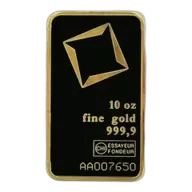
The two Swiss refiners are LBMA-accredited and carry universal recognition with dealers worldwide. PAMP Suisse is best known for the Fortuna design, the most widely recognised motif on retail gold bars, while Valcambi bars carry a clean, minimalist design. Both refiners back their minted bars with VeriScan verification technology in tamper-evident packaging.
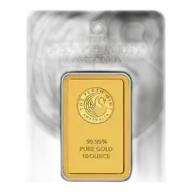
The two government operations bring sovereign backing to the format. The Royal Canadian Mint serialises its gold bars and supplies an assay certificate with each one. The Perth Mint, backed by the Western Australian Government, decorates its bars with the kangaroo design. Government-mint provenance is a meaningful reassurance at this price point, where a single bar represents a five-figure sum.
Whichever refiner you choose, the packaging conventions are the same as for smaller gold bars: minted bars ship sealed in tamper-evident assay cards containing a certificate with the bar's serial number, weight, purity, and the refiner's hallmark. Cast 10oz bars, where offered, may ship loose with a rougher poured finish and a correspondingly lower premium. Bars from non-LBMA refiners exist but may be harder to sell internationally, a real consideration on a bar this valuable.
Reselling and Storing a 10oz Gold Bar
A 10oz gold bar occupies an interesting position on the liquidity curve. Bars from LBMA-accredited refiners in sealed assay cards are widely accepted by dealers, but as bar sizes grow the retail buyer pool narrows; fewer private buyers can absorb a $30,000 purchase, even though institutional buyers and refiners accept large bars readily. Expect a 10oz bar to sell without difficulty through dealers, with somewhat fewer private-sale options than a 1oz bar enjoys.
The bigger constraint is divisibility. Selling a 10oz bar is an all-or-nothing transaction. There is no way to liquidate three ounces of it, so buyers who anticipate selling in stages should weigh that against the premium saving before committing to the format.
Packaging discipline protects resale value. Keep the assay card seal intact: a bar removed from its tamper-evident packaging may need re-assaying before a dealer will buy it, and the cost and friction of that fall on the seller. For larger bars, the gold-plated tungsten counterfeiting risk is the reason buyers get cautious; tungsten's density of 19.25 g/cm3 sits close enough to gold's 19.32 g/cm3 to defeat weight and dimension checks, and XRF testing only reads the surface. Ultrasonic testing is the reliable non-destructive answer, and a sealed card from a reputable refiner avoids the question entirely.
Storage is the format's quiet strength. A 10oz gold bar is small, roughly the size of a credit card, and extremely dense, so it stores easily while concentrating enormous value in one object. Store assay cards flat rather than standing on edge, as the cards themselves are fragile even though they protect the bar from contact damage.
10 oz Gold Bars: frequently asked questions
-
A 10 troy oz gold bar contains 10 oz of fine gold. Its melt value is ten times the current spot price of $4,408.10 per troy ounce. Dealers list the bar at spot plus a fabrication premium, which is typically lower on a percentage basis than for smaller bars. The premiums tab shows live dealer prices for comparison.
-
A 10 troy oz gold bar weighs 311.035 g. One troy ounce is 31.1035 grams, so ten troy ounces is 311.035 grams. This is a troy measurement used across the precious-metals industry, not the lighter avoirdupois ounce used in everyday commerce.
-
A 10 oz gold bar is compact but represents significant value, so secure storage is important. Options include a heavy-duty, fire-resistant home safe bolted to the floor, a bank safety deposit box, or a specialist bullion vault with allocated storage. Keep the bar in its original capsule or sealed assay card to protect the surface and maintain resale acceptance.
-
Buying gold generally does not itself trigger a tax filing; capital gains tax arises when you sell. In the UK, gains above the £3,000 annual exemption must be reported to HMRC. In Canada, 50% of the gain is included in taxable income. In the US, profits are taxed at up to 28% for long-term holdings. Some countries also require dealers to report large cash transactions at point of sale.
- 10 oz AARUS Gold Bar
- 10 oz ABC Cast Bar Gold Bar
- 10 oz Ainslie Gold Bar
- 10 oz Argor-Heraeus Gold Bar
- 10 oz Austrian Mint Gold Bar
- 10 oz Credit Suisse Gold Bar
- 10 oz Engelhard Bar Gold Bar
- 10 oz Engelhard Gold Bar
- 10 oz Fortuna Gold Bar
- 10 oz Go Gold Bar
- 10 oz Gold Bar
- 10 oz Istanbul Gold Refinery Gold Bar
- 10 oz Johnson Matthey Gold Bar
- 10 oz New Zealand Mint Gold Bar
- 10 oz PAMP Suisse Gold Bar
- 10 oz Perth Mint Gold Bar
- 10 oz Perth Mint Kangaroo Gold Bar
- 10 oz Republic Metals Corporation Gold Bar
- 10 oz Royal Canadian Mint Gold Bar
- 10 oz Sunshine Minting Gold Bar
- 10 oz Valcambi Gold Bar
- Pre-Owned 10 oz Baird Cast Bar Gold Bar
- Pre-Owned 10 oz Fortuna Gold Bar
- Pre-Owned 10 oz Gold Bar