30 listings
Filters
| Product | /oz | Premium | Price | |
|---|---|---|---|---|

 PMR Bullion
|
$1,956.00 | +8.31% | $1,956.00 | View Deal |
 AU Capital Management
|
$1,967.59 | +8.95% | $1,967.59 | View Deal |
 Bullion Standard
|
$1,979.85 | +9.63% | $1,979.85 | View Deal |
 Golden Eagle Coins
|
$2,050.50 | +13.54% | $2,050.50 | View Deal |
 Golden Eagle Coins
|
$2,050.50 | +13.54% | $2,050.50 | View Deal |
 Golden Eagle Coins
|
$2,050.50 | +13.54% | $2,050.50 | View Deal |
 Golden Eagle Coins
|
$2,050.50 | +13.54% | $2,050.50 | View Deal |
|
1-
Austin Rare Coins & Bullion
|
$2,056.29 | +13.86% | $2,056.29 | View Deal |
 Golden Eagle Coins
|
$2,060.50 | +14.09% | $2,060.50 | View Deal |
 Golden Eagle Coins
|
$2,060.50 | +14.09% | $2,060.50 | View Deal |
 Golden Eagle Coins
|
$2,060.50 | +14.09% | $2,060.50 | View Deal |
 Golden Eagle Coins
|
$2,060.50 | +14.09% | $2,060.50 | View Deal |
 Golden Eagle Coins
|
$2,060.50 | +14.09% | $2,060.50 | View Deal |
 Golden Eagle Coins
|
$2,060.50 | +14.09% | $2,060.50 | View Deal |
 Golden Eagle Coins
|
$2,060.50 | +14.09% | $2,060.50 | View Deal |
| $2,070.25 | +14.63% |
$2,070.25
S$2,647
|
View Deal | |
 Golden Eagle Coins
|
$2,071.50 | +14.70% | $2,071.50 | View Deal |
 First National Bullion
|
$2,071.88 | +14.72% | $2,071.88 | View Deal |
| $2,072.50 | +14.76% | $2,072.50 | View Deal | |

 Sprott Money
|
$2,072.60 | +14.76% | $2,072.60 | View Deal |
 Golden Eagle Coins
|
$2,080.50 | +15.20% | $2,080.50 | View Deal |
 The Bullion Bank
|
$2,116.16 | +17.17% | $2,116.16 | View Deal |
 U.S. Gold Bureau
|
$2,118.29 | +17.29% | $2,118.29 | View Deal |
 Golden Eagle Coins
|
$2,120.50 | +17.41% | $2,120.50 | View Deal |
 IDC Coin and Bullion
|
$2,147.16 | +18.89% | $2,147.16 | View Deal |
 Golden Eagle Coins
|
$2,150.50 | +19.08% | $2,150.50 | View Deal |
 Bullion Express
|
$2,156.59 | +19.41% | $2,156.59 | View Deal |
 SD Bullion
|
$2,209.99 | +22.37% | $2,209.99 | View Deal |

 Indigo Precious Metals
|
$2,228.25 | +23.79% |
$2,228.21
£1,670
|
View Deal |
 Golden Eagle Coins
|
$2,280.50 | +26.27% | $2,280.50 | View Deal |


Prices are fetched automatically and may not reflect current merchant prices. Currency conversions and tax treatment are approximate. Rankings are based solely on price. We are not a dealer and accept no responsibility for transactions with listed merchants. Past performance is not indicative of future results. This site does not provide investment advice. Full disclaimer
About the 1 oz American Platinum Eagle Platinum Coin
The 1 oz American Platinum Eagle
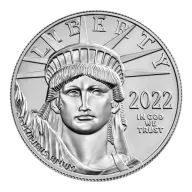
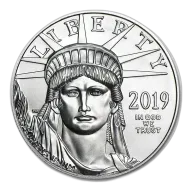
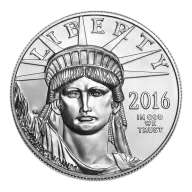
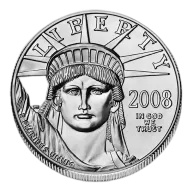
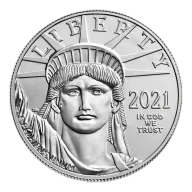
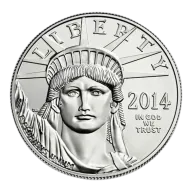
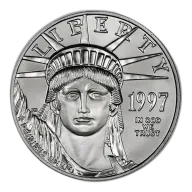
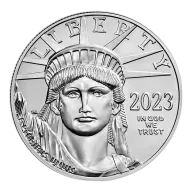
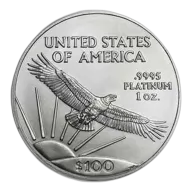
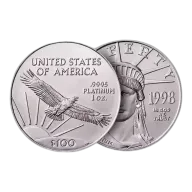
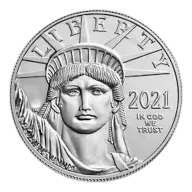
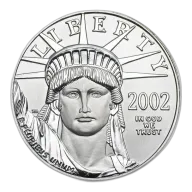
The American Platinum Eagle is the US Mint's official platinum bullion coin, first struck in 1997 and carrying the distinction of bearing the highest face value ($100) ever placed on a US coin. Each coin contains 1.0005 troy ounces of 999.5 fine platinum, and it remains the only platinum bullion coin produced by the United States government. For US investors, the Eagle's most significant feature is its explicit IRA eligibility, written directly into the tax code under Section 408(m)(3)(A)(iv). This removes the ambiguity that surrounds some other platinum products; the American Platinum Eagle is eligible by name, not by interpretation.
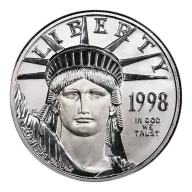
The Eagle programme has had an unusual production history. Fractional denominations (1/2, 1/4, and 1/10 oz) were produced from 1997 through 2008 and have not been struck since. Even the 1 oz bullion coin was suspended from 2009 to 2013, the longest hiatus of any active US Mint bullion programme, caused by limited platinum blank supply and declining demand during a period of historically high platinum prices. Production resumed in 2014, was suspended again in 2015, and has continued since 2016. Annual mintages have varied dramatically: 133,002 coins in 1998 (the peak) versus just 6,000 in 2006.
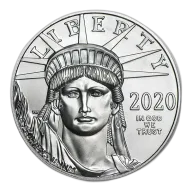
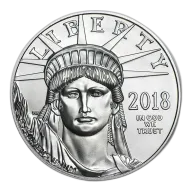
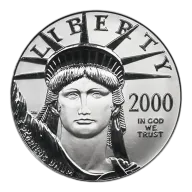
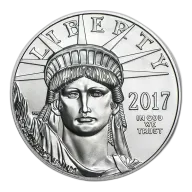
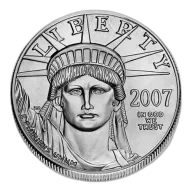
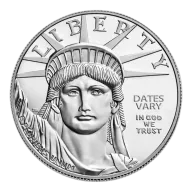
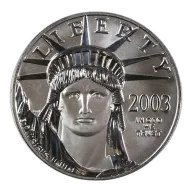
The proof version of the Platinum Eagle is unique among all US bullion programmes. It is the only US bullion coin with annually changing reverse designs. The bullion version maintains a fixed design, with John Mercanti's "Liberty Looking to the Future" Statue of Liberty obverse and Thomas D. Rogers Sr.'s "Eagle Soaring Over America" reverse unchanged since 1997. But proof Eagles have cycled through themed multi-year reverse series, including "Vistas of Liberty" (1998-2002), "Foundations of Democracy" (2006-2008), "Preamble to the Constitution" (2009-2014), and "First Amendment" (2021-2025). The 2018-2020 proof series even varied the obverse design, a first for any US bullion coin.
American Platinum Eagle Dimensions and Composition
| Property | Detail |
|---|---|
| Mint | United States Mint (West Point) |
| Metal | Platinum |
| Purity | 999.5 (99.95%) |
| Platinum content | 1.0005 troy oz (31.12g) |
| Total weight | 31.12g |
| Diameter | 32.7 mm |
| Thickness | 2.39 mm |
| Face value | $100 USD |
| Edge | Reeded |
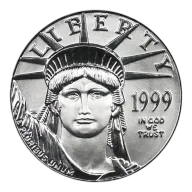
| Obverse | "Liberty Looking to the Future" (John Mercanti, 1997) |
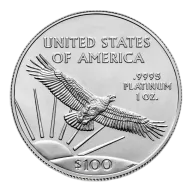
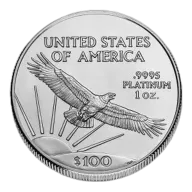
| Reverse | "Eagle Soaring Over America" (Thomas D. Rogers Sr., 1997) |
Annual Bullion Mintage (Selected Years)
| Year | Mintage |
|---|---|
| 1997 | 56,000 |
| 1998 | 133,002 |
| 2000 | 10,003 |
| 2005 | 6,310 |
| 2006 | 6,000 |
| 2008 | 21,800 |
| 2009-2013 | Not issued |
| 2014 | 16,900 |
| 2016 | 20,000 |
| 2020 | 56,500 |
| 2022 | 80,000 |
| 2023 | 12,700 |
The 2000-2008 bullion mintages are extremely low by US Mint standards. For context, the US Mint regularly produces over a million Gold Eagles annually. Platinum Eagle mintages in several years were under 10,000 coins, making these among the lowest-mintage US Mint bullion products. The coin is slightly smaller in diameter (32.7mm) than the Gold Eagle (32.7mm for the 1 oz) because platinum's higher density (21.45 g/cm3 versus gold's 19.3 g/cm3) packs the same troy weight into less volume.
Platinum Eagle Tax Treatment Across Jurisdictions
The American Platinum Eagle's tax position is defined by two key facts: its statutory IRA eligibility in the United States, and the absence of investment platinum exemptions in most other jurisdictions.
- United States: Explicitly IRA-eligible under 26 USC 408(m)(3)(A)(iv). This statutory naming means there is no question about qualification; custodians accept the Eagle without debate. Must be held by an approved custodian, not personally. Outside retirement accounts, classified as a collectible with a maximum long-term capital gains rate of 28% (not the lower 15-20% stock rate). Short-term gains taxed as ordinary income. Dealers must file Form 1099-B for sales of 25 or more Eagles in a single transaction. Most states exempt bullion from sales tax.
- United Kingdom: 20% VAT on purchase. Platinum does not qualify for the investment gold VAT exemption. Subject to Capital Gains Tax on disposal; not CGT-exempt because it is not UK legal tender. UK buyers seeking a CGT-exempt platinum coin should consider the Platinum Britannia instead.
- Canada: GST/HST exempt for platinum at 99.5% purity or above. The 999.5 fineness qualifies.
- Australia: GST-free for platinum at 99% purity or above. Capital gains tax applies with a 50% discount for holdings over 12 months.
- New Zealand: GST-exempt for platinum at 99% purity or above. No capital gains tax.
- Singapore: GST-exempt under the Investment Precious Metals scheme for qualifying platinum coins. No capital gains tax.
- Hong Kong: No sales tax, no import duty, no capital gains tax.
- South Africa: 15% VAT on platinum coins. No platinum-specific exemption.
- European Union: Standard VAT at local rates (17-27%). Platinum does not benefit from the EU Investment Gold Directive.
From Congressional Authorisation to America's Only Platinum Coin
The American Platinum Eagle traces its origins to 1995, when US Mint Director Philip N. Diehl, American Numismatic Association President David L. Ganz, and Platinum Guild International Executive Director Jacques Luben began lobbying for a US platinum bullion coin. The effort succeeded when President Bill Clinton signed the authorising legislation on September 30, 1996. The first coins were struck and released in 1997, making the United States the fourth country to produce a platinum bullion coin, after the Isle of Man (1983), Australia (1987), and Canada (1988).
Production of all four denominations ran smoothly from 1997 to 2008, though annual mintages dropped sharply after 1998's peak of 133,002 coins. By 2006, only 6,000 1 oz bullion Eagles were produced. The five-year production gap from 2009 to 2013 was unprecedented for an active US Mint programme; the Gold Eagle and Silver Eagle continued production throughout. The Mint cited a combination of platinum blank supply shortages and weak demand.
A notable episode in the Eagle's history is the Robert Kahre tax case. In 2009, Kahre was convicted of tax fraud for paying employees in gold and platinum bullion coins (including $100 Platinum Eagles) at face value to reduce reported income. He argued that wages should be reported at face value because the coins are legal tender. The courts rejected this argument, establishing the principle that bullion coins must be reported at fair market value for tax purposes, not their symbolic face value.
The proof programme has been the Eagle's most distinctive feature. Unlike the Gold Eagle, Silver Eagle, or Gold Buffalo, the Platinum Eagle proof carries a different reverse design each year. These designs have followed multi-year thematic series: regional eagle landscapes for "Vistas of Liberty" (1998-2002), branches of government for "Foundations of Democracy" (2006-2008), constitutional themes with narratives provided by Chief Justice John Roberts (2009-2014), and the five freedoms of the First Amendment (2021-2025). The 2018-2020 proofs went further, varying the obverse as well, a first for any US bullion coin.
American Platinum Eagle vs Maple Leaf, Britannia, Kangaroo, and Philharmonic
The Canadian Platinum Maple Leaf is the Eagle's closest competitor as an established platinum coin. Both are sovereign mint products at 999.5 purity, both are widely available, and both are IRA-eligible. The Maple Leaf (1988) has a nine-year head start and benefits from the Royal Canadian Mint's Bullion DNA digital authentication system. The Eagle's advantages are its statutory IRA eligibility (named in the tax code versus meeting general purity requirements) and the deeper US dealer network. The Maple Leaf is typically priced slightly below the Eagle in terms of dealer premium, making it a more cost-efficient purchase when available.
The Platinum Britannia (2018) is the newest major competitor. Its key differentiator is CGT exemption for UK taxpayers, a benefit the Eagle cannot match. The Britannia's four security features introduced in 2021 (latent image, surface animation, micro-text, tincture lines) are arguably the most advanced on any bullion coin. For UK buyers, the Britannia is the clear choice. For US buyers, the Britannia is less commonly stocked and does not have the statutory IRA clarity of the Eagle.
The Australian Platinum Kangaroo (2018) shares the annually changing design feature with the Eagle's proof programme, though the Kangaroo's bullion version also changes each year, while the Eagle's bullion design is fixed. The Kangaroo is strongest in the Asia-Pacific market and less commonly found at US dealers. The Austrian Platinum Philharmonic (2016) is the most popular platinum coin in European markets. Both the Kangaroo and Philharmonic are newer entries building their market presence.
All five coins share 999.5 purity, sovereign mint backing, and comparable physical specifications. The choice between them typically comes down to where you buy (US dealers favour the Eagle, UK dealers favour the Britannia, Australian dealers favour the Kangaroo), tax considerations (UK CGT exemption for the Britannia, US IRA eligibility for the Eagle), and premium pricing (the Maple Leaf is often the most competitive on price).
1 oz American Platinum Eagle Platinum Coin: frequently asked questions
-
The lowest price we track for the 1oz American Platinum Eagle is $1,956.00 from PMR Bullion, currently around 8.3% over spot. Use the comparison table to see all dealers listed side by side.
-
The current platinum spot price is $1,806.00 per troy ounce. This is the underlying metal value before any coin premium, dealer margin, or sales tax. The retail price of a 1oz American Platinum Eagle will be higher than spot, reflecting US Mint production costs, dealer margins, and the coin's legal-tender status.
-
Platinum's price history includes periods when it traded at a substantial premium to gold, driven by strong industrial demand and supply constraints from major mining regions. Since those peaks the price has retreated significantly, and the relationship between platinum and gold has shifted considerably. Check the live spot price on this page for the current level.
-
American Platinum Eagles carry a premium over spot for several reasons. The US Mint charges a production premium, and dealers add their own margin. Annual bullion mintages have been low in many years (as few as 6,000 coins for the 1 oz in 2006), restricting supply relative to demand. The coin's explicit IRA eligibility under US tax law, its $100 legal-tender face value, and a strong US collector market for the annually changing proof versions all support higher premiums than generic platinum bars typically command.