1 product · 1 deal

Prices are fetched automatically and may not reflect current merchant prices. Currency conversions and tax treatment are approximate. Rankings are based solely on price. We are not a dealer and accept no responsibility for transactions with listed merchants. Past performance is not indicative of future results. This site does not provide investment advice. Full disclaimer
About the Bounty Silver
Cook Islands Bounty Silver Coins
The Bounty series is an annual silver bullion coin from the Cook Islands featuring the HMS Bounty, the Royal Navy vessel made infamous by the mutiny of 1789. First issued in 2009, the series has been in continuous production for over fifteen years, establishing itself as a recognisable budget sovereign coin in the international bullion market.
The coins are legal tender of the Cook Islands, a self-governing nation of 15 islands in the South Pacific, in free association with New Zealand. The Cook Islands Dollar is pegged to the NZD. Despite this sovereign status, the coins are not struck at a government mint facility. The original 2009 release was produced by Heimerle + Meule GmbH in Germany, with later production (from at least 2017) contracted to Sunshine Minting Inc. in Idaho, USA, one of North America's largest private mints.
The 1 oz silver Bounty is the core product at .9999 fine silver, matching the purity of the Canadian Maple Leaf. The range extends to fractional and larger sizes: 1/4 oz, 1/2 oz, 2 oz, and 1 Kilo silver coins. The series also includes gold versions in 1 oz and 1/10 oz.
The Bounty occupies a particular niche: it is legal tender (unlike private mint rounds) but from a small Pacific island nation rather than a major minting power. This gives it a legal status advantage that rounds lack, but a recognition disadvantage compared to coins from the US Mint, Royal Mint, or Perth Mint. Premiums typically sit below the American Silver Eagle and closer to the level of the Silver Britannia or Austrian Philharmonic, making the Bounty a cost-effective way to acquire sovereign-status silver at .9999 purity.
Bounty Silver Coin Specifications
| Attribute | 1 oz Silver | 1/10 oz Silver | 1 Kilo Silver |
|---|---|---|---|
| Weight | 31.1 g (1 troy oz) | 3.11 g (1/10 troy oz) | 1,000 g (32.15 troy oz) |
| Purity | .9999 fine silver | .9999 fine silver | .999 fine silver |
| Diameter | 39.73 mm | Proportional | Proportional |
| Thickness | 2.98 mm | Proportional | Proportional |
| Face value | $1 CID | $0.10 CID | $30 CID |
| Finish | Brilliant Uncirculated | BU | BU |
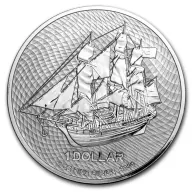
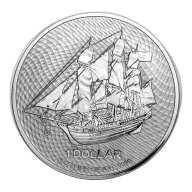
The obverse features the HMS Bounty under sail, with the face value and "1 OUNCE FINE SILVER .9999" inscribed. Both sides feature a distinctive stylised grid/wave background pattern not found on other bullion coins. The reverse carries the Ian Rank-Broadley effigy of Queen Elizabeth II, common to Commonwealth coinage during the series' early years.
The 1 oz coins are packaged in individual capsules or 20-coin mint tubes. Sunshine Minting, which produces the later editions, uses its proprietary MintMark SI anti-counterfeiting technology on some products (a micro-engraved feature visible only with a decoder lens), though it is not confirmed whether this specific feature is applied to the Bounty coins. The ship design has remained largely consistent across years, making the Bounty immediately recognisable regardless of vintage.
Cook Islands Silver Coin Tax Treatment
The Bounty is legal tender of the Cook Islands at face value denominations. This legal tender status affects its tax treatment, but the specifics vary by jurisdiction.
In the United States, the Bounty is not IRA-eligible despite exceeding the .999 purity requirement. The IRS classifies Cook Islands coins as insufficiently mainstream for retirement accounts, with the limited mintage and premium pricing potentially contributing to the collectible classification. This is a significant disadvantage for American investors seeking IRA-eligible silver; products like the Canadian Maple Leaf and American Silver Eagle meet IRA requirements while the Bounty does not. Sales tax varies by state, with most states exempting investment silver.
In the United Kingdom, silver Bounty coins attract 20% VAT. Gold versions are VAT-exempt as investment gold. The coins are not UK legal tender, so no CGT exemption applies. For UK buyers who want CGT relief on silver, the Silver Britannia remains the only eligible product.
In Australia and New Zealand, the Cook Islands' free association with New Zealand creates a particular connection. The Cook Islands Dollar is pegged to the NZD. Silver at .999+ purity qualifies for GST exemption in both countries, and the Bounty's .9999 exceeds this threshold.
Canada exempts silver at .999+ purity from GST/HST. Singapore exempts qualifying Investment Precious Metal silver coins from GST. Hong Kong has no sales tax on precious metals.
HMS Bounty: From Mutiny to Bullion
The HMS Bounty was a Royal Navy vessel acquired in 1787 for a botanical mission: to transport breadfruit plants from Tahiti to the Caribbean as a cheap food source for enslaved plantation workers. The ship was commanded by Lieutenant William Bligh, with Fletcher Christian serving as master's mate. After five months in Tahiti collecting breadfruit, the crew had grown accustomed to the island's lifestyle. Three weeks into the return voyage, on 28 April 1789, Christian led a mutiny that set Bligh and 18 loyal crew members adrift in a 23-foot launch.
Bligh's subsequent 3,618-nautical-mile open-boat voyage to Timor, navigating by memory and dead reckoning without charts, is considered one of the most remarkable feats of seamanship in naval history. The mutineers sailed the Bounty to Pitcairn Island, a remote volcanic island in the South Pacific, where they burned and scuttled the ship in January 1790 to avoid detection. Descendants of the mutineers still live on Pitcairn Island today, one of the world's most isolated inhabited communities with a population of fewer than 50.
The Cook Islands' connection to the Bounty story is geographic: the islands lie in the same South Pacific region, and Captain James Cook, after whom the nation is named, explored these waters in the 1770s, just a decade before the Bounty's fateful voyage. The coin series draws on this maritime heritage, placing the ship design against a stylised wave pattern that reinforces the nautical theme.
The coin programme itself started in 2009, with the original gold and silver versions struck by Heimerle + Meule in Germany. The 2017 silver edition had a notably low mintage of just 5,000, extremely small for a bullion coin. Later years expanded production and availability as the series became more established in the dealer market. Annual dated releases continue, with the ship design remaining consistent across vintages, a deliberate choice that prioritises brand recognition over the annual design variation used by series like the Perth Mint Kookaburra.
Bounty vs Major Sovereign Silver Coins
The Bounty's position in the market is defined by its combination of sovereign legal tender status, .9999 purity, and pricing below the major sovereign coins.
The American Silver Eagle is the market leader in US silver bullion. The Eagle trades at higher premiums (20-30% over spot in normal conditions), has vastly superior liquidity, and is universally IRA-eligible. For American buyers who need IRA eligibility, the Eagle (or the Maple Leaf) is the necessary choice. For those who do not, the Bounty offers more silver per dollar spent.
The Canadian Maple Leaf matches the Bounty's .9999 purity and has unlimited mintage, Mintshield anti-tarnish technology, and micro-engraved security features. The Maple Leaf has stronger global recognition and dealer acceptance. It is IRA-eligible. The Bounty's advantage is typically a narrower premium, though the gap varies by dealer and market conditions.
The Austrian Philharmonic consistently offers some of the lowest premiums for a sovereign silver coin at .999 purity. The Philharmonic's EUR 1.50 face value and Vienna Philharmonic design have broad European appeal. For pure premium minimisation on sovereign silver, the Philharmonic often undercuts both the Bounty and the Maple Leaf.
Among small-nation sovereign coins, the Bounty competes with Niue-denominated coins (struck by various mints, including Perth Mint and New Zealand Mint) and Tokelau bullion. All three use external minting facilities and leverage Pacific island sovereignty for legal tender status. The Bounty's long production history (since 2009) and association with Sunshine Minting's production quality give it an edge over newer small-nation programmes.
The Bounty fills a specific gap: buyers who want legal tender status and high purity at a lower premium than the major sovereign coins, and who do not require IRA eligibility. For US buyers in particular, the IRA limitation is a meaningful factor that should be confirmed before purchasing with retirement accounts in mind.
Bounty Silver: frequently asked questions
-
The Bounty is an annual silver coin series issued as legal tender of the Cook Islands, featuring the HMS Bounty, the Royal Navy vessel made famous by the 1789 mutiny. Production was originally handled by Heimerle + Meule in Germany, with later issues contracted to Sunshine Minting in the USA. Coins are struck to .9999 fine silver in 1 oz and fractional sizes.
-
We track 1 Bounty listing across 1 dealer. Like all silver bullion, the price moves directly with the silver spot price, currently $67.63 per troy ounce, plus a dealer premium. Comparing dealers in the table above shows the current range of premiums available.
-
The Bounty series is primarily a coin programme, issued in 1 oz and 1/10 oz silver sizes. Gold versions have also been available in 1 oz and fractional weights (1/10 oz, 1/4 oz, 1/2 oz). The 1 listing we track show the formats currently in stock across dealers.
-
Value depends on the premium over spot, currently $67.63 for silver. The Bounty carries legal tender status from the Cook Islands, which puts it above private mint rounds in terms of sovereign backing, but it has lower market recognition than major coins such as the Britannia or Maple Leaf. With 1 dealer tracked, the comparison table shows where it sits against the silver spot price right now.