5 products · 29 deals Prices & premiums exclude tax to compare across countries
Filters





Prices are fetched automatically and may not reflect current merchant prices. Currency conversions and tax treatment are approximate. Rankings are based solely on price. We are not a dealer and accept no responsibility for transactions with listed merchants. Past performance is not indicative of future results. This site does not provide investment advice. Full disclaimer
About the Wildlife Silver
Canadian Wildlife Silver: A Closed Six-Coin Set from the Royal Canadian Mint
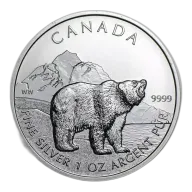
The Canadian Wildlife series ran from 2011 to 2013, producing six coins over three years with a different North American animal on each reverse. All six are struck in .9999 fine silver, matching the purity of the standard Silver Maple Leaf and exceeding the .999 used by most other world mints at the time. Each coin carries a $5 CAD face value and a mintage cap of 1,000,000 per design.
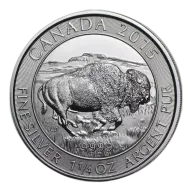
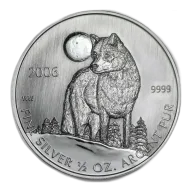
That mintage figure deserves context. One million sounds high, but the standard Silver Maple Leaf is produced in the tens of millions annually. For a Royal Canadian Mint bullion product, this is a limited run. All six designs reportedly sold out before the next release shipped, and secondary market availability has tightened steadily since the series concluded. The Timber Wolf (first issue, 2011) and Wood Bison (final issue, 2013) tend to attract the strongest premiums on the secondary market.
The series was designed as a complete, self-contained set from inception, not an open-ended annual programme. Two coins released each year, covering timber wolf, grizzly bear, cougar, moose, pronghorn antelope, and wood bison. That defined endpoint is one reason set collectors favour the Wildlife coins: you can complete the collection without chasing an indefinite number of annual releases.
Premiums on Wildlife coins sit above standard Silver Maple Leafs but below heavily numismatic products. Buyers who want four-nines purity with a changing-design collectible element, without paying proof-coin premiums, find the Wildlife series fills that gap.
Wildlife Silver Coin Specifications
| Attribute | Value |
|---|---|
| Denomination | $5 CAD |
| Purity | .9999 fine silver |
| Weight | 31.103 g (1 troy oz) |
| Diameter | 37.97 mm |
| Edge | Reeded |
| Finish | Brilliant Uncirculated |
| Mintage per design | 1,000,000 |
Complete Design List
| Year | Animal | Designer |
|---|---|---|
| 2011 | Timber Wolf | William Woodruff |
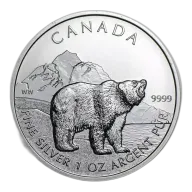
| 2011 | Grizzly Bear | William Woodruff |
| 2012 | Cougar | William Woodruff |
| 2012 | Moose | William Woodruff |
| 2013 | Pronghorn Antelope | Emily S. Damstra |
| 2013 | Wood Bison | Emily S. Damstra |
The obverse on all six coins features Susanna Blunt's portrait of Queen Elizabeth II, the standard RCM obverse used from 2003 to 2022. The "ELIZABETH II" inscription appears at the top with "5 DOLLARS" and the year date below. William Woodruff, RCM Senior Mint Engraver, designed the first four reverses with detailed naturalistic depictions of each animal in its habitat. Emily S. Damstra completed the series with the Pronghorn Antelope and Wood Bison, maintaining the same level of biological accuracy.
Security features include laser-etched radial lines on both obverse and reverse faces, deflecting light in different directions to hinder counterfeiting. The reeded edge provides an additional tactile verification marker. These coins predate the MINTSHIELD anti-tarnish technology that the RCM introduced in 2018, so milk spotting, a cosmetic defect appearing as white or cloudy patches, remains a known risk on secondary market examples. Milk spots do not affect the silver content or purity of the coin.
Wildlife Series Tax Treatment by Country
As Canadian legal tender coins struck in .9999 fine silver, the Wildlife series receives favourable tax treatment in several jurisdictions, though silver is taxed more heavily than gold in most countries.
- Canada: GST/HST exempt. Investment-grade silver bullion refined to 99.9% or higher purity qualifies for the federal exemption, and .9999 purity exceeds that threshold comfortably.
- United States: No federal sales tax. State-level exemptions vary, with roughly 35 states exempting bullion purchases. The .9999 purity meets the IRS threshold for precious metals IRA eligibility (99.9% for silver), so these coins qualify for self-directed IRAs through approved custodians.
- United Kingdom: Silver bullion carries 20% VAT on purchase. The Wildlife coins are not UK legal tender, so they do not qualify for CGT exemption either. Pre-owned examples may be available under the margin scheme (VAT on the dealer's margin only), reducing the effective tax cost.
- Australia: Investment-grade silver at 99.9% purity or above is GST-free. The .9999 purity qualifies.
- New Zealand: Fine silver bullion at 99.9% purity or higher is GST-exempt.
- Singapore: Qualifies as an Investment Precious Metal (IPM) due to meeting the 99.9% silver purity requirement. GST-exempt. No capital gains tax in Singapore.
- Hong Kong: No sales tax, no import duty, no capital gains tax.
- EU: Silver coins are subject to local VAT rates (17-27% depending on country). In Germany, the margin scheme (Differenzbesteuerung) may reduce effective VAT on pre-owned coins.
Six Animals, Three Years: The Full Wildlife Series Story
The Royal Canadian Mint launched the Wildlife series in 2011 during a period of extraordinary silver market activity. Silver prices were trading near all-time highs, reaching $49 USD per troy ounce in April 2011 before a sharp correction. The series premiered with the Timber Wolf, followed immediately by the Grizzly Bear later that same year. This two-per-year cadence continued through 2013.
Each animal was selected to represent an iconic species of North American wildlife. The progression moved from predators (wolf, bear, cougar) to larger herbivores (moose, pronghorn, bison). The Wood Bison, announced as the final coin, gave the series a clean conclusion. This stands in contrast to the open-ended approach used by the Perth Mint's Lunar series or the RCM's own later programmes.
William Woodruff handled the first four designs. His detailed, naturalistic style set the tone for the series. Emily S. Damstra took over for the final two, maintaining the same level of biological accuracy. Her Wood Bison reverse is often cited as the strongest design in the series.
One persistent issue with the Wildlife coins is milk spotting, a cosmetic defect that appears as white or cloudy patches on the silver surface. This problem affected many RCM silver products from this era. The RCM introduced MINTSHIELD anti-tarnish technology in 2018, five years after the Wildlife series concluded. Milk spots do not affect the silver content or purity, but they reduce the visual appeal and can impact premiums on the secondary market, particularly for coins sold as specimens.
The Wildlife series paved the way for several successor programmes at the RCM. The Birds of Prey series (2014-2015) and the Predator series (2016-2019) followed similar formats: limited-run, changing-design bullion coins in .9999 silver. The Predator series benefited from the MINTSHIELD technology that was unavailable for Wildlife coins.
Wildlife Series vs Other RCM and World Silver
The most direct comparison is with the standard Silver Maple Leaf. Both are .9999 fine, weigh one troy ounce, and carry $5 CAD face value. The differences are mintage scale and design. Maple Leafs are produced in quantities exceeding 10 million per year with a fixed iconic design. Wildlife coins had 1,000,000 per design with six changing reverses. For buyers who want RCM quality with a collectible element, the Wildlife series offers that at a moderate premium over standard Maples.
Against the Perth Mint Lunar series, the Wildlife series is more constrained. The Lunar programme covers 12 designs over 12 years with uncapped mintages, making individual years readily available. Wildlife's fixed 1,000,000 cap per design and completed status create a tighter secondary market. The Lunar series uses .9999 purity in its later iterations but began at .999, and it offers a wider range of weights (1/2 oz through 10 oz). The Wildlife series was limited to the 1 oz standard weight for most of its run.
The RCM's own Predator series (2016-2019) is the closest successor. It uses the same .9999 purity and limited-mintage approach but benefits from MINTSHIELD anti-spotting technology. For buyers concerned about cosmetic condition, the Predator series has an edge. For buyers who value the complete, closed-set nature and earlier issue dates, the Wildlife series holds the advantage.
Compared to the Australian Kookaburra, which has run continuously since 1990 with annual design changes at .999 purity and higher mintages, the Wildlife coins offer higher purity and greater scarcity. The Kookaburra's longer history and sovereign backing (Australian legal tender) give it broader recognition in the secondary market.
Wildlife Silver: frequently asked questions
-
The Canadian Wildlife series spans six designs issued over three years: Timber Wolf and Grizzly Bear (2011), Cougar and Moose (2012), and Pronghorn Antelope and Wood Bison (2013). The series was conceived as a complete set from the start and concluded with the Wood Bison, which was announced as the final coin.
-
Silver is currently trading at $67.63. Canadian Wildlife coins contain 1 troy oz of .9999 fine silver, so the melt value tracks closely with the silver spot price, though premiums above spot vary by design and condition.
-
BullionFerret tracks 30 Wildlife coin listings across 8 dealers. Because the series concluded in 2013, availability is on the secondary market rather than from the Royal Canadian Mint directly.
-
Generally yes. Wildlife coins typically command higher premiums than generic silver bars because of minting costs, the themed collector appeal, and the relatively modest mintage of 1,000,000 per design. Bars manufactured by refineries tend to have the lowest premiums above spot for buyers focused purely on silver content.