8 products · 31 deals
Filters
| Product | /oz | Premium | Price | |
|---|---|---|---|---|

3 deals
|
$4,479.12 | +3.06% |
$14,400.70
€12,566
|
Compare |

2 deals
|
$4,496.94 | +3.47% |
$7,228.99
€6,308
|
Compare |

6 deals
|
$4,511.61 | +3.81% |
$4,511.61
€3,937
|
Compare |

2 deals
|
$4,586.04 | +5.52% |
$1,474.44
€1,287
|
Compare |

4 deals
|
$4,618.38 | +6.29% |
$2,969.68
£2,225
|
Compare |

3 deals
|
$4,967.22 | +14.02% |
$798.50
S$1,021
|
Compare |

6 deals
|
$4,970.46 | +14.37% |
$319.61
€279
|
Compare |

5 deals
|
$5,316.75 | +22.34% |
$170.94
€149
|
Compare |
Prices are fetched automatically and may not reflect current merchant prices. Currency conversions and tax treatment are approximate. Rankings are based solely on price. We are not a dealer and accept no responsibility for transactions with listed merchants. Past performance is not indicative of future results. This site does not provide investment advice. Full disclaimer
About the Kinebar Gold
Banknote-Grade Security on a Gold Bar
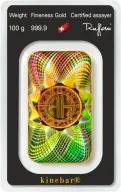
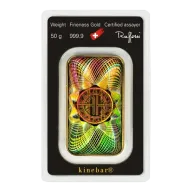
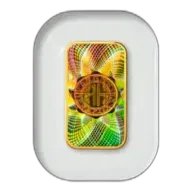
The Kinebar is a gold bar with a Kinegram, a diffractive optical security device, embossed directly into its surface. Produced by Argor-Heraeus SA, one of the world's largest precious metals refiners based in Mendrisio, Switzerland, the Kinebar applies government-grade authentication technology to retail bullion at a very small premium over standard bars.
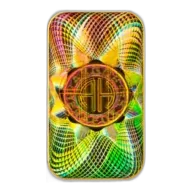
The Kinegram is not a sticker or applied hologram. It is created by sub-micron engravings (less than 0.0015 mm deep) pressed into the gold surface itself, producing dynamic colour-shifting patterns when the bar is tilted under light. The technology is manufactured by OVD Kinegram AG, a Swiss company that supplies the same optical security elements to government agencies for banknotes, passports, and identity documents. The Kinebar is an unusual commercial application of what is otherwise restricted to sovereign security use.
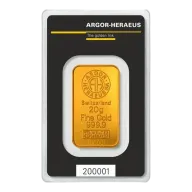
First introduced in December 1993 through Union Bank of Switzerland (UBS), which then owned Argor-Heraeus, the Kinebar went on retail sale in 1994. The product is trademarked by UBS AG. All Kinebars are .9999 fine gold, minted (not cast), individually serialised, and sealed in tamper-evident blisterpack packaging with an assay card certified by Argor-Heraeus's sworn assayer.
The premium for a Kinebar over a standard Argor-Heraeus bar is typically just $2-5 per ounce. For that modest additional cost, the buyer gets a gold product that can be visually authenticated by anyone, anywhere, without equipment, apps, or database lookups. This simplicity of verification is the Kinebar's core advantage, particularly relevant for private sales or transactions in markets where electronic verification infrastructure is unavailable.
Kinebar Sizes and Technical Specifications
| Size | Purity | Dimensions | Available Since |
|---|---|---|---|
| 1 g | .9999 | varies | 1994 |
| 2 g | .9999 | varies | 1994 |
| 5 g | .9999 | varies | 1994 |
| 10 g | .9999 | varies | 1994 |
| 20 g | .9999 | varies | 1994 |
| 1 oz (31.1 g) | .9999 | 40.4 x 23.3 x 1.8-2.1 mm | 1994 |
| 50 g | .9999 | varies | 2012 |
| 100 g | .9999 | 49.7 x 28.5 x 3.9 mm | 2012 |
The obverse carries the Argor-Heraeus logo, "Switzerland" country of origin, weight and purity markings, melter/assayer marking, and individual serial number. The reverse is occupied entirely by the Kinegram holographic security element. Edges are smooth (not reeded).
The design has remained consistent since 1994. Unlike coins with annual design changes, each Kinebar size has a fixed, unchanging layout. The Kinegram pattern itself has been refined over the years with advances in optical technology, but the format and placement are stable.
The 50g and 100g sizes were not added until 2012, eighteen years after the original launch, suggesting the smaller sizes (1g through 1oz) remain the primary market. Kinebars are exclusively gold; no silver, platinum, or palladium versions exist.
Kinebar Tax Treatment by Country
United Kingdom
Kinebars are VAT-exempt as investment gold. At .9999 fine from an LBMA-accredited refiner, they comfortably exceed the .995 purity threshold for the investment gold exemption. On disposal, Kinebars are subject to Capital Gains Tax. Gold bars lack the CGT exemption available to UK legal tender coins (Britannias and Sovereigns). Gains above the £3,000 annual allowance are taxed at 18% (basic rate) or 24% (higher rate). For UK investors prioritising tax efficiency, coins with CGT exemption offer a structural advantage over bars of any brand.
United States
Kinebars are IRA-eligible. Argor-Heraeus is an LBMA and COMEX-approved refiner, and the .9999 purity exceeds the IRS minimum of .995 for precious metals IRAs. Bars must be held by an approved custodian. Outside an IRA, gains are taxed at the collectibles rate (up to 28% federal). State sales tax varies by jurisdiction; approximately 35 states exempt investment bullion.
European Union
VAT-exempt as investment gold under EU Council Directive 98/80/EC (gold bars at .995+ purity, 1g or above). Argor-Heraeus is a domestic Swiss refiner with established distribution across EU markets.
Switzerland
Investment gold is VAT-exempt. As a Swiss-manufactured product, the Kinebar benefits from the home market's favourable tax environment and proximity to the refinery for storage and buyback.
Other Jurisdictions
Australia: GST-free for investment gold at 99.5%+ purity. Canada: GST/HST exempt; RRSP-eligible through an approved custodian. Singapore: GST-exempt under the Investment Precious Metals scheme for gold bars at 99.5%+ purity from LBMA-accredited refiners. Hong Kong: no sales tax, import duty, or capital gains tax.
Kinebar Compared to Other Security-Enhanced Gold Bars
The most direct comparison is with the PAMP Suisse Fortuna and its VeriScan authentication. Both are Swiss, LBMA-accredited, .9999 gold, individually serialised, and sealed in tamper-evident packaging. The authentication approaches differ fundamentally. VeriScan maps microscopic surface topography and stores the data in PAMP's database; verification requires a smartphone app or scanner and database access. The Kinegram is optically self-verifying: tilt the bar under any light source, and the shifting holographic pattern is either present or absent. No app, no database, no equipment.
PAMP Fortuna bars carry higher brand premiums (3-8% over spot) compared to Kinebars (the standard Argor-Heraeus bar premium plus $2-5). For buyers who value the lowest cost per gram of security-enhanced gold, the Kinebar is the stronger proposition. For buyers who prioritise the global brand recognition and design appeal of the Lady Fortuna, PAMP commands the market.
Against the standard Argor-Heraeus gold bar (the Kinebar's non-holographic sibling), the comparison is simple: same refiner, same purity, same assay process, with the Kinebar adding visual authentication at a modest premium. For buyers who handle bars in their original packaging and never expect to verify authenticity outside of it, the standard bar saves a few dollars. For anyone who anticipates private resale, storage outside packaging, or authentication needs in the field, the Kinebar's embedded security is worth the small additional cost.
The Valcambi CombiBar offers a different value proposition entirely: divisibility. A 50g or 100g bar pre-scored into 1g segments can be snapped apart for fractional use. No holographic or security feature is included. The CombiBar serves buyers who want the ability to break a single purchase into smaller tradeable units; the Kinebar serves buyers who want authentication confidence in a standard bar format.
The Perth Mint gold bar, backed by the Western Australian government, uses a kangaroo security hologram on its CertiCard packaging. The hologram is on the packaging, not the bar itself, a meaningful distinction: if the bar is removed from its card, the holographic verification is lost. The Kinegram is part of the gold, permanent and inseparable from the bar regardless of packaging. Perth Mint bars typically carry lower premiums in the Australian and Asian markets.
Kinebar Gold: frequently asked questions
-
A Kinebar is a 999.9 fine gold minted bar produced by Argor-Heraeus in Switzerland, distinguished by a Kinegram embedded into the reverse surface. The Kinegram is a diffractive optical element, similar to the security technology used on banknotes and passports, that shifts colour and pattern when tilted. It is embossed directly into the gold rather than applied as a sticker, making it a permanent part of the bar.
-
Kinebars are available in 1g, 2g, 5g, 10g, 20g, 1 troy oz (31.1g), 50g, and 100g, all at 999.9 fine gold. The original range (1g to 1 oz) launched in 1994; the 50g and 100g sizes were added in 2012. Each bar carries an individual serial number matched to a sealed assay card. We track 33 listings across 11 dealers.
-
The Kinegram on a Kinebar consists of microscopic engravings less than 0.0015 mm deep pressed directly into the gold surface. These create diffraction patterns that shift colour and shape as the bar is tilted, producing an effect that cannot be replicated without the specialised equipment of the original manufacturer, OVD Kinegram AG. Unlike holographic stickers, it cannot be peeled off or transferred, as it is physically part of the bar's surface.
-
Tilt the bar under a light source and look for shifting, colour-changing optical patterns on the reverse; a genuine Kinegram moves dynamically with the bar's angle. Check that the serial number engraved on the bar matches the number printed on the sealed assay card, and that the assay card packaging is intact and untampered.
-
Kinebar prices are based on the current gold spot price ($4,408.10) plus a small premium for the minted format and Kinegram security feature, which typically adds a modest amount above a standard Argor-Heraeus cast bar. We track 33 Kinebar listings across 11 dealers; the comparison table shows current prices and premiums for each weight.