1 product · 4 deals
Filters
| Product | /oz | Premium | Price | |
|---|---|---|---|---|

4 deals
|
$4,711.32 | +8.43% |
$4,711.33
£3,531
|
Compare |
Prices are fetched automatically and may not reflect current merchant prices. Currency conversions and tax treatment are approximate. Rankings are based solely on price. We are not a dealer and accept no responsibility for transactions with listed merchants. Past performance is not indicative of future results. This site does not provide investment advice. Full disclaimer
About the Rand Refinery Krugerrand Gold
The Gold Krugerrand
The Krugerrand holds a unique place in bullion history. Introduced on 3 July 1967, it was the world's first modern gold bullion coin, created by the South African government specifically to promote private gold ownership. Before the Krugerrand, there was no simple way for individual investors to buy exactly one troy ounce of gold in coin form. Every major bullion coin that followed, from the Canadian Maple Leaf in 1979 to the Gold Britannia in 1987, was built on the precedent the Krugerrand established.
A note on naming: "Rand Refinery Krugerrand" and "South African Mint Krugerrand" refer to the same coin. Production is split between two entities. Rand Refinery Ltd (established 1920, one of the world's largest gold refineries) produces the gold blanks. The South African Mint strikes those blanks into finished coins. Rand Refinery then handles packaging and distribution. Some dealers attribute the bullion version to Rand Refinery and proof versions to the SA Mint, but the underlying product is identical.
The coin is struck from 22 karat gold (91.67% pure), alloyed with copper. A 1 oz Krugerrand contains exactly one troy ounce of pure gold but weighs 33.93 grams total because of the copper content. The alloy gives the Krugerrand its distinctive orange-gold colour and makes it more resistant to scratches and handling damage than 24 karat coins. The American Gold Eagle uses an almost identical 22 karat composition for the same durability reasons.
By 1980, the Krugerrand accounted for more than 90% of the global gold coin market. That dominance was interrupted by apartheid-era import bans across Western nations during the 1970s and 1980s, which pushed buyers toward alternatives like the Maple Leaf, Eagle, and Britannia. Most restrictions were lifted in 1991. Over 50 million ounces of gold Krugerrands have been struck since 1967, making it one of the most widely held gold coins in existence.
The Krugerrand is legal tender in South Africa, but unlike almost every other modern bullion coin, it carries no denominated face value. Its value derives solely from its gold content, rising and falling with the spot price. Available in four sizes (1 oz, 1/2 oz, 1/4 oz, and 1/10 oz), with a silver version added in 2017 for the 50th anniversary and a platinum Krugerrand following shortly after.
Krugerrand Denominations and Dimensions
| Size | Total weight | Fine gold content | Diameter | Thickness |
|---|---|---|---|---|
| 1 oz | 33.93 g | 31.103 g (1 troy oz) | 32.77 mm | 2.84 mm |
| 1/2 oz | 16.965 g | 15.552 g | 27.07 mm | 2.215 mm |
| 1/4 oz | 8.482 g | 7.776 g | 22.06 mm | 1.888 mm |
| 1/10 oz | 3.393 g | 3.110 g | 16.55 mm | 1.35 mm |
Key Specifications
| Attribute | Value |
|---|---|
| Purity | 22 karat (916.7 millesimal fineness) |
| Alloy composition | 91.67% gold, 8.33% copper |
| Edge | Reeded (160 serrations on bullion, 220 on proof) |
| Face value | None |
| Legal tender | South Africa |
| First issued | 1967 |
The total weight exceeds the stated gold content because the 22 karat alloy adds mass. A 1 oz Krugerrand contains exactly 1 troy ounce (31.103 g) of pure gold, with approximately 2.83 g of copper on top. Buyers pay for the gold content only; the copper alloy does not affect the coin's pricing relative to spot. The reeded edge differs between bullion (160 serrations) and proof (220 serrations) versions, providing one method to distinguish the two finishes. Authentication is primarily through weight, dimensions, and the distinctive copper-gold colour, as the Krugerrand carries no modern embedded security technology such as micro-engraving or DNA markers.
Krugerrand Tax Treatment by Country
The Krugerrand's 22 karat (916.7 fine) purity places it below the 99.5% threshold used by several countries to define tax-exempt bullion. This creates a split where the coin qualifies for gold tax relief in some jurisdictions but not others, particularly in markets that set their purity bar at 995 or higher.
South Africa
Gold Krugerrands are zero-rated for VAT as legal tender under the Value-Added Tax Act. This applies to both bullion and proof versions. Silver Krugerrands (introduced 2017) are not covered by the gold zero-rating and attract 15% VAT. Capital gains tax applies to Krugerrand disposals, with individuals facing a 40% inclusion rate (effectively a maximum rate of around 18% at the top marginal income tax rate of 45%).
United Kingdom
Gold Krugerrands are VAT-exempt as investment gold. The UK definition of qualifying coins requires post-1800 legal tender with purity of at least 900 fine, which the Krugerrand's 916.7 fineness exceeds. A common misconception is that Krugerrands are CGT-exempt in the UK. They are not. Only British legal tender coins (the Britannia and the Sovereign) qualify for CGT exemption. Krugerrands are subject to CGT at the individual's rate (18% basic, 24% higher), though the £3,000 annual CGT allowance applies.
United States
No federal sales tax. Over 35 states exempt investment-grade bullion from state sales tax. Both gold and silver Krugerrands are IRA-eligible. The American Eagle is specifically named in IRS Section 408(m) with an exemption from the standard purity requirement, but the Krugerrand qualifies through the general 99.5% rule for gold coins held in bullion form. Long-term capital gains on bullion are taxed at the 28% collectible rate.
Canada
The GST/HST exemption for gold bullion requires 99.5% purity. The Krugerrand's 91.67% fineness falls below this threshold, meaning gold Krugerrands are not GST/HST-exempt in Canada. This is a material cost disadvantage compared to 999.9 fine coins like the Maple Leaf. Capital gains are taxed at the 50% inclusion rate (66.67% above CAD $250,000).
Australia
The GST exemption for investment-grade gold requires 99.5% purity. The Krugerrand falls below this threshold and may attract 10% GST depending on dealer interpretation. Buyers in Australia should confirm GST status with their dealer before purchasing.
New Zealand
Fine gold exempt from GST must be 99.5% pure or higher. The Krugerrand at 91.67% does not qualify, meaning 15% GST applies. This is a significant cost penalty. New Zealand buyers preferring GST-free gold should consider 999.9 fine alternatives.
Singapore
The Investment Precious Metals (IPM) scheme requires gold coins to be 99.5% pure or higher. The Krugerrand at 916.7 does not qualify, so 9% GST applies. This is a notable disadvantage compared to 999.9 fine coins from other sovereign mints.
Hong Kong
No sales tax, no import duty, and no capital gains tax apply to any gold bullion regardless of purity. The Krugerrand's 22 karat composition creates no tax disadvantage in Hong Kong.
European Union
Gold Krugerrands qualify for VAT exemption under the EU Investment Gold Directive (post-1800 legal tender, 900+ fineness). They appear on the EU's official annual list of qualifying coins. Silver Krugerrands attract standard VAT at the local rate (17% to 27% depending on the member state), with margin scheme options available for pre-owned silver in Germany and the Netherlands.
From Apartheid-Era Dominance to Global Standard
The Krugerrand's history tracks the politics and economics of South Africa across six decades. The coin takes its name from two sources: Paul Kruger (1825-1904), president of the South African Republic from 1883 to 1900, and the Rand, South Africa's currency (itself named after the Witwatersrand gold reef that drove the Johannesburg gold rush).
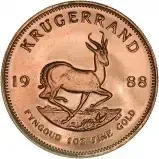
In 1966, the South African Reserve Bank authorised a unique division of labour: Rand Refinery Ltd would manufacture gold blanks, and the South African Mint would strike them into coins. This arrangement persists today. The first coins were struck on 3 July 1967, and the design by Otto Schultz (obverse portrait of Kruger) and Coert Steynberg (reverse springbok) has remained essentially unchanged since, making it one of the most consistent coin designs in modern bullion.
Through the 1970s, as gold prices surged following the end of the gold standard (1971) and the legalisation of gold ownership in the United States (1974), the Krugerrand became the vehicle through which millions of private investors bought gold for the first time. By 1980, over 90% of the global gold coin market was Krugerrands.
That dominance ended abruptly when Western nations imposed sanctions against apartheid-era South Africa. The United States, European Economic Community, and many Commonwealth nations banned Krugerrand imports during the 1980s. This created the commercial opening for the Canadian Maple Leaf (1979), the American Eagle (1986), the Britannia (1987), and the Philharmonic (1989). Each was explicitly designed to capture the market share that sanctions had stripped from the Krugerrand.
Most import bans were lifted in 1991 following the beginning of South Africa's transition to democracy. The Krugerrand returned to international markets but never recaptured its monopoly position. Over 50 million ounces of gold Krugerrands have been struck to date, and the coin's brand recognition remains unmatched historically even if annual sales volumes now trail the Maple Leaf and Eagle.
The 50th anniversary in 2017 marked the first Silver Krugerrand (with a face value of 1 Rand), followed by a Platinum Krugerrand. The silver edition's 1,000,000 mintage featured a commemorative privy mark. The expansion into silver and platinum brought the Krugerrand name to metals where South Africa's competitors had long been established.
Krugerrand vs Britannia, Maple Leaf, and Eagle
The Krugerrand competes directly with the three coins that were created to replace it during the sanctions era. Each has a distinct profile, and the right choice depends on the buyer's country, tax situation, and priorities.
The 1 oz Gold Britannia is the strongest competitor for UK buyers specifically. Since 2013, the Britannia has been struck from 999.9 fine gold and carries CGT exemption as British legal tender. The Krugerrand offers neither advantage in the UK market: its 916.7 fineness is lower, and it is not CGT-exempt. For UK investors, the Britannia's double tax exemption (no VAT on purchase, no CGT on sale) represents a concrete financial advantage that the Krugerrand cannot match. The Krugerrand's counter-argument is its historical cachet and, on the secondary market, sometimes lower premiums.
The 1 oz Gold Maple Leaf has been the Krugerrand's most direct rival since 1979. At 999.9 purity, the Maple Leaf meets the 99.5% threshold for tax exemption in every major jurisdiction, including Canada, Australia, New Zealand, and Singapore, where the Krugerrand's 22 karat composition fails to qualify. The Royal Canadian Mint's Bullion DNA micro-engraving provides authentication technology that the Krugerrand lacks. For international buyers outside South Africa and the UK/EU, the Maple Leaf is the more tax-efficient choice.
The American Gold Eagle is the Krugerrand's closest peer in composition, sharing the 22 karat alloy (91.67% gold with copper and silver). Both weigh more than one troy ounce total while containing exactly one troy ounce of pure gold. The Eagle carries a $50 face value (the Krugerrand has none) and dominates the US market. For American buyers, the Eagle has stronger brand recognition domestically and is specifically named as IRA-eligible in the tax code. The Krugerrand qualifies for IRAs through the general bullion purity provisions.
The Krugerrand's enduring advantage is its secondary market. With over 50 million ounces struck since 1967, there is a deep pool of pre-owned Krugerrands available globally, often at lower premiums than newly minted competitors. Buyers who prioritise cost per ounce of gold over purity, security features, or tax efficiency will frequently find the Krugerrand, especially on the secondary market, priced below the Maple Leaf, Britannia, or Eagle.