1 product · 5 deals
Filters
| Product | /oz | Premium | Price | |
|---|---|---|---|---|

5 deals
|
$4,432.30 | +0.55% | $2,216.16 | Compare |
Prices are fetched automatically and may not reflect current merchant prices. Currency conversions and tax treatment are approximate. Rankings are based solely on price. We are not a dealer and accept no responsibility for transactions with listed merchants. Past performance is not indicative of future results. This site does not provide investment advice. Full disclaimer
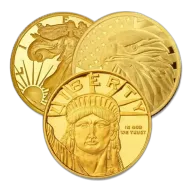
About 1/2 oz Gold Rounds
Why Buy a 1/2 oz Gold Round
A 1/2 oz gold round contains 15.5517 grams of gold in a coin-shaped format struck by a private mint. Unlike a sovereign coin, a round carries no face value and no legal tender status; the term "round" exists precisely to mark that distinction, and calling one a coin is technically incorrect. The buyer of a 1/2 oz gold round is after the metal itself at a lower premium than a sovereign coin commands, in a unit half the size of the standard ounce.
This is a niche within a niche. Gold rounds are already a small segment of the gold market, since private mints concentrate their round production on silver, where the premium savings matter more to retail buyers at the lower unit price. Fractional gold rounds are rarer still: most gold rounds are struck at 1 oz, with only some private mints producing 1/2 oz, 1/4 oz, and 1/10 oz sizes. Buyers who want this format are accepting a thinner market in exchange for the round's core appeal of no legal tender markup, lower private-mint production costs, and no sovereign mint branding premium.
The 1/2 oz weight itself is a sensible compromise. It is the largest fractional gold size, offering meaningful gold content at roughly half the outlay of a full ounce, and the premium penalty for stepping down from 1 oz is smaller at 1/2 oz than at 1/4 oz or 1/10 oz. The same logic applies whether the product is a round or one of the 1/2 oz gold coins produced by every major sovereign mint.
One caution for UK buyers: rounds are not CGT-exempt, because they have no legal tender status. A 1/2 oz Gold Britannia is exempt from capital gains tax in the UK; a 1/2 oz round is taxed the same as a bar. Given the small premium difference between gold rounds and gold bars, UK investors have little reason to choose rounds over either bars or CGT-exempt coins.
1/2 oz Gold Round Premiums in Context
Gold rounds as a category carry premiums of approximately 2-5% over spot, sitting between gold bars at 1-4% and sovereign gold coins at 3-8%. That positioning is the round's whole pitch: coin-shaped gold without the legal tender markup. The gap is narrower in gold than in silver, where round premiums can be meaningfully lower than coin premiums; for gold, the saving from choosing rounds over bars is marginal.
Fractional sizes change the picture. Fractional gold rounds are uncommon, and when they are available they carry proportionally high premiums. The fixed costs of striking, packaging, and distributing a piece do not halve when the gold content does, so the percentage premium on a 1/2 oz round runs above what the same mint charges on its 1 oz round. Buyers comparing a 1/2 oz round against two purchases of 1 oz gold rounds should expect to pay more per ounce for the smaller format.
The sovereign coin market at this weight gives a useful reference point. A 1/2 oz American Gold Eagle trades at roughly 5-8% over spot, against 3-5% for the 1 oz version. At a $4,200 gold spot price that works out to a penalty of roughly $40-$60 per half ounce versus buying full ounces, which is modest compared with the step-down to 1/4 oz or 1/10 oz sizes. A 1/2 oz round needs to undercut that 5-8% coin range to justify its weaker resale position; whether it does depends on the mint and the dealer, which is exactly what a price comparison across dealers will show.
Two structural points apply across the weight scale. Premiums are inversely related to unit size, so the per-ounce cost falls as the piece gets larger. And premiums widen during high-demand periods, so the fractional penalty grows when the market is stressed.
What Is Available at 1/2 oz
The gold round market is far less standardised than the coin or bar markets, and the fractional end of it is thinner again. Most gold rounds are struck at 1 oz; 1/2 oz pieces come from the subset of private mints that produce fractional sizes at all. The major private mints producing gold rounds include Sunshine Minting, SilverTowne, Asahi, Highland Mint, and Golden State Mint. The standard purity is .9999 fine gold, matching most modern sovereign coins.
Design-wise, the gold round market is built around a few recurring themes rather than flagship annual series. The Buffalo round, struck by various private mints, borrows its design from the classic US Buffalo nickel; it should not be confused with the American Gold Buffalo, which is a sovereign coin from the US Mint. The Incuse Indian design is based on the $5 Indian Head gold coin. Beyond these, the bulk of the market is generic rounds branded with the producing mint's own logo and sold as undifferentiated bullion. Private mints rarely invest in signature gold round designs the way they do for silver, because gold's higher unit price means fewer buyers and lower volume.
The sovereign coin alternatives at this weight are extensive by comparison. Every major world mint produces a 1/2 oz gold coin as part of its flagship series: the American Gold Eagle with a $25 face value, the Gold Britannia at £50, the Canadian Gold Maple Leaf, the South African Krugerrand, the Austrian Philharmonic, and the Australian Kangaroo, plus the Chinese Gold Panda at 15g as the closest metric equivalent. Gold bars at 1/2 oz are also niche, produced by some private mints but not a mainstream format. A buyer set on exactly half an ounce of gold has far more choice in coins than in rounds or bars.
Selling and Storing 1/2 oz Gold Rounds
Liquidity is the round's weak point, and it matters more at a niche weight. Gold rounds are less liquid than sovereign mint coins: dealers universally recognise Maples, Eagles, and Britannias, while rounds require more scrutiny on buyback. Rounds from well-known private mint brands such as Sunshine, Asahi, and SilverTowne are accepted by most major dealers without difficulty. Generic or obscure-brand rounds may be bought at melt value only, or may require assay testing, which widens the effective buy-sell spread beyond what coins face.
The resale discount versus coins can run 1-3% of spot, which partially or fully erodes the premium saving made at purchase. That arithmetic is why investors who prioritise exit liquidity are steered toward sovereign coins or LBMA-branded bars rather than rounds, and it applies with extra force to a 1/2 oz round, since the fractional format already carries a proportionally higher acquisition premium than the 1 oz version. The 1/2 oz weight class itself resells well when the product is a sovereign coin: it ranks second only to 1 oz in liquidity among gold coin weights, with tighter bid-ask spreads than smaller fractionals. The round format does not inherit that standing automatically; brand recognition does the work that legal tender status does for coins.
Storage is straightforward. Rounds share their dimensions with coins, so they fit standard tubes and capsules; for reference, a 1/2 oz gold coin such as the Eagle measures approximately 27mm across, slightly smaller than a UK 50p coin. The format is very compact: tubes hold 10-20 pieces, a tube of twenty 1/2 oz pieces weighs approximately 311g, and a small safe accommodates a substantial holding. Like all .9999 gold, rounds are soft, so individual capsules or tube storage are worthwhile to prevent surface contact. There are no special storage considerations versus gold coins.
1/2 oz Gold Rounds: frequently asked questions
-
A 1/2 troy oz gold round contains exactly half an ounce of gold, so its metal value is one half of the live gold spot price, currently $4,408.10 per troy ounce. Dealers charge a small premium above melt value; the page above shows offers from 3 dealers across 5 listings so you can compare premiums directly.
-
A 1/2 troy oz gold round weighs 1/2 oz (exactly 15.5518 g). Troy ounces are the standard for precious metals and differ from the everyday avoirdupois ounce: one troy ounce is 31.1035 g, so half is 15.5518 g.
-
Gold rounds are privately minted discs with no government backing, no face value, and no legal-tender status. Government-issued coins, such as Britannias or Maple Leafs, carry a face value, are struck at a sovereign mint, and may enjoy tax advantages in their home country. Because rounds skip the sovereign-mint overhead, they typically carry a lower premium over spot than comparable official coins.
-
Gold rounds are not legal tender in any tracked market, so no automatic CGT exemption applies. In the UK, gains above the £3,000 annual exempt amount are taxed at 18% or 24% depending on your income. US investors pay up to 28% on long-term gains. In Canada, 50% of any gain is included in taxable income. Check the rules in your own jurisdiction before buying.