1 product · 2 deals
Filters
| Product | /oz | Premium | Price | |
|---|---|---|---|---|

2 deals
|
$4,600.34 | +4.36% | $1,150.09 | Compare |
Prices are fetched automatically and may not reflect current merchant prices. Currency conversions and tax treatment are approximate. Rankings are based solely on price. We are not a dealer and accept no responsibility for transactions with listed merchants. Past performance is not indicative of future results. This site does not provide investment advice. Full disclaimer
About 1/4 oz Gold Rounds
1/4 oz Gold Rounds: A Niche Within a Niche
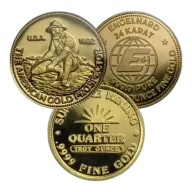
A gold round is a coin-shaped bullion product struck by a private mint. It carries no face value, no legal tender status, and no government backing; those features belong to coins from sovereign mints, and calling a round a coin is technically incorrect. Most gold rounds are struck at 1 oz, but some private mints also produce fractional sizes, including 1/2 oz, 1/4 oz, and 1/10 oz. The 1/4 oz size contains 7.7758 grams of gold and sits in the middle of the fractional weight range.
Gold rounds are already a small market segment. Private mints concentrate their round production on silver, where the lower unit price makes premium savings more meaningful to retail buyers, so gold rounds exist as a small niche, and fractional gold rounds are uncommon even within that niche. The appeal of rounds in general is cost: with no legal tender markup, lower production costs at private mints, and no sovereign mint branding premium, they undercut coins on price. At fractional weights, that case weakens, because fractional gold rounds carry proportionally high premiums when they are available at all.
The buyer this size suits is someone who wants gold in smaller, more affordable units than a full ounce and is focused purely on accumulating metal at the lowest cost per purchase. The main alternative is the same weight in sovereign coin form: 1/4 oz gold coins are produced by every major world mint in their flagship series, making 1/4 oz the most popular fractional size by number of product variants. Those coins bring recognition and, in some markets, tax advantages that rounds lack: in the UK, rounds receive no CGT exemption because they have no legal tender status, leaving them in the same tax position as bars.
How 1/4 oz Round Premiums Fit the Weight Scale
At the standard 1 oz weight, gold rounds carry premiums of approximately 2-5% over spot, positioned between gold bars at 1-4% and sovereign coins at 3-8%. That gap is the entire commercial case for rounds, and it is already narrow for gold: the difference between gold rounds and gold bars is smaller than the equivalent gap in silver, so the saving from choosing rounds over bars is marginal.
Moving down the weight scale erodes the picture further. Premiums are inversely related to unit size across all gold products, and fractional gold rounds are uncommon enough that they carry proportionally high premiums when available. For context on what fractional weights cost in coin form: 1/4 oz gold coins such as the American Gold Eagle run at roughly 7-12% over spot, versus 3-5% for 1 oz coins and 10-18% for 1/10 oz. The 1/4 oz weight occupies a middle ground, meaningfully cheaper per ounce than 1/10 oz while keeping the outlay per unit roughly half that of 1/2 oz.
The premium paid on the way in is only half the equation. Rounds face a resale discount versus coins that can run 1-3% of spot, which partially or fully erodes the initial premium saving. Buyers should weigh the headline premium on a 1/4 oz Gold Eagle or similar sovereign coin against the full round-trip cost of a private mint round, not just the purchase price. For investors whose priority is the lowest acquisition premium at full-ounce scale, 1 oz gold bars remain the benchmark.
What Is Actually Available at 1/4 oz
Gold rounds are a small market segment compared with gold coins or bars, and products are less standardised. The recurring designs in the gold round market are the Buffalo round, struck by various private mints with a design inspired by the classic US Buffalo nickel, and the Incuse Indian, based on the $5 Indian Head gold coin design. The Buffalo round should not be confused with the American Gold Buffalo, which is a sovereign coin from the US Mint. Beyond these, the market consists largely of generic rounds branded with the producing mint's own logo and sold as generic bullion.
The major private mints producing gold rounds are Sunshine Minting, SilverTowne, Asahi, Highland Mint, and Golden State Mint. Standard purity is .9999 fine gold, the same as most modern sovereign coins. Private mints rarely invest in developing signature gold round designs the way they do for silver, because gold's higher unit price means fewer buyers and lower volume; fractional gold rounds are correspondingly thin on the ground.
Because supply at this weight is sparse, most buyers shopping at the 1/4 oz price point end up comparing against sovereign coins instead. Every major world mint strikes a 1/4 oz coin in its flagship series: the American Gold Eagle with its $10 face value, the Gold Britannia (£25 face value), the Canadian Gold Maple Leaf, the South African Krugerrand, the Austrian Philharmonic, and the Australian Kangaroo, with the Chinese Gold Panda's 8g coin as the closest metric equivalent.
Selling and Storing 1/4 oz Gold Rounds
Liquidity is the weak point for rounds at any weight. Dealers universally recognise Maples, Eagles, and Britannias; rounds require more scrutiny. Products from well-known private mint brands such as Sunshine, Asahi, and SilverTowne are accepted by most major dealers without difficulty, but generic or obscure-brand rounds may be bought at melt value only, or require assay testing before purchase, which widens the effective buy-sell spread beyond what coins face. The resale discount versus coins can reach 1-3% of spot. For investors who prioritise exit liquidity, gold coins or LBMA-branded bars are the stronger choice.
Authentication follows the same logic. Rounds lack the security features of sovereign mint coins: no Bullion DNA, no government-certified specifications, no tincture lines. Verification relies on weight and dimension measurement, sigma testing, and refiner reputation. Sunshine Minting includes its MintMark SI security feature, a micro-engraved logo readable with a proprietary decoder lens, on its rounds and bars. The small form factor of a 1/4 oz piece keeps the tungsten-substitution risk lower than for large bars, since density substitution is detectable at this size, but the absence of standardised government specifications still makes basic checks less straightforward than with coins. Buying from established dealers protects provenance.
Storage is simple. Rounds share the dimensions of coins and are compatible with standard tubes and capsules. Gold rounds are soft, the same as gold coins, so individual capsules or tube storage prevent surface contact damage. A quarter-ounce gold piece is compact; the 1/4 oz Gold Britannia, for comparison, measures approximately 22mm in diameter, about the size of a UK 1 penny coin, and weight at this size is negligible.
1/4 oz Gold Rounds: frequently asked questions
-
A 1/4 troy oz gold round's metal value is one quarter of the live gold spot price, currently $4,408.10 per troy ounce. That gives you the approximate melt value; retail prices will be higher once a dealer's premium is added. Use the listings on this page to compare prices across dealers.
-
A 1/4 troy oz gold round weighs 7.7759 grams. One troy ounce equals 31.1035 g, so a quarter of that is 7.7759 g. Troy ounces are the standard unit for gold and other precious metals, differing from the everyday avoirdupois ounce.
-
Yes. Fractional gold rounds such as the 1/4 oz typically carry a larger percentage premium over spot than 1 oz rounds. Production costs (blanking, minting, packaging, distribution) are broadly similar per piece regardless of size, so they are spread over a smaller gold content, pushing the percentage premium up. Buyers who prioritise low premiums often prefer 1 oz sizes.
-
Gold rounds are privately minted discs that carry no face value and have no legal-tender status. Government-issued coins, such as Eagles or Krugerrands, are struck at sovereign mints, bear a face value, and may carry tax advantages in their issuing country. Rounds generally trade at a lower premium over spot than official coins because they skip the sovereign-mint overhead.