



Prices are fetched automatically and may not reflect current merchant prices. Currency conversions and tax treatment are approximate. Rankings are based solely on price. We are not a dealer and accept no responsibility for transactions with listed merchants. Past performance is not indicative of future results. This site does not provide investment advice. Full disclaimer
About 1 oz Gold Rounds
Why Buy 1oz Gold Rounds
A 1oz gold round contains one troy ounce (31.1035 grams) of gold, the benchmark unit for bullion worldwide, struck by a private mint rather than a sovereign one. It carries no face value, no legal tender status, and no government backing. That distinction is what separates a round from a coin: calling a round a "coin" is technically incorrect, since the term coin is by convention reserved for sovereign mint products with legal tender status. The buyer gets the same gold content as a 1oz gold coin, typically at the same .9999 fine purity used by most modern sovereign coins, without the institutional backing.
The case for rounds rests on cost. Premiums are lower than on sovereign coins because there is no legal tender markup, production costs at private mints are lower, and there is no sovereign mint branding premium. The buyer who cares only about accumulating gold metal at the lowest cost per ounce is the natural customer.
Gold rounds are a small niche compared with silver rounds. Private mints focus round production primarily on silver, where the lower unit price makes the premium savings more meaningful to retail buyers. At gold's price point, the premium saved per ounce is a smaller percentage of total cost, so the incentive to accept lower liquidity is weaker. Tax also works against rounds in some markets: in the UK, rounds are not CGT-exempt because they lack legal tender status, the same position as bars, whereas UK legal tender coins such as the Britannia are CGT-exempt. UK buyers therefore have little reason to choose rounds over gold bars, given the small premium difference between the two. In most markets the practical choice is between coins for liquidity and tax advantages and bars for the lowest premiums, with rounds sitting between the two without decisively winning on either axis.
1oz Gold Round Premiums vs Coins and Bars
Gold rounds carry premiums of approximately 2-5% over spot, positioned between gold bars at 1-4% and sovereign gold coins at 3-8%. At the 1oz weight specifically, gold coins typically run 3-5% over spot and bars slightly lower at 2-4%, so a round priced toward the bottom of its range undercuts most coins while only marginally beating a comparable bar.
That last point matters. The premium gap between gold rounds and gold bars is smaller than the equivalent gap in silver, where round premiums can be meaningfully lower than coin premiums. For gold, the saving from choosing rounds over bars is marginal. Against coins the saving is more real: rounds can save 1-3% versus coins for a buyer focused purely on metal accumulation. But coins retain more of their premium at resale than bars or rounds do, and the resale discount on rounds can partially or fully erode the initial saving, so the headline premium difference overstates the total cost advantage.
Moving down the weight scale does not help. Fractional gold rounds are uncommon, and they carry proportionally high premiums when available. The 1oz size is where round production concentrates, and it is also the sweet spot for premiums across gold bullion generally: 1oz is where coin premiums bottom out, and acquiring 10 ounces of gold via ten 1oz coins costs approximately $3,500-$4,000 less in premiums than buying the same weight in 1/10oz coins. A buyer comparing a 1oz round against a 1oz gold bar is comparing two products near the bottom of the gold premium spectrum, which is why the decision usually comes down to liquidity and tax treatment rather than the sticker premium.
Major 1oz Gold Rounds
Gold rounds are a relatively small market segment compared to gold coins or bars, and the products are less standardised. Private mints rarely invest in developing signature gold round designs the way they do for silver, because gold's higher unit price means fewer buyers and lower volume. The market splits into a handful of recurring design themes and mint-branded generics.
The Buffalo round is the most recognisable design, produced by various private mints and inspired by the classic US Buffalo nickel. It should not be confused with the American Gold Buffalo, which is a sovereign coin from the US Mint; the round shares the design lineage but none of the legal tender status. The Incuse Indian is another recurring design, based on the $5 Indian Head gold coin, struck by various private mints.
Beyond these, the market consists of generic rounds from the major private mints: Sunshine Minting, Asahi, SilverTowne, and Highland Mint, with Golden State Mint also producing gold rounds. These are typically branded with the mint's own logo and sold as generic bullion. Mint reputation does meaningful work here. Well-known brands such as Sunshine, Asahi, and SilverTowne are accepted by most major dealers without difficulty, while obscure-brand rounds may face scrutiny at resale. Sunshine Minting adds its MintMark SI security feature, a micro-engraved logo visible with a proprietary decoder lens, to its rounds and bars, one of the few security features in a category that otherwise lacks the anti-counterfeiting technology of sovereign coins.
Standard purity across the category is .9999 fine gold, matching most modern sovereign coins. While rounds are typically 1oz, some private mints produce fractional sizes (1/2oz, 1/4oz, 1/10oz), though these are uncommon.
Selling and Storing 1oz Gold Rounds
The 1oz weight is the most liquid unit in bullion: every dealer worldwide buys and sells 1oz products. But within that weight class, rounds sit below sovereign coins on the liquidity ladder. Dealers universally recognise Maples, Eagles, and Britannias; rounds require more scrutiny. Well-known private mint brands (Sunshine, Asahi, SilverTowne) are accepted by most major dealers without difficulty, but generic or obscure-brand rounds may be sold at melt value only, or require assay testing, which widens the effective buy-sell spread beyond what coins face.
That spread is the hidden cost of the round's lower purchase premium. The resale discount versus coins can be 1-3% of spot, partially or fully eroding the initial premium saving. For investors prioritising exit liquidity, gold coins or LBMA-branded bars are generally preferable to rounds. For buyers who intend to hold long term and sell to an established dealer, a recognised-brand round keeps most of the cost advantage.
Authentication relies on weight and dimension measurement, sigma testing, and refiner reputation, since rounds lack the security features of sovereign mint coins (no Bullion DNA, no government-certified specifications). The tungsten-core risk is lower for rounds than for large bars, because the small form factor makes density substitution detectable, but the lack of government-standardised specifications makes basic verification less straightforward than with coins. Buying from established dealers protects provenance, which matters at resale.
Storage is straightforward. Rounds share the same dimensions as coins and are compatible with standard tubes and capsules. Gold is soft, so rounds benefit from individual capsules or tube storage to prevent surface contact. There are no special storage considerations versus coins, and the 1oz gold format is compact: a tube of 1oz gold pieces fits in a small safe.
1 oz Gold Rounds: frequently asked questions
-
The live spot price for one troy ounce of gold is $4,408.10. That is the raw metal value; gold rounds sell at a small premium above spot to cover production and dealer margin. The listings on this page show current retail prices so you can see the actual premium each dealer charges.
-
Gold rounds are privately minted, coin-shaped discs with no legal-tender face value. Gold bars are rectangular, often produced by accredited refiners, and come in a wider range of sizes from small wafers up to large kilobars. Both formats track spot closely and carry a percentage premium over melt value; which format suits a buyer depends on storage preference and liquidity needs rather than any significant price difference at 1 oz.
-
One troy ounce equals 1 oz (exactly 31.1035 g). The troy ounce is the global standard for weighing precious metals and is slightly heavier than the everyday avoirdupois ounce used for groceries and parcels, which is only 28.3495 g.
-
Yes, in most countries. In the UK, gains on gold rounds above the £3,000 annual exemption are taxed at 18% or 24%. US investors face up to 28% on long-term gains. In Canada, 50% of any capital gain is included in taxable income. Gold rounds carry no legal-tender exemption in any of these markets.
- 1 oz American Prospector Gold Round
- 1 oz Asahi Refining Lunar Gold Round
- 1 oz Cayman Marlin Gold Round
- 1 oz Dwelling Taniwha Gold Round
- 1 oz Gold Kiwi Gold Round
- 1 oz Gold Round
- 1 oz Humpback Whale Gold Round
- 1 oz Kinebar Gold Round
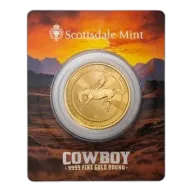
- 1 oz Scottsdale Cowboy Gold Round
- 1 oz Scottsdale Stacker Gold Round
- 1 oz US Mint Liberty Gold Round
- 1 oz Walking Liberty Gold Round
- Pre-Owned 1 oz Gold Round
- Pre-Owned 1 oz US Mint Gold Round