1 product · 2 deals
Filters
| Product | /oz | Premium | Price | |
|---|---|---|---|---|

2 deals
|
$4,680.92 | +6.19% | $468.10 | Compare |
Prices are fetched automatically and may not reflect current merchant prices. Currency conversions and tax treatment are approximate. Rankings are based solely on price. We are not a dealer and accept no responsibility for transactions with listed merchants. Past performance is not indicative of future results. This site does not provide investment advice. Full disclaimer
About 1/10 oz Gold Rounds
A Niche Within a Niche: 1/10 oz Gold Rounds
A 1/10 troy oz gold round contains 3.1103 grams of gold, the smallest commonly produced fractional weight in gold bullion. Rounds are coin-shaped products struck by private mints rather than sovereign mints: they carry no face value, no legal tender status, and no government backing. That distinction is what separates a round from a coin, and calling a round a coin is technically incorrect.
Gold rounds are already a small segment of the gold market. Private mints concentrate their round production on silver, where the lower unit price makes the premium savings more meaningful to retail buyers, and they rarely invest in signature gold round designs because the higher unit price means fewer buyers and lower volume. Fractional gold rounds narrow that niche further: rounds are typically struck at 1 oz, with fractional sizes such as 1/2 oz, 1/4 oz, and 1/10 oz produced by only some private mints. Standard purity is .9999 fine gold, the same as most modern sovereign coins.
The buyer at this weight is usually someone who wants a low-cost entry point into gold ownership. The 1/10 oz size serves low-cost entry, gifts, and maximum divisibility. For wealth accumulation, larger sizes are more cost-effective, and within the 1/10 oz weight class most buyers gravitate to sovereign coins such as the 1/10 oz American Gold Eagle for their recognisability and government backing. A 1/10 oz gold round only makes sense for a buyer who prioritises the lowest possible outlay over liquidity and institutional backing.
How 1/10 oz Gold Round Premiums Compare
Gold rounds in general carry premiums of approximately 2-5% over spot, positioned between gold bars at 1-4% and sovereign gold coins at 3-8%. The savings versus coins come from three things: no legal tender markup, lower production costs at private mints, and no sovereign mint branding premium. The catch at this weight is that fractional gold rounds are uncommon, and they carry proportionally high premiums when they are available at all.
The same per-unit economics that inflate fractional coin premiums apply here. Manufacturing costs for die work, quality control, and packaging are nearly the same for a small piece as for a 1 oz piece, but they are spread over one-tenth the gold. That is why 1/10 oz sovereign coins run 10-18% over spot for the American Gold Eagle, the highest premiums of any standard bullion coin weight, and why accumulating 1 oz of gold via ten 1/10 oz coins costs roughly $400 more than buying a single 1 oz coin.
Moving up the weight scale changes the picture quickly. At 1 oz, the standard round size, the premium gap between gold rounds and gold bars is smaller than the equivalent gap in silver; for gold, the saving from choosing rounds over bars is marginal. A buyer whose goal is simply the cheapest gold per ounce will find gold bars at 1-4% over spot hard to beat. A buyer who wants the 1/10 oz size specifically should compare any round on offer against the 10-18% premiums on the equivalent sovereign coins before assuming the round is the cheaper route.
What Is Actually Available at 1/10 oz
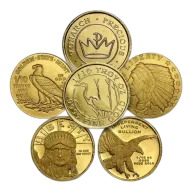
Gold rounds are a relatively small market segment compared to gold coins or bars, and products are less standardised. The recognisable designs that do circulate are the Buffalo round, struck by various private mints with a design inspired by the classic US Buffalo nickel, and the Incuse Indian, based on the $5 Indian Head gold coin design. The Buffalo round should not be confused with the American Gold Buffalo, which is a sovereign coin from the US Mint. Beyond those, the market consists of generic rounds branded with the producing mint's logo and sold as generic bullion.
The major private mints producing gold rounds include Sunshine Minting, SilverTowne, Asahi, Highland Mint, and Golden State Mint. Rounds are typically 1 oz; only some of these mints extend production into fractional sizes like 1/10 oz, so inventory at this weight is thin and inconsistent compared with the 1 oz round market.
The sovereign alternatives at the same weight are far more numerous. Every major mint produces a 1/10 oz gold coin: the American Gold Eagle ($5 face value, 22k), the 1/10 oz Gold Britannia (£10 face value, 24k), the Canadian Gold Maple Leaf (24k), the South African Krugerrand (22k), the Austrian Philharmonic (24k), and the Australian Kangaroo (24k). A buyer shopping the 1/10 oz weight class will see many more of these coins listed than rounds, and dealer selection reflects that.
Resale, Spreads, and Storage at the Smallest Size
Liquidity is the weak point of this product on two counts. First, the weight class itself: 1/10 oz pieces show the widest bid-ask spreads of any fractional size, and sellers should expect to recover less of their premium than with larger pieces. The broad buyer base at the low price point partially offsets this, but buyback prices relative to spot remain less favourable than for larger gold. Second, the form: gold rounds are less liquid than sovereign mint coins. Dealers universally recognise Maples, Eagles, and Britannias; rounds require more scrutiny. Well-known private mint brands such as Sunshine, Asahi, and SilverTowne are accepted by most major dealers without difficulty, but generic or obscure-brand rounds may be bought at melt value only or require assay testing. The resale discount versus coins can run 1-3% of spot, partially or fully eroding the initial premium saving. For investors prioritising exit liquidity, gold coins or LBMA-branded bars are generally preferable to rounds.
Physically, rounds share the dimensions of coins and are compatible with standard tubes and capsules. At 1/10 oz the pieces are tiny: the equivalent coins measure around 16.5mm in diameter, smaller than a UK 5p coin, and a tube of fifty 1/10 oz pieces weighs only about 155 grams. That makes them extremely compact and portable, but also easy to lose; capsules or tubes are essential. Gold is soft, so individual capsules or tube storage also protect the surfaces from contact damage. Authentication relies on weight and dimension measurement, sigma testing, and refiner reputation, since rounds lack the security features of sovereign coins. Sunshine Minting's pieces carry its MintMark SI micro-engraved security feature, readable with a proprietary decoder lens.
1/10 oz Gold Rounds: frequently asked questions
-
The spot value of a 1/10 troy ounce gold round is $4,408.10 divided by 10. Retail prices from dealers include a premium on top of that, which is typically higher on small weights than on 1oz or larger pieces. Compare current dealer prices in the table above to find the lowest premium available.
-
One-tenth of a troy ounce equals 1/10 oz (3.1103 g). A troy ounce is 31.1035 grams, so dividing by 10 gives just over 3.1 grams. This is a common question for buyers converting between troy and metric measurements when comparing products.
-
The cost of producing a coin or round, such as blanking, striking, assaying, and packaging, is largely fixed regardless of the size. Spreading those fixed costs across just 3.1 grams of gold means the per-gram production cost is much higher than for a 1oz piece. As a result, smaller sizes reliably carry a proportionally larger premium over spot than 1oz or multi-ounce products.
-
In most countries you are not required to notify tax authorities when purchasing gold. However, you must record gains on disposal. In the US, dealers must file reports for certain large cash transactions, and long-term gains on gold are taxed at up to 28%. In the UK, gains above £3,000 are subject to CGT. In Canada, 50% of any gain is included in taxable income. Keeping purchase receipts in all markets is essential.
-
3 dealers list 5 1/10 oz gold round products on BullionFerret. Having multiple retailers competing on this size means you can compare premiums directly. Thin supply from fewer dealers typically means less price competition, so the count here tells you how competitive the market is for this format.